
Task-Oriented Crowdsourcing: Bridging the Gap Between Human Intuition and Machine Logic
A survey of task-oriented crowdsourcing
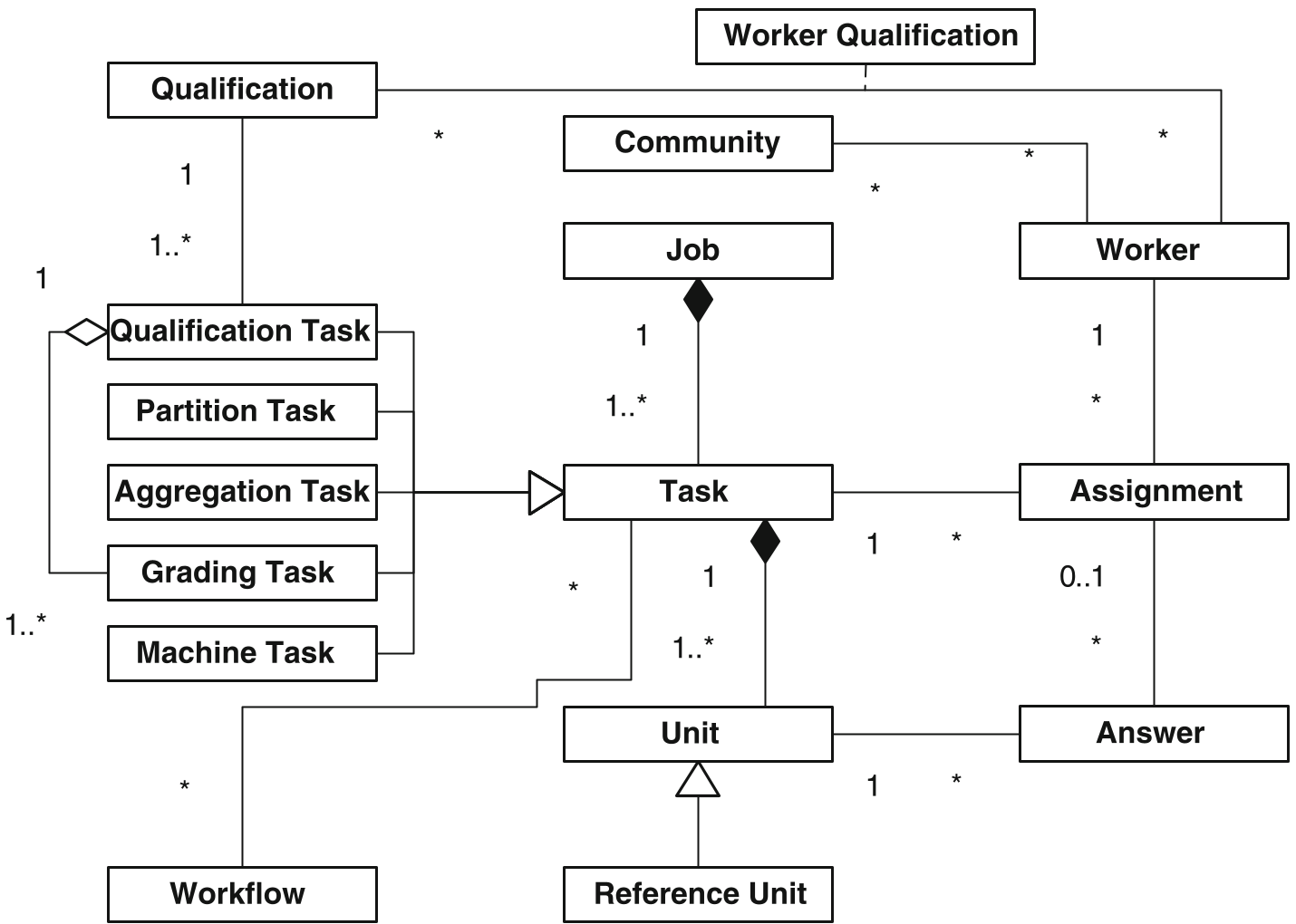
This paper provides a comprehensive technical survey of task-oriented crowdsourcing and human computation systems. It categorizes platforms into micro-task and complex task processors, proposing a formal ontology to systematize terminologies and processes across diverse services like Amazon Mechanical Turk and CrowdForge.
TL;DR
This seminal survey explores the transition of crowdsourcing from a simple business outsourcing tool to a sophisticated technical framework for Human Computation (HC). It breaks down how platforms move beyond simple tag-and-click tasks into complex, iterative workflows that allow humans and machines to work in a "symbiotic" loop.
Context: Published as the field shifted from simple data entry to complex problem solving, this work provides the technical "dictionary" and blueprints for building complex crowd-powered algorithms.
The Core Problem: Beyond Simple Clicks
Machines excel at data processing but fail at tasks requiring common sense, creativity, or nuanced interpretation (e.g., natural language understanding or complex image recognition). Early crowdsourcing solved this by treating humans as "black box" computational units. However, as tasks became more complex—like writing an entire article or buying a specific camera—the "black box" approach failed.
The author's insight is that solving complex problems requires Structured Workflows. Without a technical framework to manage the flow of data between workers, error and bias accumulate, leading to project failure.
Methodology: The Anatomy of Human Computation
The paper systematizes crowdsourcing into two distinct layers:
- Micro-tasks: Atomic operations (e.g., "Is this an adult image?").
- Complex Tasks: Sets of micro-tasks linked by logic (e.g., Partition -> Map -> Reduce).
The Standard Process
The authors define a three-phase lifecycle that is now standard in the industry:
- Design Phase: Requester configures the workflow and UI.
- Online Phase: Real-time distribution, assignment assessment, and task execution.
- Conclusion Phase: Rewarding and result aggregation.
Managing Complexity: Methods of Execution
The paper highlights several groundbreaking strategies for handling complex work:
- MapReduce (CrowdForge/Jabberwocky): Large tasks are partitioned, processed by many (Map), and then merged (Reduce).
- Crash and Rerun (TurKit): Treats human tasks like code. If a workflow fails, it reruns but pulls previous human answers from a database to save costs.
- Divide and Conquer (Turkomatic): Workers themselves decide how to split the task into smaller sub-tasks.
Comparative Landscape
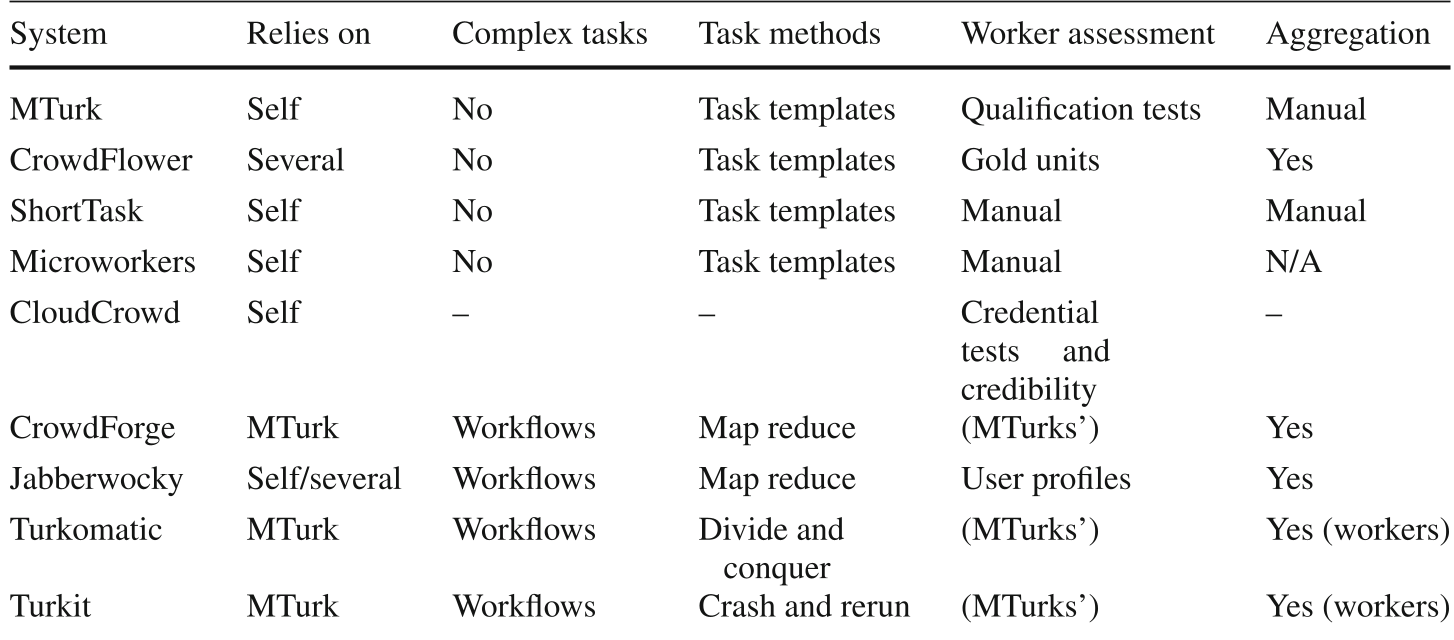
The survey provides a critical comparison of the "Titans" of the era:
| Feature | MTurk | CrowdFlower | Jabberwocky |
|---|---|---|---|
| Task Complexity | Simple/Standalone | Middle-tier | Complex Workflows |
| Quality Control | Qualification Tests | Gold Units (Reference) | User Profiles |
| Aggregation | Manual | Voting Schemes | Crowdsourced |
Critical Analysis & Future Directions
The authors conclude that the primary bottleneck in crowdsourcing isn't the "crowd" itself, but communication.
- Limitations: Current systems suffer from "loss of identity" (where a worker in step 2 doesn't know what happened in step 1) and "natural language noise."
- Future Vision: The authors advocate for Ontology-driven workflows. By using semantically enriched structured data, we can create interfaces that machines can understand and humans can interact with more naturally. This allows for better "Justification of Results"—knowing why a crowd reached a specific conclusion.
Conclusion: A Symbiotic Future
As we move further into the age of AI, this paper reminds us that the goal isn't just to replace humans, but to create a Man-Computer Symbiosis. By providing the technical scaffolding for complex tasks, we can harness the "Wisdom of Crowds" to solve problems that neither humans nor machines could tackle alone.