
SLP: Revolutionizing Public Opinion Surveys with Semi-Supervised Social Media Labeling
Surveying public opinion using label prediction on social media data
The paper introduces Semi-supervised Label Prediction (SLP), a framework designed to survey public opinion from large-scale social media data using only a small labeled "seed." By iteratively labeling unlabeled posts based on confidence thresholds and leveraging models like fastText and VDCNN, it achieves state-of-the-art performance in domain-specific short-text classification.
TL;DR
Understanding public sentiment on platforms like Twitter is often hindered by a "labeling bottleneck"—the need for massive annotated datasets. This paper proposes Semi-supervised Label Prediction (SLP), a framework that starts with a tiny "seed" of labeled data and iteratively grows its knowledge by "self-labeling" millions of unlabeled posts. The result? A 3-50% accuracy boost over standard supervised models on short-text tasks.
The Core Challenge: The Cost of Noise
While social media is a goldmine for public opinion, it presents two massive hurdles:
- Short Contexts: Tweets and comments lack the structural depth of long-form articles.
- Labeling Scarcity: Expert labeling is expensive. Recent SOTA models like VDCNN and fastText are data-hungry, requiring millions of samples that most researchers simply don't have.
Previous attempts at automation, like clustering, often group data by keywords rather than the nuanced "opinion" or "viewpoint."
Methodology: The SLP Framework
The authors suggest a two-pronged strategy to break the bottleneck:
1. Semi-Automatic Seed Labeling
Instead of labeling random posts, the authors target "advocacy proprofiles." By identifying users or organizations with a known, consistent stance (e.g., Gun Rights vs. Gun Control), they can bulk-label thousands of "seed" posts with high confidence and minimal manual effort.
2. Iterative Label Prediction
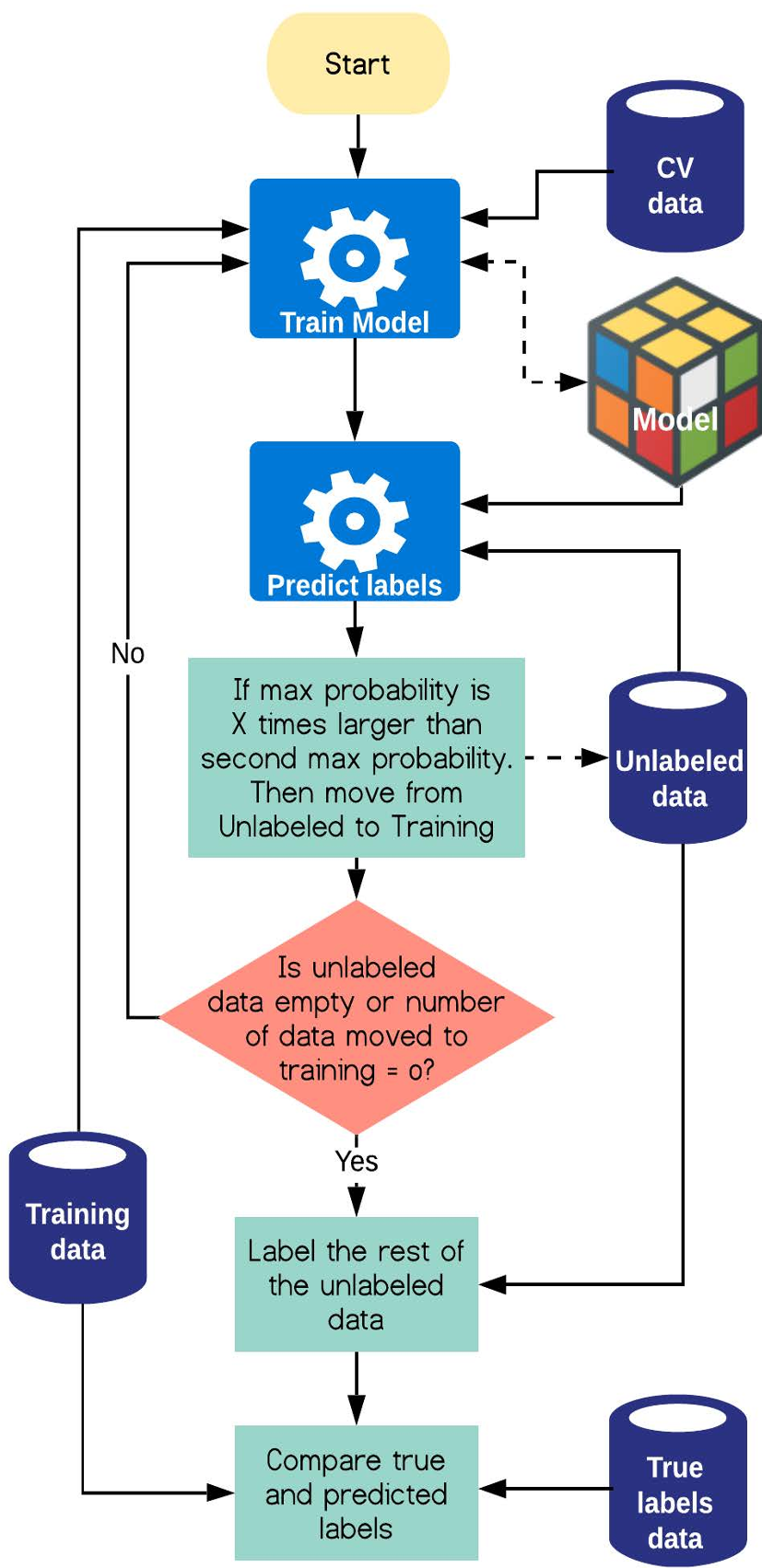
The SLP framework (detailed in the architecture below) treats labeling as an evolutionary process.
- Step A: Train a base model (e.g., fastText or VDCNN) on the initial seed.
- Step B: Predict labels for the unlabeled pool.
- Step C: If the model is "very sure" about a post—specifically, if the probability ratio between the top two labels is high—it moves that post to the training set.
- Step D: Repeat until convergence.
Why It Works: Context Matters
The study reveals a critical insight: Language models that learn from context (VDCNN, fastText) benefit significantly from SLP, whereas bag-of-words models (TF-IDF) do not.
Because TF-IDF relies on global word frequencies, adding noisy labels just adds jitter. However, for Deep Learning models, the iterative process allows the model to "discover" new slang, typos, and domain-specific phrases that weren't in the tiny initial seed, effectively performing a form of unsupervised domain adaptation.
Experimental Results
The authors tested SLP against industry benchmarks. The performance leaps were most dramatic on smaller seed sizes (5,000 samples):
| Dataset | Baseline fastText | SLP(fastText) |
|---|---|---|
| AG News | 33.6% | 85.5% |
| Yelp Polarity | 50.0% | 81.0% |
| Amazon Polarity | 50.0% | 81.7% |
Even on the highly imbalanced Twitter Gun Advocacy dataset, SLP proved robust. By leveraging a combination of TF-IDF (for initial stability) and fastText (for contextual growth), the model achieved an accuracy of 96.5%.
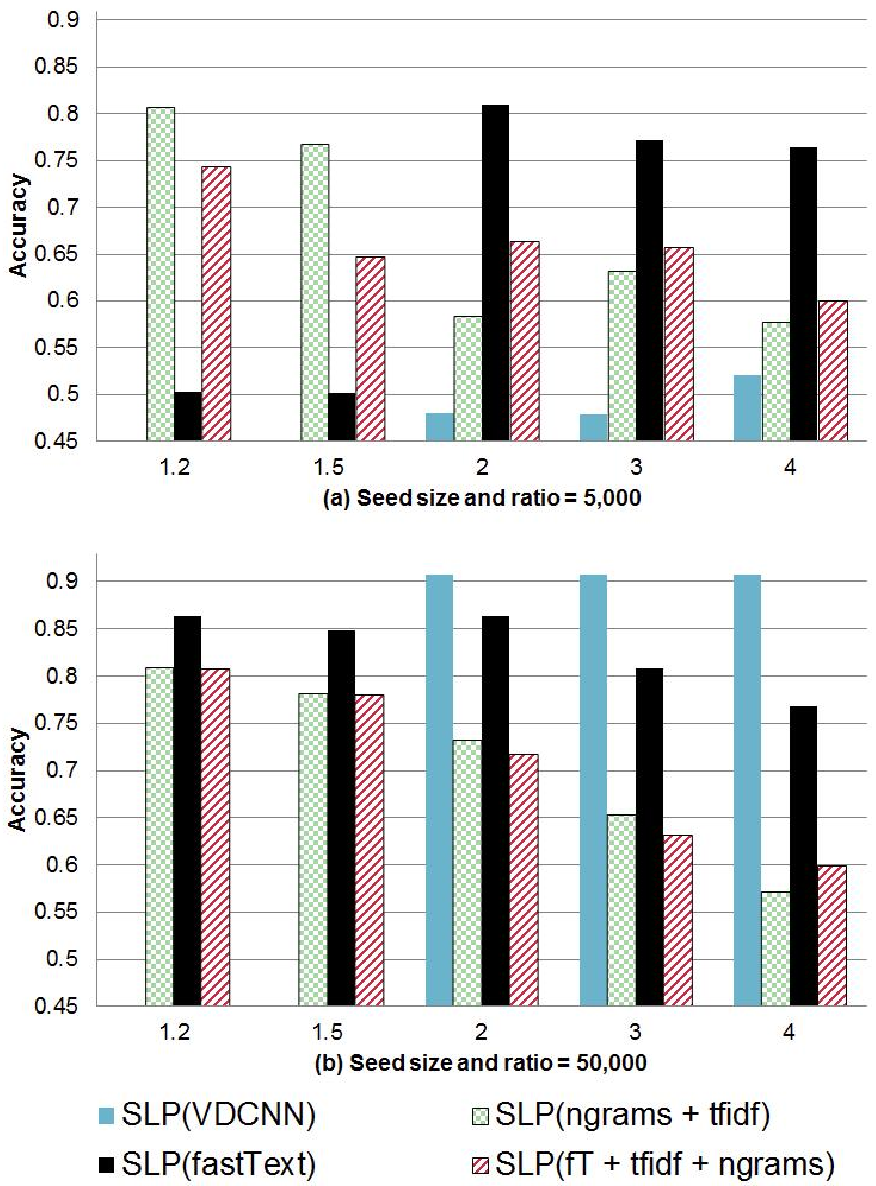 Figure: The impact of ratio X on accuracy. Lower ratios (more aggressive labeling) often work better for small seeds, while higher ratios (more caution) are safer for larger seeds.
Critical Insight & Limitations
One of the most fascinating findings is the "Exit Criteria Analysis." The authors found that the posts left unlabeled at the end of the process were often "double-edged" reviews—posts where a user likes one aspect but hates another. Discarding these "hardest" posts actually increased final model accuracy by 3-5%, suggesting SLP can double as a high-quality data filter.
Limitations:
- The model struggles when the number of classes exceeds 10 (e.g., DBpedia), as the "seed per class" becomes too diluted.
- Performance is sensitive to the choice of the threshold .
Conclusion
SLP provides a pragmatic blueprint for organizations needing to monitor public sentiment without the budget of a tech giant. By combining advocacy-based seed labeling with an iterative contextual learning loop, the framework turns massive, noisy "big data" into a self-refining pedagogical tool for AI.