
Peer Power vs. Official Nudges: What Actually Makes Us Change Our Privacy Settings?
Susceptibility to Social Influence of Privacy Behaviors: Peer versus Authoritative Sources
This study investigates the susceptibility of Online Social Network (OSN) users to social influence regarding privacy behaviors. Utilizing a randomized experiment with 167 Facebook users, the researchers compared the impact of "Peer" senders (strong and weak ties) versus "Authoritative" organizations, successfully modeling behavioral intentions through an extended Theory of Planned Behavior (TPB).
TL;DR
Changing privacy habits on social media isn't just about the "what," but the "who." A landmark study from Tel Aviv University reveals that we are significantly more likely to adopt privacy advice if it comes from a peer—specifically a "weak tie"—rather than an official organization like Facebook or the government. However, this effect is heavily dictated by our own technical confidence: the less we feel in control, the more we trust our friends over the "experts."
The "Contested" Nature of Privacy
Why is it easier to convince someone to try a new app than to fix their privacy settings? The researchers argue that privacy is a contested norm. Unlike security—where the "hacker" is a common enemy—privacy involves a tension between the user and the platform itself. Because users often mistrust OSN operators, traditional "top-down" advice can suffer from a "boomerang effect," pushing users further away from protective behaviors.
Methodology: Simulating Real Social Pressure
To move beyond hypothetical surveys, the study used a custom application that pulled real data from participants' Facebook networks.
- The Manipulation: Participants saw privacy tips (e.g., how to hide friend lists or remote logout) appearing to come from three distinct sources:
- Strong Ties: Close friends (calculated via interaction frequency).
- Weak Ties: Casual acquaintances.
- Authoritative Sources: Official pages like Facebook Safety, CNN, or Government agencies.
- The Framework: The study extended the Theory of Planned Behavior (TPB), looking at how attitude, subjective norms, and Perceived Behavioral Control (PBC) influence the intent to act.
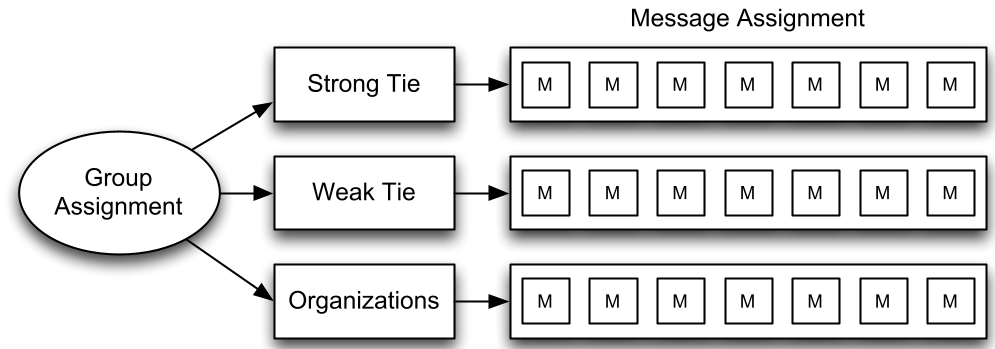 Figure 1: The experimental design segmented users into influence groups while randomizing the message content.
Key Insights: Why "Acquaintances" Win
The results shattered several assumptions about social influence:
1. The Paradox of Tie Strength
Standard social theory (and the researchers' own hypothesis) suggests strong ties are most influential. Yet, the data showed weak ties actually drove higher behavioral intention. This suggests that when it comes to "tech tips," we might value the breadth of knowledge from our broader network more than the intimate trust of close friends.
2. PBC as the Great Mediator
The "Who" only matters if you feel "low" on the "How."
- Low PBC Users: Those who feel they don't know how to manage settings are highly susceptible to peer influence and significantly less likely to trust organizations.
- High PBC Users: Technical "power users" are equally influenced by official sources and peers; their self-efficacy makes them less suspicious of the source's motives.
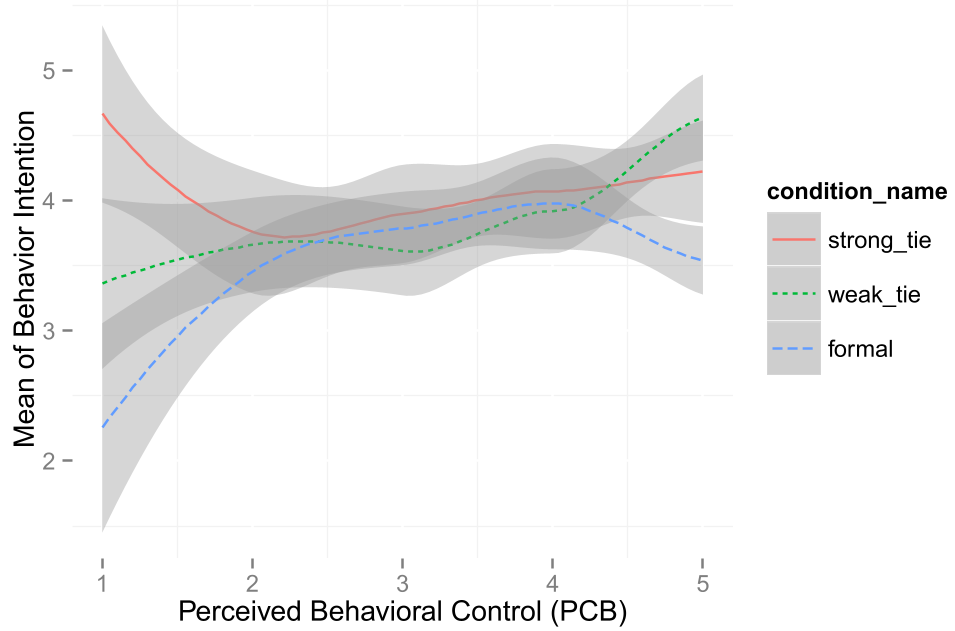 Figure 2: Behavioral intentions normalized by sender category and the user's Perceived Behavioral Control (PBC).
3. The Virality of Protection
The study found a strong correlation between the intent to adopt a practice and the intent to share it. This suggests that privacy isn't just a personal choice; it's a social contagion. If an intervention succeeds in convincing a user, that user becomes a voluntary "node" for further education.
Critical Analysis: Design Implications
The study provides a roadmap for "Privacy Design":
- Avoid Monolithic Messaging: Platforms should not rely solely on "System Notifications." They should leverage "Social Clues" (e.g., "3 of your friends recently updated their audience settings").
- Target the "Privacy Agile": The researchers found that users who frequently change their audience settings (Privacy Agility) are more receptive to new advice. These are your "early adopters" for new security features.
Conclusion
This work highlights a fundamental truth of the digital age: Trust is the currency of influence. When users feel technically vulnerable, they turn away from the "Authoritative" machine and toward the human network. For developers and policy makers, the message is clear: to fix the privacy crisis, you must first empower the community to teach itself.
Limitations to Consider: The study relied on American MTurk workers, who typically show higher privacy awareness than the general public. Additionally, "intended" behavior does not always equal "actual" behavior—a gap known as the Privacy Paradox.