
Facebook vs. Email: Where are You More Likely to Click a Dangerous Link?
Susceptibility to URL-based Internet attacks: Facebook vs. email
This paper presents a quasi-experimental study comparing user susceptibility to URL-based attacks on Facebook versus Email. By sending 398 users "suspicious" links from unknown senders, the researchers quantified clicking behavior and discovered that Email users are significantly more likely to fall for such attacks than their counterparts on social networks.
Executive Summary
TL;DR: A controlled quasi-experiment reveals a counter-intuitive truth: users are significantly more likely to click on suspicious links in Email (56%) than on Facebook (38%). Despite years of antispam education, the traditional medium remains the more successful vector for URL-based attacks.
Academic Context: This study serves as a critical empirical baseline in cyber-psychology. It challenges the assumption that the "novelty" and "social trust" of platforms like Facebook make them inherently more dangerous than "old-school" Email for stranger-originated attacks.
Problem & Motivation: The "Trust" Paradox
In the landscape of cybersecurity, the "Human Factor" is often cited as the weakest link. Conventional wisdom suggests that because Facebook is built on social connections and perceived intimacy, users might lower their guard, making them easy prey for "drive-by-download" or phishing links.
The researchers set out to test this "Social Trust" hypothesis. Do users apply different heuristics when evaluating a link from a stranger in their Inbox vs. their Facebook Messenger? The motivation was to see if the richer visual and social context of a Facebook profile—or the lack thereof—impacted the "clickability" of a threat.
Methodology: The Quasi-Experimental Setup
The authors designed a rigorous "quasi-experiment" to isolate the variables that drive risky behavior.
- The Stimulus: A message containing a link to a fake "photo cloud" site. The link was individualized via a hash (e.g.,
page.php?h=unique_id) to track specific user clicks. - The Variables:
- Medium: Facebook vs. Email.
- Sender Profile: Varied by gender (Male, Female, Neutral) and "Openness" (Public, Restricted, or Private profiles).
- Social Interaction: On Facebook, half the participants received a friend request alongside the link.
Experimental Architecture
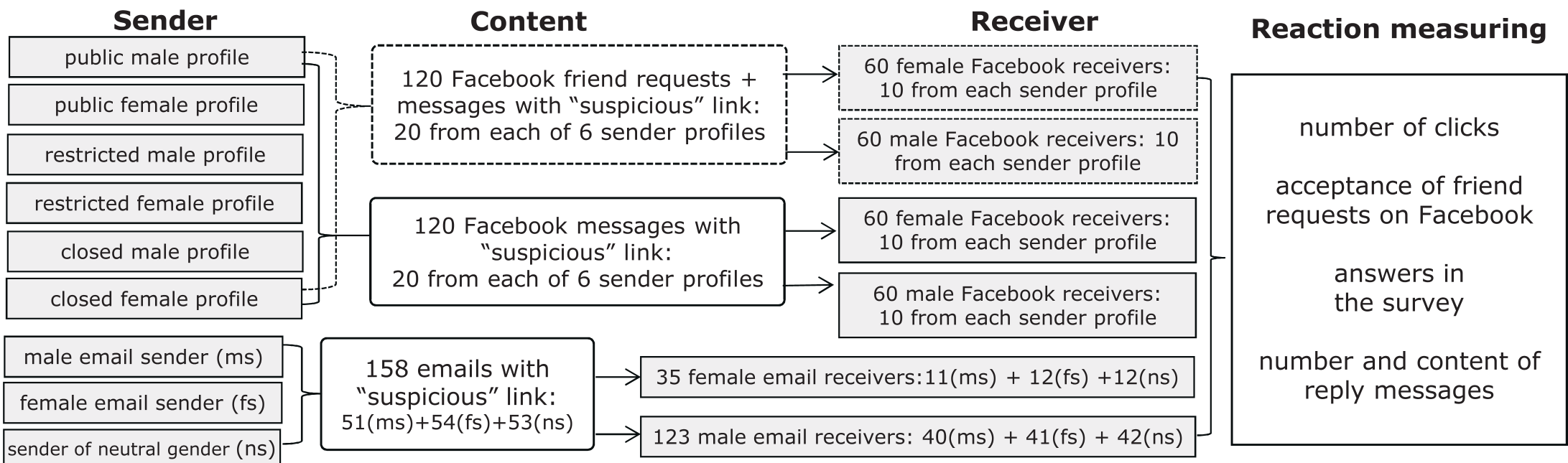 The workflow involved sending messages, tracking direct clicks, monitoring replies, and concluding with a post-experimental survey to gauge the delta between awareness and action.
Detailed Results: Shattering Assumptions
The results from the 398 participants were surprising and statistically significant.
1. Email is the Clear "Winner" for Attackers
Despite expectations, the Email success rate (56%) far outpaced Facebook (38%).
- Why? The authors suggest that because the email addresses used the participants' first names, the messages felt more "personally addressed" than typical spam. Conversely, Facebook users might have used the platform's social tools to verify they didn't know the sender, leading to a higher rejection rate.
2. Social Context Minimal Impact
Interestingly, the "Openness" of a sender's Facebook profile (Public vs. Private) and the presence of a "Friend Request" did not significantly alter the click rate. This suggests a "Click First, Look Later" mentality among a large subset of users.
3. The Awareness-Behavior Gap
In the post-survey, only 17% of users admitted to clicking the link, whereas the experiment recorded 39%. This massive discrepancy indicates that users either forget their risky behaviors or are ashamed to admit they "fell for it," making self-reported survey data in cybersecurity highly unreliable.
Statistical Breakdown
 Table I highlights the highly significant p-value (<.01) for the communication channel compared to the negligible impact of gender or profile settings.
Critical Analysis & Conclusion
Takeaways
- Context provides Defense: Facebook's infrastructure, which allows users to cross-reference a stranger's profile, may inherently provide better defense-in-depth than Email's "blank slate" sender model.
- Email Bias: Users may perceive individualized Emails as more legitimate because modern spam filters have made generic "junk mail" easy to ignore; a personalized-sounding email thus breaks through the skepticism barrier.
Limitations
The study's population was primarily German university students (average age 22). This cohort is digitally native but may not represent the broader, older Internet demographic which might be more—or less—vulnerable to specific social engineering tactics.
Perspectives
This research underscores that technology alone is not a silver bullet. While Facebook’s technical filters might have caught some messages, the real difference was human behavior. Future research should look into "context-aware" phishing, where an attacker impersonates a known friend—a scenario where Facebook's social advantage might become its greatest vulnerability.