
Accelerating Social Contagion: Transforming SIS Models with External Recruitment
Accelerating information diffusion in social networks under the Susceptible-Infected-Susceptible epidemic model
This paper introduces an augmented Susceptible-Infected-Susceptible (SIS) epidemic model that incorporates "direct recruitment" (external control) to accelerate information diffusion in social networks. By providing a closed-form analytical solution, the authors optimize campaigning strategies under both weighted cost functions and fixed budget constraints.
TL;DR
Information in social networks doesn't just spread through word-of-mouth; it is often sparked and sustained by external forces like advertising. This paper reformulates the classic SIS (Susceptible-Infected-Susceptible) epidemic model to include a constant "recruitment" rate. By solving the underlying differential equations in closed form, the authors provide a powerful toolkit for optimizing marketing and political campaigns under real-world budget constraints.
Problem & Motivation: Beyond "Organic" Spreading
Most baseline models for information diffusion assume an organic process: you learn about a product because your friend told you (Susceptible-Infected contact). However, this ignores the reality of modern campaigning where media intervention (ads, billboards, sponsored content) directly "infects" the population regardless of their social circle.
The authors identify a gap in literature:
- Passive Theory: Standard models are too slow as they rely solely on contact.
- Complex Computation: Earlier studies using time-varying controls (Pontryagin's Principle) are mathematically "black boxes" that don't allow for simple, intuitive calculations of system evolution.
The core insight here is that by injecting a constant external control , we don't just add more "infected" nodes; we create a catalytic effect where those new nodes then go on to infect others organically.
Methodology: The Mathematics of Recruitment
The authors modify the standard SIS rate equation:
Where:
- : Message diffusion rate.
- : Recovery/forgetting rate.
- : External recruitment rate (The Control).
By applying partial fraction expansion, they derive a Closed-Form Solution for , which is a rare and valuable find in non-linear dynamics. This allows a campaign manager to predict exactly what percentage of the population will be "infected" (aware) at any deadline .
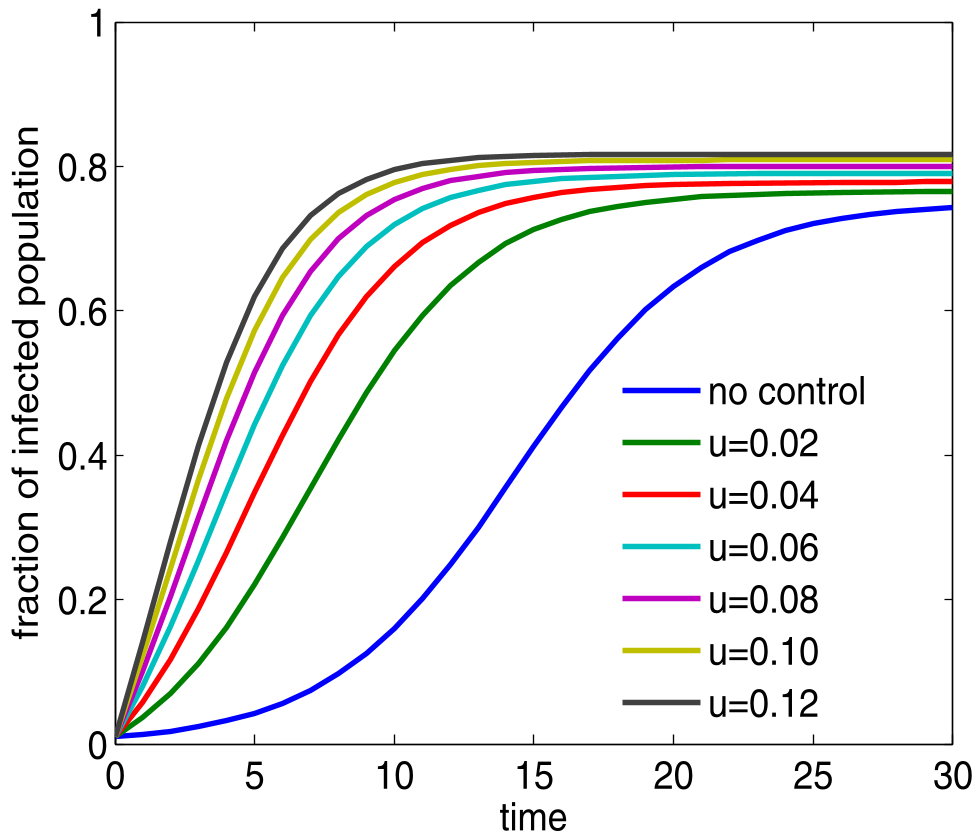 The figure above illustrates how different levels of control (u) change the system's equilibrium. Note that as u increases, the limit of awareness in the population moves significantly higher.
Experiments & Results: Is it Worth the Cost?
The paper evaluates two primary scenarios:
- Weighted Cost: Balancing the reward of awareness against the expense of the campaign. The authors find the cost function to be convex, meaning there is a mathematically "perfect" amount of advertising spend that maximizes ROI.
- Fixed Budget: Maximizing awareness given a hard limit on resources.
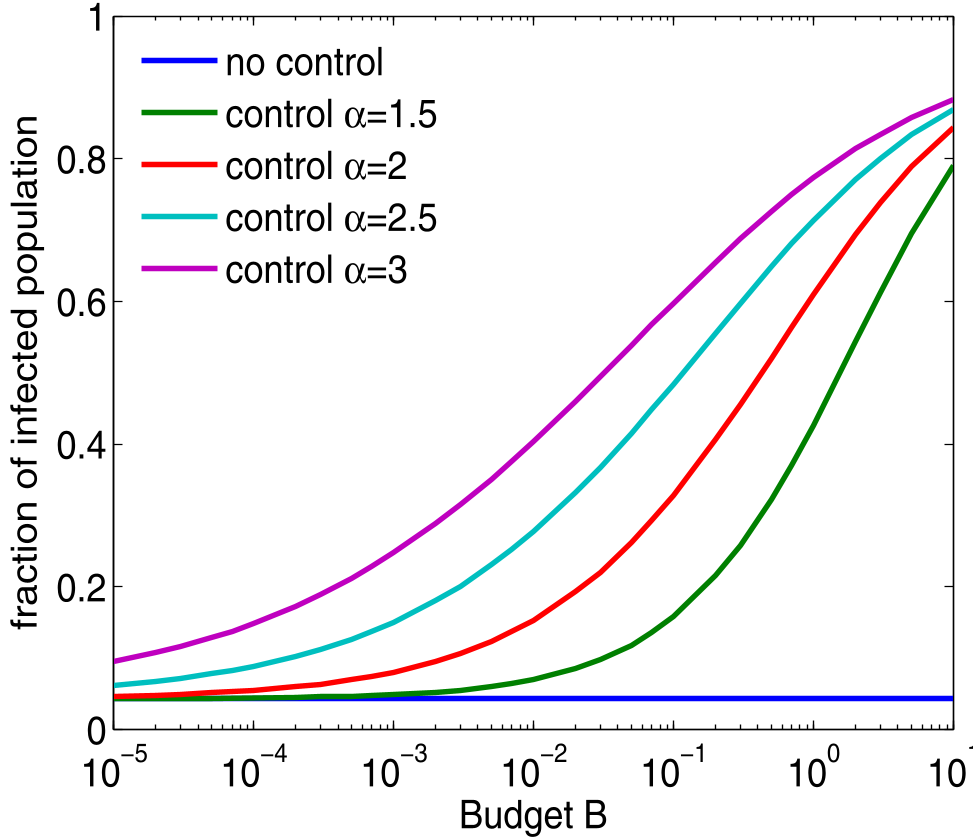 This chart demonstrates the relationship between the budget (B) and the final awareness (i(T)). It serves as a lookup table for campaign planners to determine the funding required for a target penetration rate.
Key Findings:
- Equilibrium Shift: External recruitment doesn't just speed up the process; it permanently raises the "steady state" of awareness in the population (Endemic State).
- Monotonicity: Awareness is a monotonically increasing function of control—meaning in a fixed budget scenario, it is always optimal to use the full budget early and consistently.
Critical Analysis & Conclusion: Future Outlook
This work provides a rigorous foundation for quantitative marketing. By moving from "rules of thumb" to "closed-form equations," it allows for predictable campaign outcomes.
Takeaway: The "Direct Recruitment" term is a simple but effective proxy for advertising. It proves that external intervention acts as a force multiplier for organic word-of-mouth.
Limitations & Future Work:
- Network Homogeneity: The model assumes an average degree for all nodes. In reality, "Influencers" (high-degree nodes) would change the dynamics of .
- Constant Rate: Future research could explore "burst" advertising (high at the start) versus sustained campaigns to see which captures the market faster.
Ultimately, this paper bridges the gap between epidemic theory and economic strategy, providing a clear roadmap for anyone looking to "infect" a social network with a new idea.