
SUT-Miner: Bridging Knowledge Discovery and Active Medical Databases
SUT-Miner: A Knowledge Mining and Managing System for Medical Databases
SUT-Miner is an integrated knowledge discovery and management system tailored for medical databases, utilizing second-order Horn clauses to automate the induction of association and classification rules. It achieves state-of-the-art utility by transforming discovered patterns into active database triggers for real-time consistency monitoring and decision support.
TL;DR
SUT-Miner is a sophisticated framework designed to automate the lifecycle of medical knowledge—from mining hidden patterns in patient data to enforcing them as active database constraints. By leveraging the expressive power of Second-Order Logic, it streamlines the creation of database triggers, ensuring medical data remains consistent with newly discovered clinical insights.
Background & Motivation: Beyond Static Databases
In the medical domain, knowledge often exists in two forms: Explicit (stored in guidelines) and Implicit (hidden within patient records). While existing tools handle explicit data well, extracting implicit knowledge—such as a specific correlation between skin-fold thickness and insulin levels in diabetic patients—requires advanced mining.
The authors identify a major bottleneck: even when knowledge is discovered, deploying it for real-time monitoring (via SQL Triggers) is manually intensive. SUT-Miner aims to solve this by providing a "Suite of Tools" that not only finds the rules but also automates their application.
Methodology: The Power of Second-Order Logic
Unlike traditional systems relying on First-Order Logic (FOL), SUT-Miner utilizes Second-Order Horn Clauses.
- Why Second-Order? High-level knowledge mining often involves reasoning about patterns themselves. Second-order logic allows variables to quantify over predicates, leading to more concise and verifiable code (using SWI-Prolog).
- The Architecture: The system is split into Knowledge Induction (back-end mining using Apriori) and Knowledge Inferring (front-end deployment).
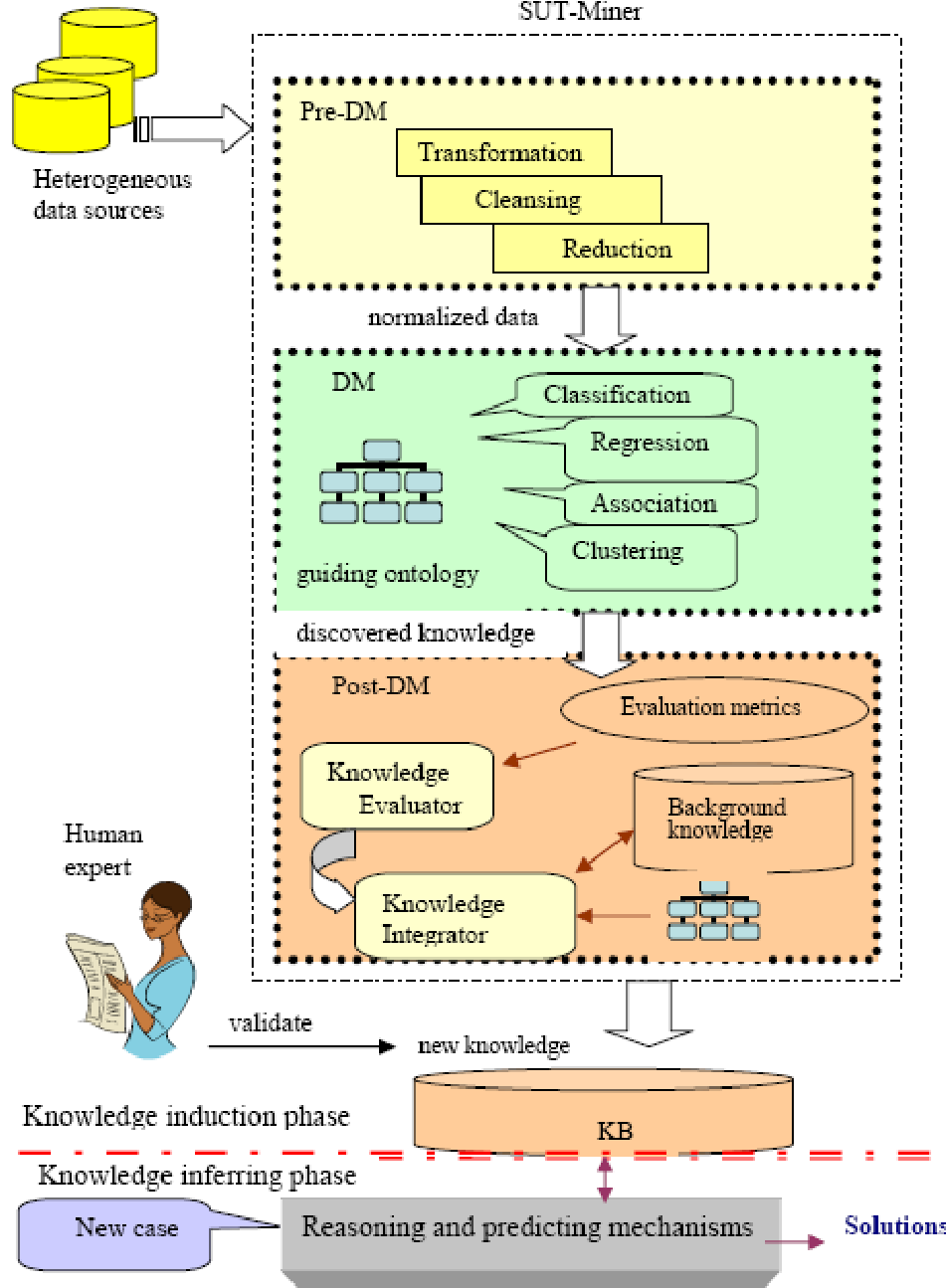 Figure 1: The dual-phase architecture connecting raw data sources to a refined knowledge base.
From Rule Mining to Active Triggers
A standout feature of this research is the Semi-automatic Trigger Creation. When the mining engine discovers a strong association rule—such as:
IF triceps-thickness is (0-9.9] AND pedigree-fn is (0-0.312] THEN insulin is (0-84.6]
SUT-Miner automatically generates the corresponding SQL Trigger code:
sql CREATE TRIGGER rule_1 ON diabetes FOR UPDATE, INSERT AS IF (SELECT COUNT(*) FROM diabetes WHERE ... violation_condition) > 0 BEGIN RAISERROR ('soft constraint violation'); END
This transforms a discovered "pattern" into a "guardrail" for the database.
Experimental Validation
Using the UCI Diabetes dataset, the researchers validated the system's ability to find clinically relevant associations among 768 female patients.
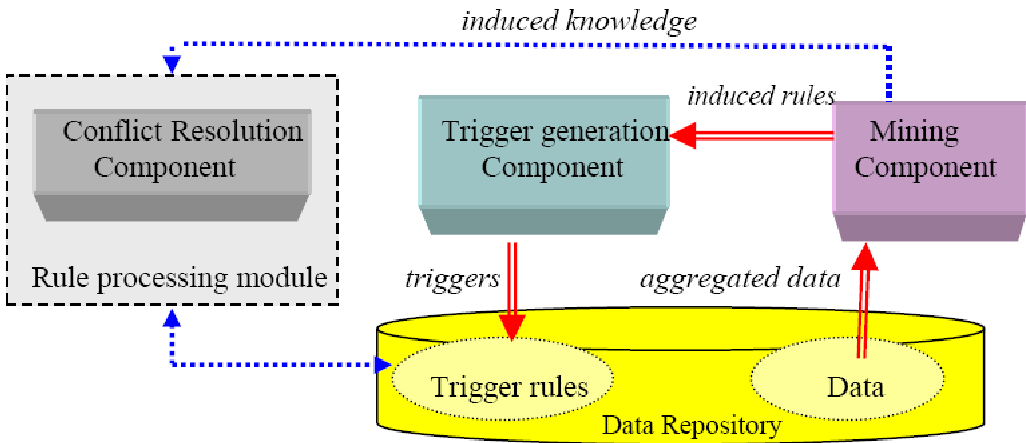 Figure 2: The workflow showing how induced rules are integrated back into the database repository as active triggers.
The study highlighted five top-performing association rules, focusing on glucose concentration, BMI, and age. These weren't just academic results; they were functional constraints that prevented the insertion of "clinically illogical" data points.
Critical Insight & Conclusion
SUT-Miner moves the field from Explanatory Mining (just looking at data) to Active Governance.
- The Value: It reduces the "Software Engineering" burden on clinical researchers.
- The Limitation: While association rules are powerful, they are sensitive to "noise." The system currently requires human experts to validate the "Usefulness" of a rule before it becomes a trigger.
- The Future: As healthcare data moves toward "Big Data" scales, the declarative SOL approach might face performance hurdles, but the paradigm of Self-Protecting Databases via induced knowledge remains a vital contribution to medical informatics.
Takeaway: If a database can learn from its own data, it should also be able to protect itself from data that contradicts its learned logic.