
SVDMC: Leveraging Latent Spaces for Robust Social Event Detection
An SVD-based Multimodal Clustering method for Social Event Detection
This paper introduces SVDMC (SVD-based Multimodal Clustering), an unsupervised framework for detecting social events from large-scale multimedia collections. By fusing heterogeneous features like timestamps, tags, and geo-tags into a binary adjacency matrix and applying Singular Value Decomposition (SVD), the method achieves state-of-the-art performance on the MediaEval SED 2012 benchmark.
TL;DR
SVDMC (SVD-based Multimodal Clustering) is a powerful, fully unsupervised framework designed to group social media photos into discrete "events." By representing multimodal relationships (time, location, text) as a sparse binary matrix and using Singular Value Decomposition (SVD) to find a latent "event space," the authors demonstrate superior performance on the MediaEval SED benchmark, even when crucial data like GPS tags are 80% missing.
Background & Motivation: The Chaos of Social Media
In the era of Flickr and Instagram, social event detection—grouping images by the real-world activities they represent (e.g., a specific protest or a soccer match)—is a daunting task. The data is "multimodal" (timestamps, tags, geo-locations, user IDs) and "incomplete" (most users don't share GPS data).
Prior works often fell into two traps:
- Step-by-Step Filtering: Processing time, then space, then text. This loses "cross-talk" between features.
- Supervised Classifiers: Requiring labeled "training" data which is rarely available for real-time emerging events.
The authors' insight is simple: The neighboring relationships between photos across different modes contain a hidden structure. If we can find a mathematical way to fuse these "votes" for proximity, the events will naturally emerge.
Methodology: The Three Pillars of SVDMC
The SVDMC pipeline is elegant in its simplicity, focusing on robustness over complexity.
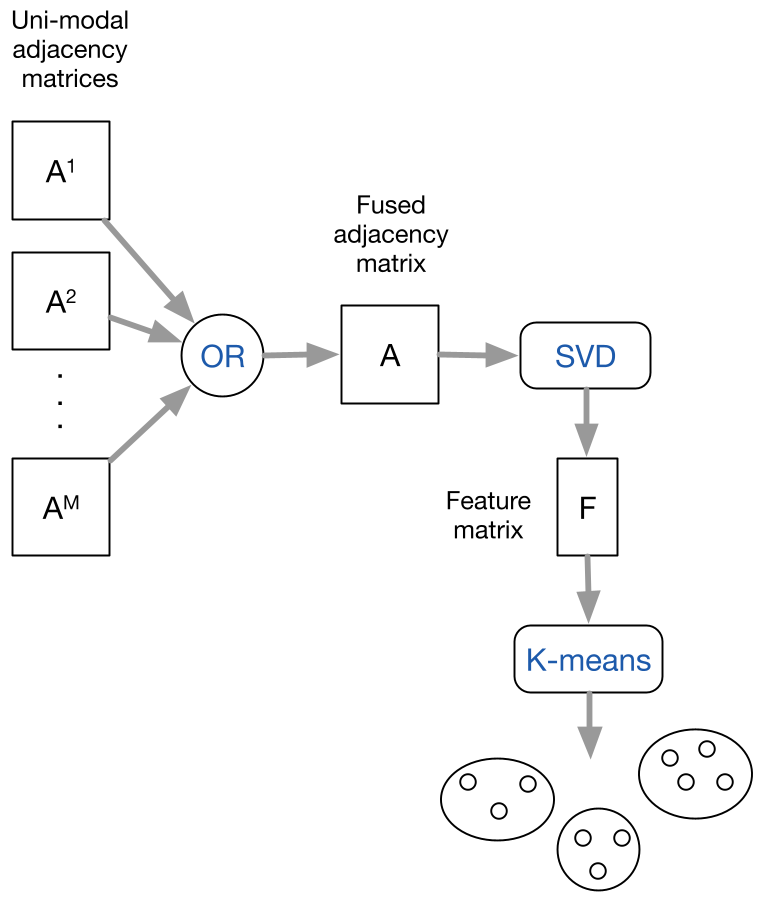
1. Robust Multimodal Fusion (The Logical OR)
Instead of calculating a complex weighted sum of distances (which fails if one feature like GPS is missing), the authors construct binary K-nearest neighbor (k-NN) matrices for each modality.
- If Photo A and Photo B are "close" in either time, or tags, or location, they are marked as related (logical OR).
- This creates a sparse, possibly asymmetric matrix where if is a neighbor of in any modality.
2. SVD: The Latent Feature Extractor
The binary matrix is noisy. The authors apply Singular Value Decomposition (SVD) to find a low-rank approximation. This is the "secret sauce" because:
- Noise Reduction: SVD ignores the small, random "ones" in the matrix that don't fit the global pattern of an event.
- Handling Asymmetry: Unlike Laplacian Eigenmap (which often produces complex numbers for asymmetric graphs), SVD always stays in the real-number domain, making it more practical for real-world k-NN graphs.
3. Latent Space Clustering
Finally, the objects are represented by the rows of . These low-dimensional vectors are then clustered using K-means++.
Experimental Showdown
The authors tested SVDMC on the MediaEval SED 2012 dataset, which consists of over 167,000 images. The dataset deliberately simulated real-world conditions by removing 80% of geo-tags.
Key Competitive Results:
As shown in the table below, SVDMC significantly outperformed traditional generic methods and graph-based methods like SCAN in most challenges.
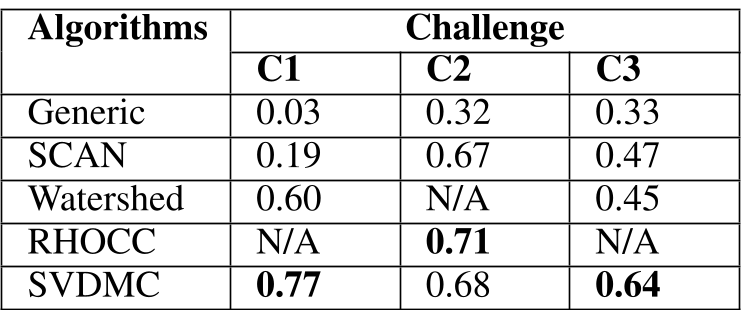
Key Takeaways from the Data:
- Feature Synergy: Using
Time + Tag + Geo-tagyielded the best results. Interestingly, addingUser IDactually decreased performance (NMI drop), likely because it introduced noise from prolific users who attend multiple unrelated events. - SVD vs. LEMC: SVD provided a much cleaner representation than Laplacian Eigenmap (LEMC), particularly when the latent space dimension was high (e.g., 50D).
Critical Analysis: Reflections from the Editor
SVDMC is a testament to the power of matrix factorization in the age of Deep Learning. While it doesn't use massive neural networks, its ability to handle "asymmetric relationships" is a vital observation.
Limitations:
- The number of clusters must be predefined. In a real-world scenario where the number of events is unknown, an automated way to determine (like the Elbow method or X-means) would be necessary.
- It ignores visual content. While the authors argue visual features are often noisy for events (e.g., two different weddings look visually similar), modern Vision Transformers (ViTs) might provide the semantic "oomph" missed here.
Conclusion
SVDMC offers a robust, unsupervised blueprint for social media analysis. Its reliance on "logical OR" fusion and SVD dimensionality reduction makes it particularly suited for the "messy" data of the social web, where incompleteness is the rule rather than the exception.
Future Directions: The next frontier for this work is clearly "Event Description"—automatically generating a human-readable summary of the detected event clusters.