
CSO-ANFIS: Leveraging Swarm Intelligence to Predict Facebook Post Virality
Swarming Behaviors of Chicken for Predicting Posts on Facebook Branding Pages
The paper introduces CSO-ANFIS, a hybrid predictive model that integrates Chicken Swarm Optimization (CSO) with the Adaptive Neuro-Fuzzy Inference System (ANFIS). It aims to predict key performance metrics (e.g., reach, engagement, likes) for Facebook branding pages to optimize digital marketing strategies.
TL;DR
In the hyper-competitive world of social media branding, knowing how a post will perform before you hit "Publish" is the ultimate competitive advantage. This paper presents CSO-ANFIS, a hybrid model that merges the logical reasoning of Fuzzy Logic with the optimization power of the Chicken Swarm Optimization (CSO) algorithm. By outperforming genetic algorithms and particle swarm optimization, it provides managers with a high-precision tool to forecast engagement metrics.
Background: Why Social Media Prediction is Hard
Predicting user interaction on Facebook branding pages isn't just about counting "Likes." It involves a complex interplay of post types, timestamps, and categories. Traditional statistical methods often fail because the relationship between a post's attributes and its reach is non-linear and "fuzzy."
While the Adaptive Neuro-Fuzzy Inference System (ANFIS) is a potent tool for mapping these relationships, its accuracy depends entirely on how well its internal parameters (membership functions and rules) are tuned. The standard gradient-based training often gets stuck in local optima, leading to mediocre predictions.
Methodology: The Chicken Swarm to the Rescue
The authors propose using Chicken Swarm Optimization (CSO) to refine ANFIS. CSO mimics the hierarchical social structure of a poultry farm:
- Roosters: The "best" solutions that explore the search space aggressively.
- Hens: They follow roosters but compete for better positions.
- Chicks: They move around their mothers (hens) to find the local optimum.
By treating the ANFIS parameters as "chickens" in a swarm, the algorithm iteratively searches for the parameter set that minimizes prediction error.
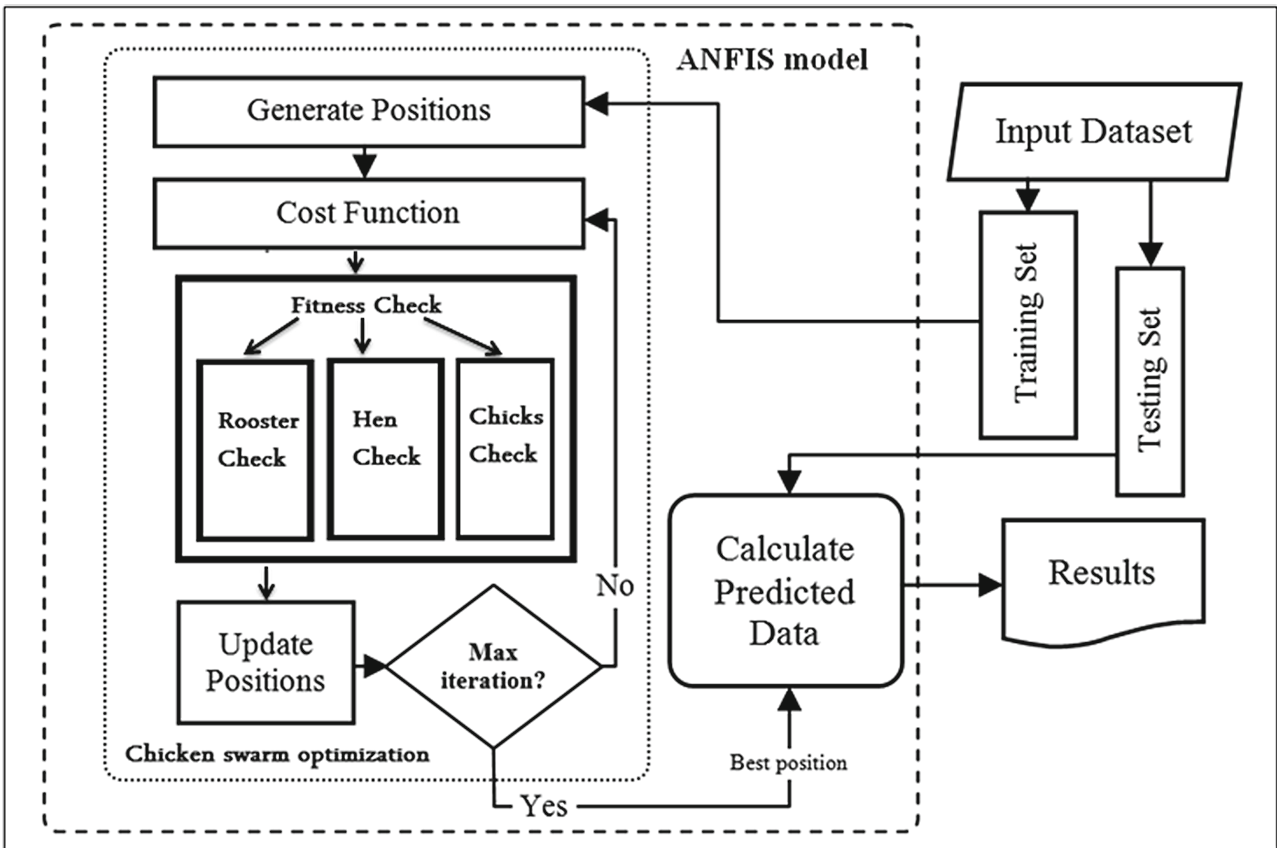
The Prediction Pipeline
- Input Vector: Attributes such as Post ID, Message Type, Category, and whether it's a Paid post.
- CSO Optimization: Fine-tunes the ANFIS layers (fuzzification to defuzzification).
- Output: Predictions for 12 metrics, including "Lifetime Post Consumers" and "Total Interactions."
Experiments: Breaking the Benchmarks
The model was validated using a real-world dataset of 790 posts from a cosmetic brand’s Facebook page. The goal was to predict the Lifetime Post Consumers.
Comparative Performance
The researchers compared CSO-ANFIS against:
- Standard ANFIS (The baseline)
- PSO-ANFIS (Particle Swarm Optimization)
- GA-ANFIS (Genetic Algorithm)
- Krill-ANFIS (Krill Herd Optimization)
| Model | RMSE (Lower is Better) | AAPRE |
|---|---|---|
| CSO-ANFIS | 0.07531 | 1.6154 |
| GA-ANFIS | 0.07644 | 1.5843 |
| PSO-ANFIS | 0.07686 | 1.6262 |
| ANFIS | 0.08521 | 1.6147 |
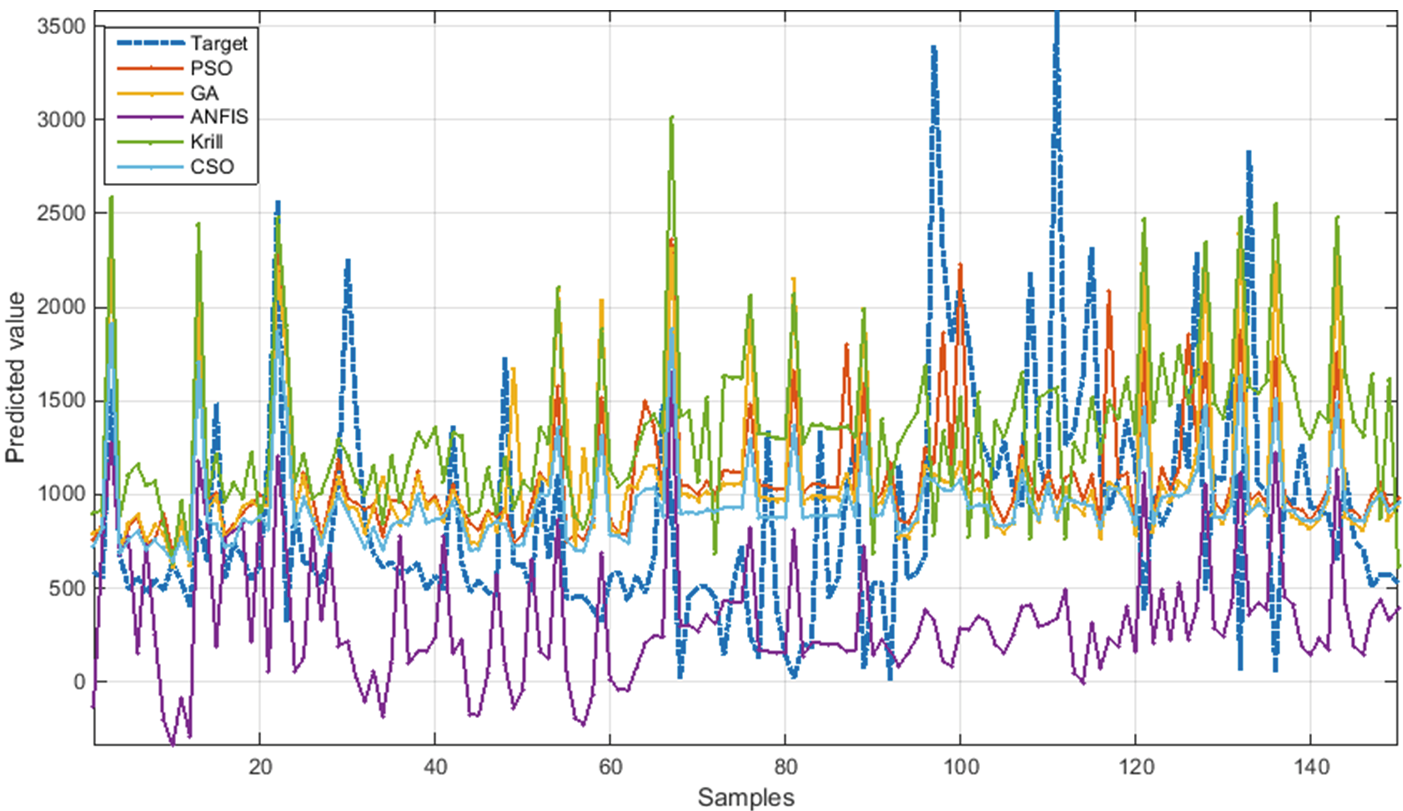
The results clearly show that the Chicken Swarm approach provides a more robust search mechanism for ANFIS, reaching a lower Root Mean Square Error (RMSE) than even the more established Genetic Algorithms.
Critical Insight: Why Does It Work?
The success of CSO-ANFIS lies in its balance of exploration and exploitation. The division of the swarm into roosters, hens, and chicks ensures that the search doesn't converge too quickly (exploration) while fine-tuning the local best solutions (exploitation). This is particularly effective for the "rugged" error landscapes typical of social media data.
Conclusion & Future Outlook
CSO-ANFIS marks a significant step toward "Prescriptive Analytics" in social media. Instead of reacting to low engagement, managers can iterate on their content—changing the type or timing—until the model predicts a high-performance score.
What's next? The authors suggest that adding a Sentiment Analysis layer (analyzing the actual text of the post message) could further boost accuracy. Integrating chaotic maps into the swarm movements could also prevent the model from plateauing in even more complex datasets.
Reference: Ahmed, K., et al., "Swarming Behaviors of Chicken for Predicting Posts on Facebook Branding Pages," SRGE Research.