
SWE-chat: Beyond Benchmarks to the Messy Reality of Vibe Coding
SWE-chat: Coding Agent Interactions From Real Users in the Wild
SWE-chat is the first large-scale, "in-the-wild" dataset of real-world AI coding agent interactions, containing 6,000 sessions with 63,000 user prompts and 355,000 tool calls. It tracks complete trajectories from agents like Claude Code and Cursor, providing line-level attribution to distinguish between human and agent-authored code in real GitHub repositories.
TL;DR
Is the future of software engineering just "vibe coding"? SWE-chat, a new large-scale dataset from Stanford researchers, suggests we are getting there—but at a significant cost. By analyzing 6,000 real-world sessions of developers using AI agents like Claude Code and Cursor, the paper reveals that while agents author over half of committed code, they are remarkably inefficient and introduce security vulnerabilities at alarming rates compared to human-AI collaboration.
The "Sim-to-Real" Crisis in Coding Agents
Academic benchmarks for coding agents (e.g., SWE-bench) typically present a clean, well-defined GitHub issue and ask the agent to "fix it" in one shot. In the wild, software engineering is rarely that simple. Developers use agents to understand legacy code, fight with git merges, or refactor small snippets iteratively.
The authors argue that we have been flying blind, lacking data on how humans actually steer agents. They introduce SWE-chat, a living dataset that captures the full interaction trace: from the initial "vibe" prompt to the final git commit, with precise line-level attribution of who wrote what.
Methodology: Mapping the Human-Agent Frontier
To make sense of 2.7 million logged events, the researchers categorized sessions into three Coding Modes:
- Human-only: The agent explains code or runs tests, but the human writes the patch.
- Collaborative: A true duet where both contribute to the commit.
- Vibe Coding: The agent authors >99% of the code, often based on vague user instructions.
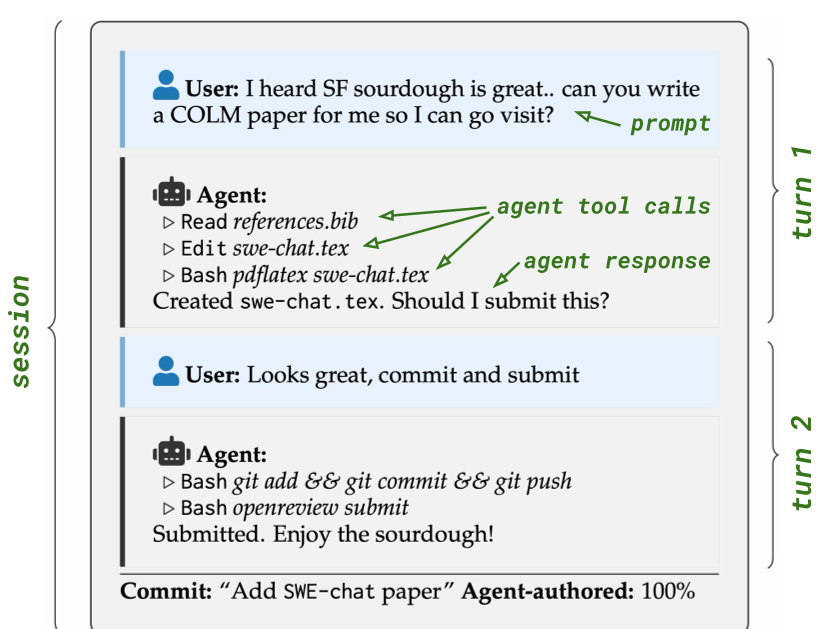 Figure 1: The anatomy of an SWE-chat session, showing the interleaving of prompts, tool calls (bash, edits), and output.
The team used LLM-as-a-judge (calibrated against human experts) to label user personas. Are you an "Expert Nitpicker" (correcting every line) or a "Vague Requester"? The data shows that even in vibe coding, many users remain "nitpickers," pushing back against agent outputs in nearly 40% of turns.
The Harsh Reality: Inefficiency and Insecurity
The findings are a wake-up call for the "Full Autonomy" hype train:
- The Survival Gap: Less than 45% of code produced by agents actually makes it into the final commit. Agents often hallucinate or produce "bloat" that developers ultimately discard.
- The Security Tax: This is the most striking result. Vibe-coded commits introduce 9x more security vulnerabilities (like SQL injection and path traversal) per line than human-only code.
- Collaboration Wins: "Collaborative coding" was found to be the most efficient mode, requiring fewer tokens and less time per committed line than full agent autonomy.
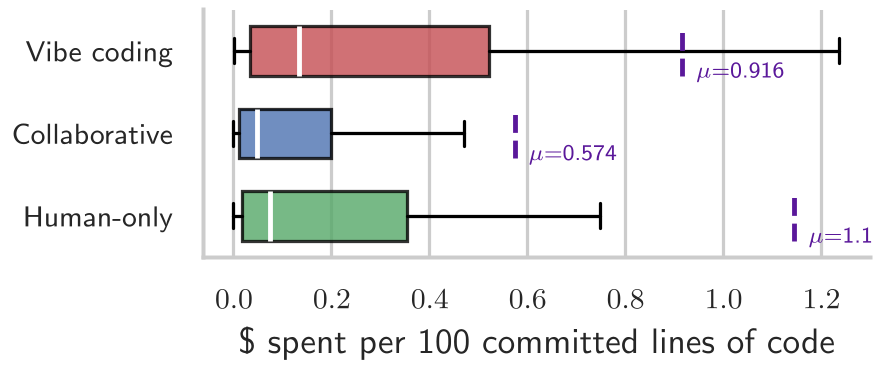 Figure 2: Cost and token efficiency across different coding modes. Vibe coding, while fast to prompt, is the most expensive in terms of resource consumption.
Critical Insight: Autonomy vs. Oversight
The paper highlights a dangerous asymmetry: Autonomy is outpacing oversight. Agents are working independently for longer (some turns exceeding 100 minutes), yet they rarely stop to ask for clarification (only ~1.4% of the time). This forces the human into a reactive role, "firefighting" the agent's mistakes through corrections and interruptions.
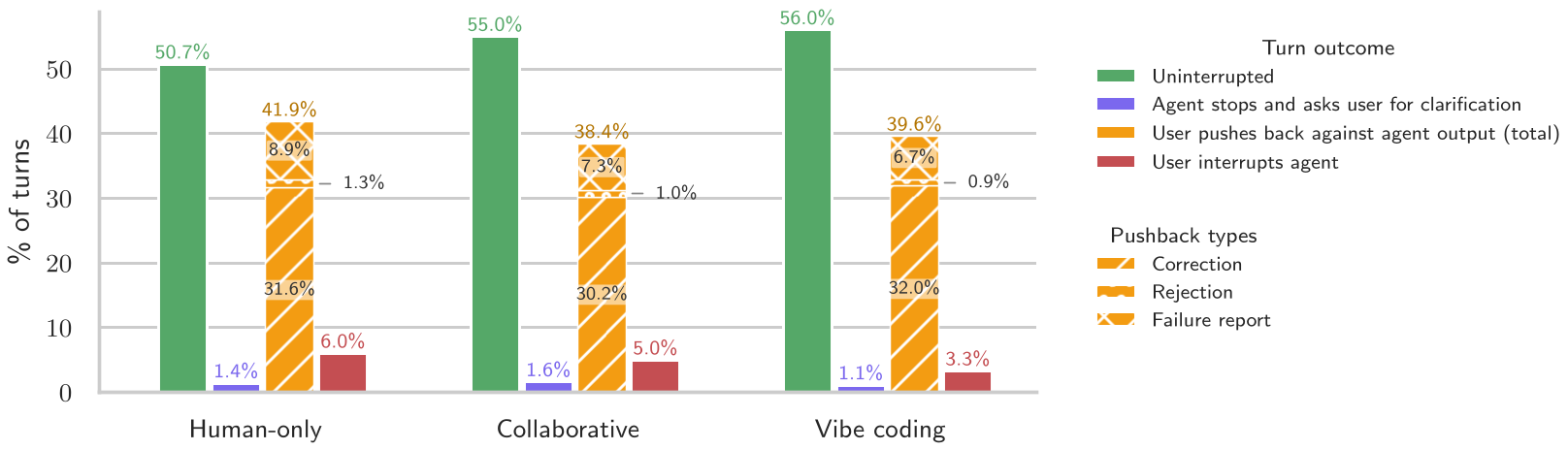 Figure 3: Friction points in Claude Code sessions. Users frequently interrupt or "push back" because the agent fails to signal uncertainty.
Conclusion: A Roadmap for the Next Generation
SWE-chat isn't just a dataset; it's an indictment of current evaluation methods. To build better agents, the authors suggest:
- Adaptive Interaction: Agents need to learn when to stop and ask questions.
- User Simulators: Researchers can use SWE-chat to train "human-like" simulators that push back, nitpick, and change their minds, creating more realistic training environments.
- Real-time Security Guardrails: Since vibe coding is inherently riskier, agents need proactive security scanning baked into the "edit-loop," not just as a post-hoc check.
As "vibe coding" continues to double in popularity every few months, the industry must decide: do we want autonomous agents that write a lot of code, or collaborative agents that write the right code? SWE-chat suggests the latter is the path to true productivity.