
SWIM: Bridging the Gap Between Search Engines and Social Intelligence
SWIM: fostering social network based information search
SWIM (Small World Instant Messenger) is a peer-to-peer social search system built on top of Instant Messaging (IM) infrastructure. It introduces a decentralized referral agent mechanism that automates information retrieval through social networks and expert matching based on mined user profiles.
TL;DR
Before the era of massive social graphs, SWIM (Small World Instant Messenger) proposed a visionary infrastructure to solve the "hidden knowledge" problem. It transforms Instant Messaging from a simple communication tool into a decentralized search engine that navigates your friends' networks to find experts you don't even know yet.
Background & Motivation: The Limits of Public Data
In 2004, the web was already vast, but the most valuable information—personal experience, internal organizational knowledge, and expert opinions—remained trapped in people's heads. While we trust referrals from friends more than search results, manual social searching scales poorly. If your direct "buddies" don't have the answer, the search usually dies.
The authors identified a critical "Information Identity" gap: users often don't know what their friends' friends know. SWIM was designed to bridge this gap by automating the "Small World" phenomenon (the idea that everyone is connected by a short chain of social ties).
Methodology: How SWIM Navigates the Social Graph
The system's innovation lies in its Referral Agent architecture and its automated approach to user profiles.
1. Constructing the Information Identity
Rather than relying solely on manual input, which is often incomplete, SWIM automatically mines data sources like:
- Browser Bookmarks: Current interests and resources.
- Homepages: Documented expertise and professional history.
This creates a keyword vector representing the user's "Information Identity."
2. The Referral Loop
When a user issues a query, the magic happens in a multi-hop P2P process:
- Local Search: The agent checks the user's own profile.
- Broadcast: If no match, it sends the query to agents of direct buddies.
- Propagation: Buddies' agents repeat the process, forwarding the query based on "control settings" until an expert is found or the "max hops" limit is reached.
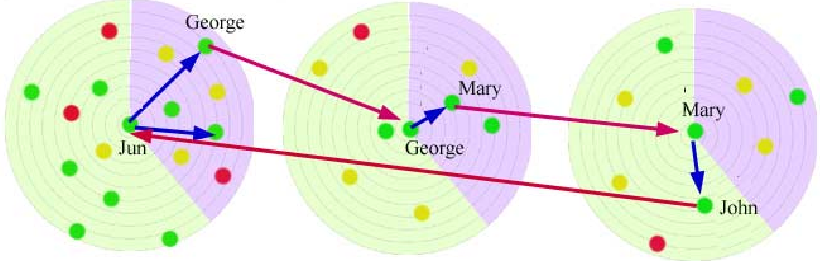 Figure 1: The architecture of query propagation through social referrals.
Experiments & Core Insights
SWIM was architected as a Peer-to-Peer (P2P) system, which was a strategic choice for two reasons:
- Privacy: Users retain ownership of their profile data. Unlike centralized modern social networks, the data stays on the user's "peer" node.
- Scalability: Searching is distributed across the network rather than taxing a central server.
While the paper focuses on the technical feasibility, it sets the stage for organizational studies to see how these "automated referrals" affect social dynamics. It recognizes a key tension: Disturbance vs. Discovery. To solve this, SWIM allows for "asynchronous discussion," letting experts respond when they aren't busy.
Critical Analysis: A Precursor to Modern Social Graphs
Looking back from a PhD-level technical perspective, SWIM was ahead of its time in advocating for Decentralized Social Search.
Strengths:
- It treats the social network as a routing protocol for information, not just a list of contacts.
- It addresses the cold-start problem of profiles through automated mining.
Limitations:
- Security: P2P systems are vulnerable to "Sybil attacks" or malicious nodes providing false info.
- Context Decay: As a query travels more hops (e.g., 4 or 5), the social trust between the searcher and the respondent thins significantly.
Conclusion: Why It Still Matters
SWIM's legacy is found in every "People also know" or "Endorsements" feature in modern professional networks. It proved that search isn't just about indexing documents; it's about indexing connections. As we move towards decentralized web (Web3) and AI agents that can "negotiate" on our behalf, the principles of SWIM—autonomous agents navigating social paths—are more relevant than ever.