
The Swing Voter’s Curse 2.0: When Social Networks Sabotage Democracy
The swing voter's curse in social networks
This paper investigates how vote recommendations in social networks affect common-interest elections. It introduces a model of "sincere behavior" (giving and following recommendations) and proves that such communication can lead to a "swing voter's curse," where informational efficiency is undermined if the network structure is unbalanced.
TL;DR
Information sharing is usually seen as a net positive for collective intelligence. However, Buechel and Mechtenberg prove that in social networks, more communication can lead to worse outcomes. If a voter has a large "audience" but only average expertise, their recommendation can "curse" their followers, leading the group to pick the wrong policy even when better information was available elsewhere in the network.
Background: The Price of Influence
In a perfect Condorcet Jury world, every voter has an independent signal, and the majority is almost always right. But we live in a world of correlated information. We listen to "influencers" or better-informed friends. This paper asks a critical question: Does the architecture of who talks to whom fundamentally change the accuracy of our votes?
The Problem: The Unbalanced Network
The authors identify a specific structural trap. In a "Strongly Balanced" network, expertise is distributed proportionally to influence. But in a "Star" network—think of a single popular Twitter account with thousands of passive followers—one person’s signal is amplified so much that it drowns out the quiet expertise of everyone else.
Methodology: Sincere Behavior vs. LTED
The authors analyze two primary ways humans act in these systems:
- Let the Experts Decide (LTED): Uninformed people recognize they are uninformed and abstain, letting those with private signals handle the vote. This is theoretically efficient.
- Sincere Behavior: Experts share what they know, and followers trust them.
The mathematical core of the paper is the Balancedness Definition, which measures whether a group's "expertise" (the log-odds weight of their signals) matches their "power" (the number of votes they control via their audience).
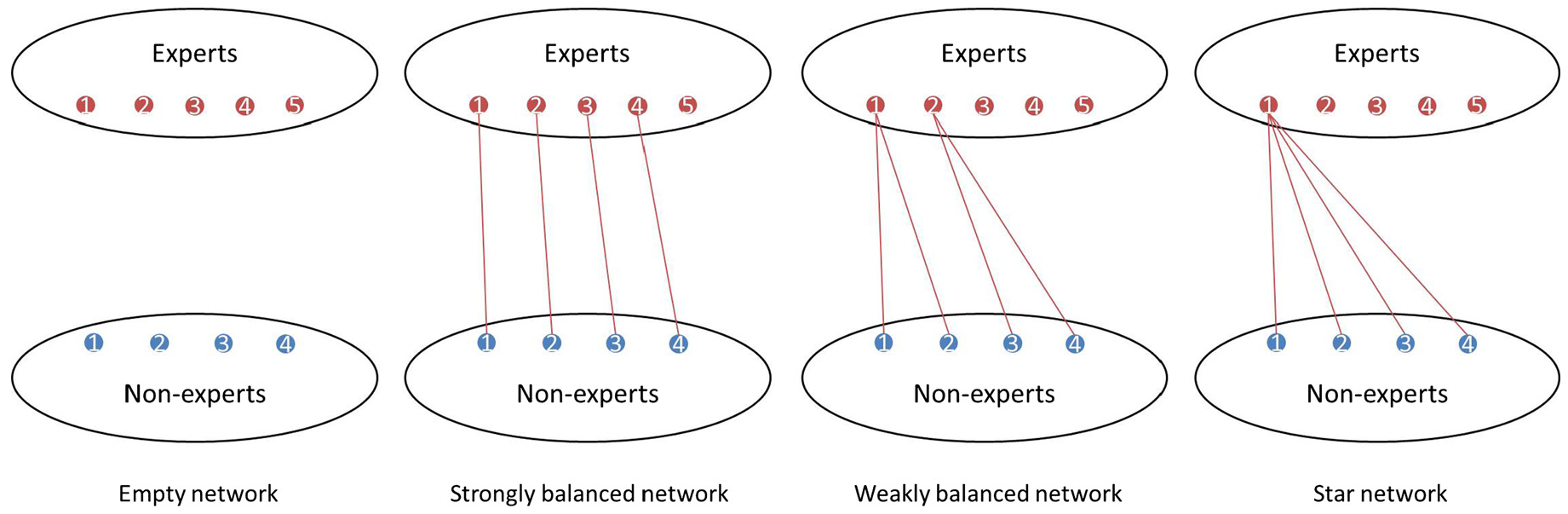 Figure: The four experimental treatments: Empty, Strongly Balanced, Weakly Balanced, and the Star network.
The "Curse" in the Laboratory
The researchers didn't just stay in the realm of theory. They ran experiments with 189 subjects to see how real people handle being "cursed."
Key Findings:
- The Swing Voter’s Curse is Real: In Star networks, followers realize—at least partially—that if their vote is "pivotal," it likely means the sender was wrong. Because if the sender were right, the rest of the experts would have voted with them, making any single follower’s vote irrelevant.
- Selection Bias for Inefficiency: Even though the Star network makes "sincere" voting irrational, many humans still do it. Over 50% of non-experts followed recommendations even when it led to suboptimal group payoffs.
- The "Empty" Advantage: Groups often performed better when they weren't allowed to talk at all (the Empty network) than when they were stuck in an unbalanced Star network.
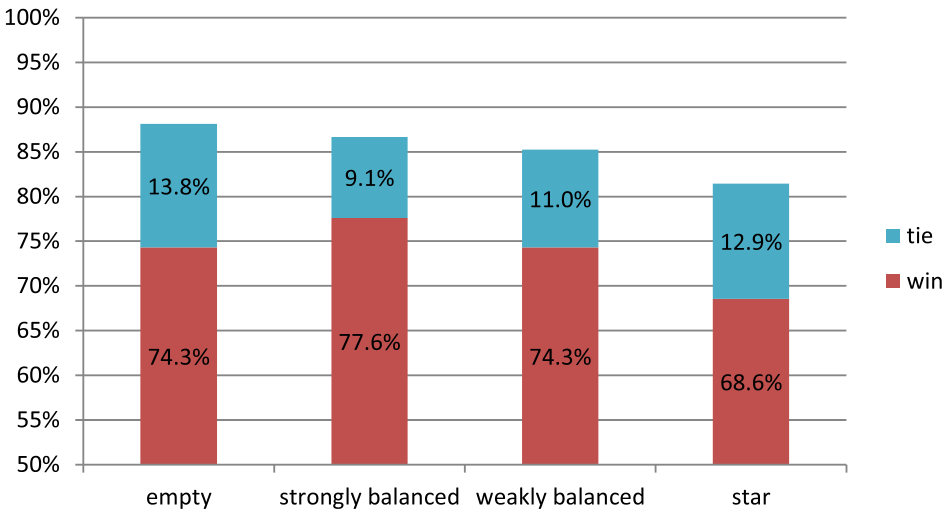 Figure: Informational Efficiency across treatments. The Star network consistently shows the lowest efficiency.
Critical Insight: Why Does Communication Fail?
The failure isn't due to "fake news" or lying (the authors assumed everyone has common interests). The failure is purely topological. When a network is "Unbalanced," the strategic logic of voting breaks down. Bayesian voters should ignore influencers in star-like structures to avoid the curse, but "sincere" communication is a powerful psychological attractor that leads groups into inefficient traps.
Conclusion: Designing Better Networks
This work has profound implications for how we design digital forums and corporate voting structures. If we want better decisions, we must either:
- Ensure influence is tied strictly to expertise.
- Encourage "Let the Experts Decide" behaviors (strategic abstention).
- Recognize that in highly centralized networks, silence (The Empty Network) can actually be more "intelligent" than a conversation dominated by a few voices.