
SWTrust: Bridging the Gap Between Massive Social Networks and Reliable Trust Evaluation
SWTrust: Generating Trusted Graph for Trust Evaluation in Online Social Networks
This paper introduces SWTrust, a framework designed to generate high-quality trusted graphs from large-scale online social networks (OSNs). It leverages a novel Preprocessing Social Network (PSN) algorithm based on small-world theories and distributed path discovery to bridge the gap between massive social graphs and efficient trust evaluation.
TL;DR
Online Social Networks (OSNs) are too large for traditional trust algorithms. SWTrust solves this by using a novel preprocessing algorithm (PSN) that identifies the most "relevant" neighbors based on topic and social distance. It slashes computation time by nearly 80% while preserving high trust-prediction accuracy, effectively finding "short-cuts" in the small-world fabric of social data.
Problem & Motivation: The Scalability Wall
If Alice wants to know if Bob is a good PhD tutor, she might ask her friends. In a digital OSN, Alice might have hundreds of friends, who each have hundreds of their own. Traditional Breadth-First Search (BFS) for a trusted path quickly hits an exponential growth wall.
Current SOTA methods often set a "max-hop" limit (like 6 degrees of separation), but they don't solve the "branching factor" problem—which friend should Alice prioritize asking first? Prior work often treated all connections equally or relied on global metrics that ignore the specific context (topic) of the trust request.
Methodology: Intelligent Social Pruning
The core innovation of SWTrust is the PSN (Preprocessing Social Network) algorithm. It moves away from "blind" search by simulating how humans actually seek advice: we ask people who know about the subject (Topic-related) or who know the person in question (Target-related).
1. The Small-World Intuition
The authors categorize neighbors into three tiers based on Social Distance (derived from overlapping interest domains):
- Category 1 (Local): Intimate connections with high domain overlap.
- Category 2 (Longer Contact): Moderate overlap; potential "bridges" to other communities.
- Category 3 (Longest Contact): Minimal overlap; these are the "weak ties" that provide the short-cuts characteristic of small-world networks.
2. Priority Scoring
A neighbor's priority is calculated using a weighted formula of their relevance to the specific topic and the target user.
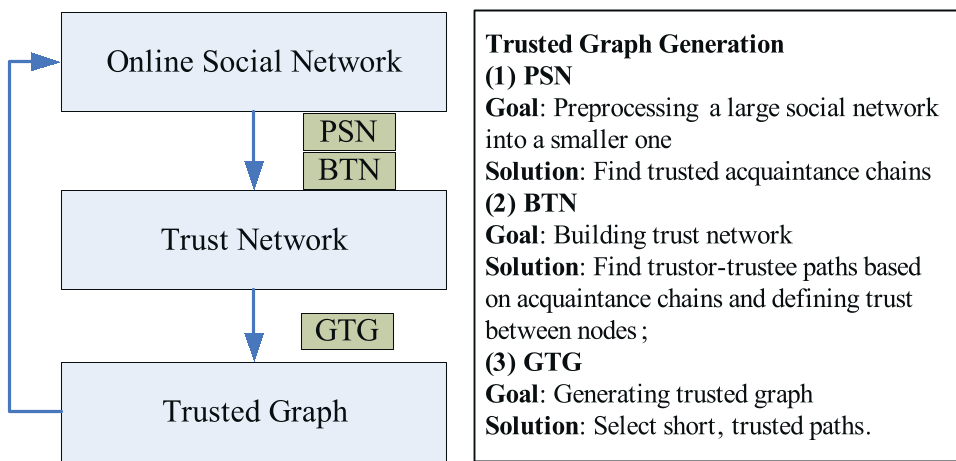 Fig 2: The SWTrust Architecture showing the flow from PSN to Trusted Graph generation.
3. Distributed Discovery (DBFS & DGTG)
Instead of a heavy centralized server, SWTrust uses distributed algorithms:
- DBFS: A distributed BFS that selects next-hop neighbors based on the PSN priority.
- DGTG: A "Trusted Graph" generator that applies a trust threshold () to prune unreliable paths, ensuring only high-quality chains remain.
Experiments & Results
The authors validated SWTrust using the Epinions.com dataset (3,168 nodes, ~52k edges).
Efficiency Gains
By limiting the number of next-hop neighbors () using PSN, the system becomes significantly faster. Reducing from "all" to 3 dropped the average search time from 3.55s to 0.74s. Interestingly, "coverage" (the ability to find a path) stayed relatively stable, proving that PSN picks the right neighbors.
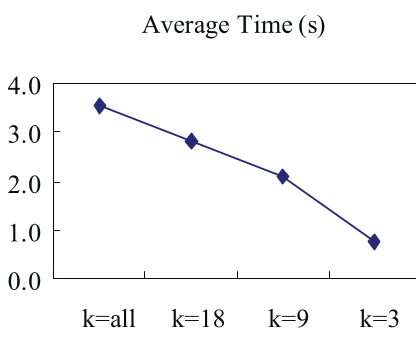 Fig 6: Impact of PSN on computing time—notice the dramatic drop as neighbor selection is optimized.
Predictability & Accuracy
Even with a pruned graph, the accuracy remains high. Using metrics like Precision, Recall, and Fscore, the framework achieved results around 0.80. The authors tested this against "Malicious Behavior" (collusive and non-collusive attackers) and found the framework robust, especially when using the "Wave" aggregation function for final trust calculation.
Critical Analysis & Conclusion
Takeaway: SWTrust successfully demonstrates that semantic context (domains and topics) serves as a powerful heuristic for navigating social graphs. By mimicking the "small-world" search behavior of humans, it avoids the "big data" trap of exhaustive search.
Limitations:
- Domain Definition: The paper assumes domains are static and easily extracted from site structures. In modern, fluid social media (like X or Reddit), defining these "active domains" programmatically is more complex.
- Functional Trust: The paper focuses on finding paths rather than calculating the initial weights between users, leaving the initial trust mining to future work.
Future Outlook: This architecture paves the way for privacy-preserving, decentralized trust protocols where individual devices can verify credentials through "trusted acquaintance chains" without ever needing a full map of the global network.