
Sybil Defenses: Leveraging Social Trust to Secure Open Systems
Sybil defenses via social networks: a tutorial and survey
This paper provides a comprehensive tutorial and survey on Sybil defenses that leverage social network structures. It primarily highlights SybilLimit, a decentralized protocol that achieves near-optimal bounds on the number of accepted fake identities by utilizing the structural bottlenecks (attack edges) between honest and malicious nodes.
TL;DR
A Sybil attack occurs when a single malicious entity creates multiple fake identities to dominate a distributed system. This survey explores how the intrinsic structure of Social Networks—specifically the sparse connectivity between honest people and attackers—can be used to bound these fake identities. We focus on SybilLimit, a protocol that uses random walks to ensure that even an attacker with millions of fake accounts can only compromise a tiny fraction of the system.
The Core Dilemma: When Identities Are Free
The foundational problem in distributed computing is that protocols (like BFT or voting) rely on the assumption that "at least 2/3 of nodes are honest." In an open-access system (like P2P networks or Reddit), if identities are free to create, an attacker can simply create nodes and instantly control the outcome.
While CAPTCHAs and IP filters provide some friction, they are essentially "economic" defenses that fail against well-funded adversaries. The insight of this paper is that Trust is a limited resource. An attacker can create a million fake accounts, but they can only convince a few real humans to "friend" them.
Methodology: The Geometry of Trust
The defense relies on the topological difference between an "Honest Region" and a "Sybil Region."
- Fast Mixing: In a healthy social network, a random walk quickly reaches a stationary distribution (it "mixes" fast).
- Attack Edges: The connection between honest users and attackers is a bottleneck. Since an attack edge requires a real-world relationship, the number of these edges () is small and independent of how many Sybil nodes the attacker creates.
- The Cut: This bottleneck creates a "sparse cut." Random walks starting in the honest region are statistically unlikely to cross these few attack edges and enter the Sybil "wilderness."
Architecture of SybilLimit
SybilLimit improves upon its predecessor, SybilGuard, by using an "intersection trick" with random walk tails.
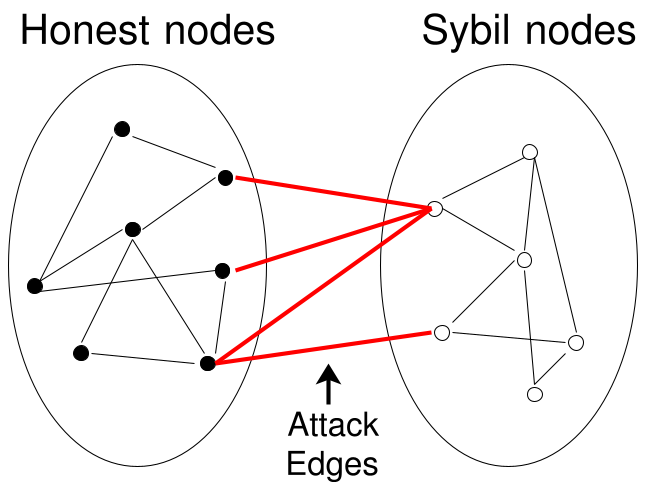
- Nodes and both perform multiple random walks.
- If they are both honest, their walk "tails" (the last edges reached) are likely to intersect because the honest region is well-connected.
- To prevent attackers from faking tails, SybilLimit uses Random Routes (unique per-node routing tables) which force Sybil-initiated walks to merge and stay limited within the honest region's quotas.
Experimental Performance
The survey compares several major protocols, including SybilLimit, SybilInfer, and Gatekeeper.
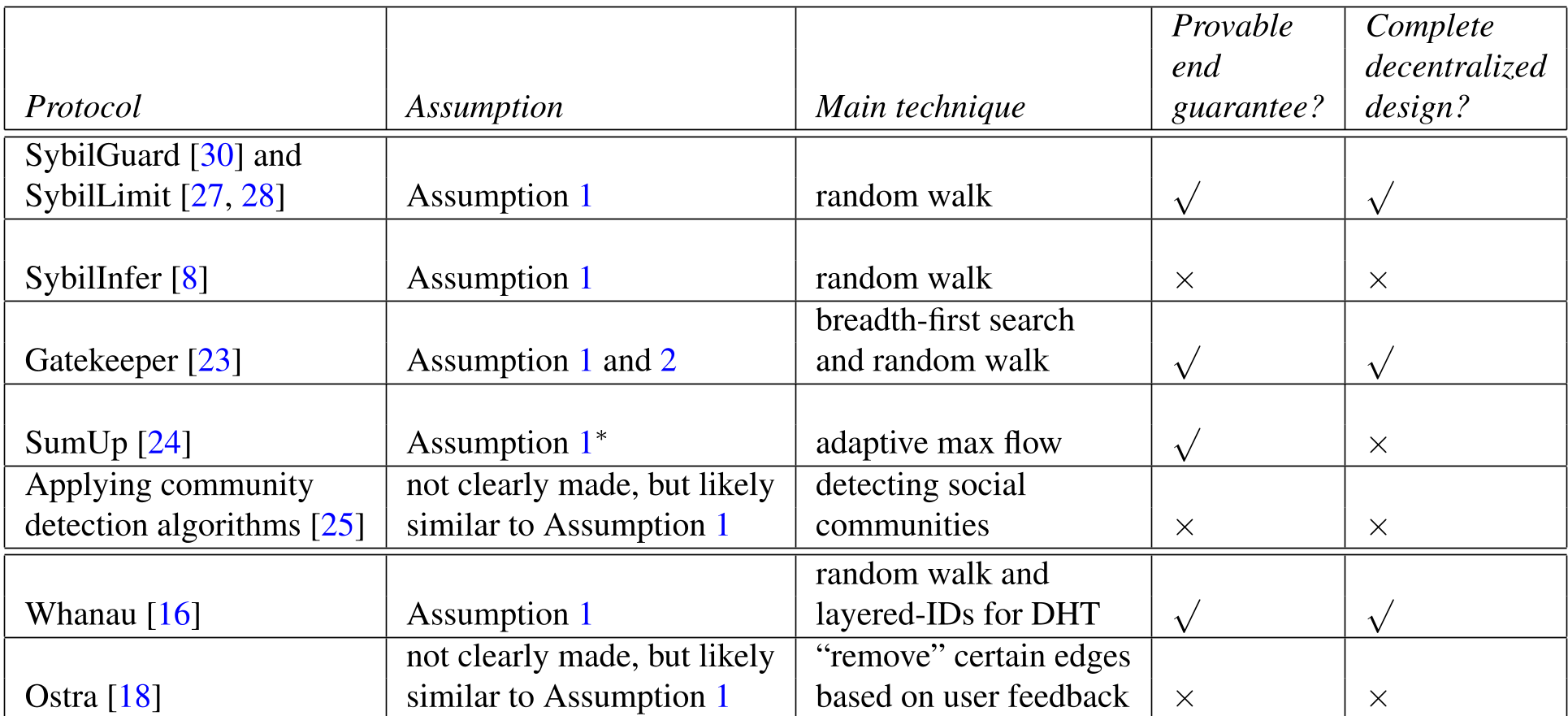
Key Benchmarks:
- Scalability: SybilLimit works on networks with nodes.
- Bound: It limits the attacker to just identities per attack edge.
- False Positives: Approximately 5% of honest nodes might be mislabeled as Sybil nodes if they are "poorly connected" (low-degree nodes), but they can still function by inheriting labels from their more connected neighbors.
Critical Analysis: Is "Mixing Time" a Fair Assumption?
The biggest academic debate in this field revolves around Assumption 1: Do real social networks actually have small mixing times?
Recent studies suggest that social networks are not perfectly uniform; they contain "whiskers" (small, poorly connected groups) and "communities." If a network doesn't mix fast, the random walks must be longer, which increases the number of "leaked" Sybil identities.
Moreover, what constitutes an "edge"? In the era of Social Media Bots, "following" someone is not a sign of trust. For these defenses to work in production, we need Strong Trust Edges—authenticated relationships where a real-world bond exists.
Conclusion
Sybil defense via social networks remains the most mathematically sound way to secure decentralized systems without recurring to centralized identity providers (like government IDs). While the "Mixing Time" assumption is sensitive to graph topology, the principle of limiting the quotient of attack cuts provides a near-optimal framework for future "Web3" and P2P security architectures.
Future Work: The next frontier is Trust Inference, where we automatically determine the "strength" of an edge based on interaction frequency (chats, video calls) to filter out the "weak" edges often exploited in automated social engineering.