
SybilSCAR: Unifying Random Walks and Belief Propagation for Robust Sybil Detection
SybilSCAR: Sybil detection in online social networks via local rule based propagation
This paper introduces SybilSCAR, a novel structure-based Sybil detection method for online social networks that unifies Random Walk (RW) and Loopy Belief Propagation (LBP) approaches. By designing a linearized "local rule," SybilSCAR achieves state-of-the-art accuracy, scalability, and guaranteed convergence on large-scale social graphs.
TL;DR
SybilSCAR is a breakthrough framework in social network security that solves a long-standing dilemma: How do you build a Sybil detection system that is both robust to noisy labels (LBP's strength) and scalable to hundreds of millions of users (RW's strength)? By linearizing the local update rules of Belief Propagation, the authors created an algorithm that is faster, more accurate, and mathematically guaranteed to converge.
Background & Motivation: The Structural Dilemma
In the battle against fake accounts (Sybils), defenders rely on the Homophily Assumption: the idea that benign users rarely link to Sybils. However, the two primary structural detection families have hit a plateau:
- Random Walk (RW) Methods: Efficient but "blind" to labeled Sybil examples and fragile if even 10% of your training labels are wrong.
- Loopy Belief Propagation (LBP) Methods: Robust and "smart" enough to use all data but computationally "heavy"—they require storing messages on every edge, leading to massive memory overhead and oscillation (failure to converge) on real-world graphs.
The authors discovered that both are essentially just different "local rules" for moving information across a graph. SybilSCAR was born from the insight that we can combine the multiplicative logic of LBP with the linear efficiency of RW.
Methodology: The Power of Linearized Local Rules
At its heart, SybilSCAR introduces a new local rule that models "Neighbor Influence." Instead of raw probabilities, it works with Residual Variables ().
1. Modeling Influence
The influence of a neighbor on user is defined as , where represents homophily strength. This captures the intuition that if is likely a Sybil and the edge is strong, is also likely a Sybil.
2. Linearization for Scalability
While LBP uses complex products, SybilSCAR uses a first-order approximation () to turn these products into sums. This yields a beautiful, simple matrix form:
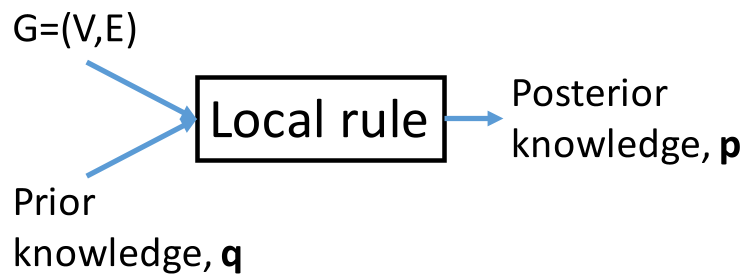 Fig 1: The unification framework showing how different local rules lead to different detection paradigms.
Scalability and Convergence
One of the major contributions of this work is the Convergence Theorem. The authors proved that SybilSCAR converges if the homophily strength is bounded by the spectral radius of the adjacency matrix . This provides a rigorous engineering guideline that LBP-based methods lack.
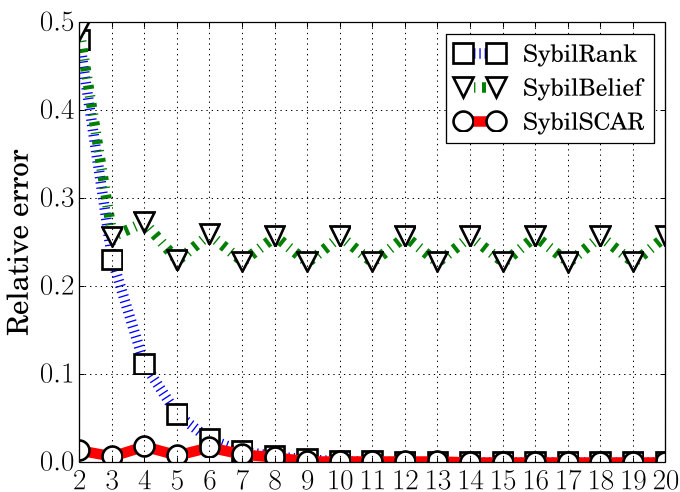 Fig 2: Time scalability comparison. SybilSCAR maintains the efficiency of Random Walks while providing much higher accuracy.
Experimental Validation
The authors tested SybilSCAR against SybilRank (State-of-the-art RW) and SybilBelief (State-of-the-art LBP) across three massive datasets, including a 21-million-node Twitter graph.
- Accuracy: SybilSCAR outperformed SybilRank significantly on noisy real-world data (AUC 0.82 vs 0.69).
- Robustness: When 20-30% of labels were intentionally flipped to "noisy," SybilRank's performance collapsed to random guessing. SybilSCAR remained stable, proving its resilience to adversarial noise or human manual-labeling errors.
- Efficiency: In terms of memory and runtime, SybilSCAR matched the lightweight footprint of SybilRank, being orders of magnitude faster than the cumbersome SybilBelief.
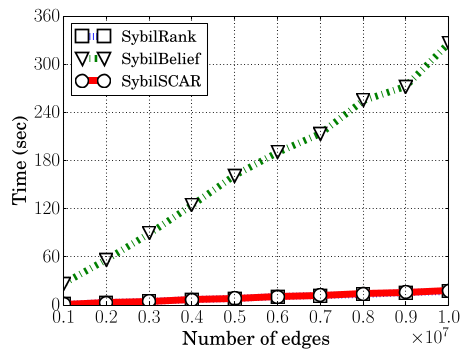 Fig 3: AUC performance vs. Label Noise. Notice how SybilSCAR (solid line) persists while SybilRank (dotted) degrades rapidly.
Critical Insight & Conclusion
SybilSCAR proves that we don't need to sacrifice mathematical rigor for scalability. By reframing graph propagation as a local rule application, the authors bridge the gap between probabilistic graphical models and linear algebra.
Future Outlook: The next frontier for SybilSCAR is "adaptive homophily"—automatically learning which edges represent trust and which are compromised, further hardening social networks against increasingly sophisticated botnets.