
Sybil SAN: Decoding Fake Accounts via Social-Activity Hyper-Graphs
Sybil Detection in Social-Activity Networks: Modeling, Algorithms and Evaluations
The paper introduces Sybil SAN, a novel sybil detection framework that integrates user friendships and social activities into a two-layer hyper-graph. By coupling three random walk-based algorithms, it achieves a significant performance leap, improving AUC by at least 17.7% over state-of-the-art methods on real-world datasets.
TL;DR
Researchers from the Chinese University of Hong Kong have developed Sybil SAN, a system that dismantles the "limited-attack-edge" assumption. By treating social interactions (retweets, mentions) as a separate, more reliable layer than friendships, and using a coupled random walk algorithm, they have increased detection accuracy by over 17% in real-world Twitter scenarios.
The Death of the "Limited-Attack-Edge" Assumption
For over a decade, the gold standard for sybil detection was based on a simple premise: Sybils are outsiders. If an honest user doesn't know you, they won't friend you. This created a "bottleneck" in the graph that algorithms like SybilRank could easily identify.
However, the reality of 2024+ OSNs is different. Social bots have become masters of psychological manipulation, achieving friend-request acceptance rates of up to 80% on Facebook and 26% on RenRen. When the "bottleneck" disappears, the graph becomes a giant hairball, and traditional algorithms lose their ability to distinguish between a "well-connected" sybil and a popular honest user.
Methodology: The Social and Activity Network (SAN)
The core insight of the paper is that while it is easy to trick someone into a "Follow" or "Friendship," it is much harder to lure them into a meaningful Interaction (replying to a post or retweeting).
The authors construct a two-layer hyper-graph:
- Layer 1 (Friendship): The standard social graph.
- Layer 2 (Activity): A complex web of tweets, creators, and mentions.
The Coupled Random Walk
Instead of a simple walk on a friendship graph, Sybil SAN uses three coupled transition matrices:
- Friendship Walk: Standard exploration/exploitation of known seeds.
- Activity-Following Walk: Trust flows from a retweet back to the original content.
- User-Activity Mapping: Connects users to the content they produce or are mentioned in.
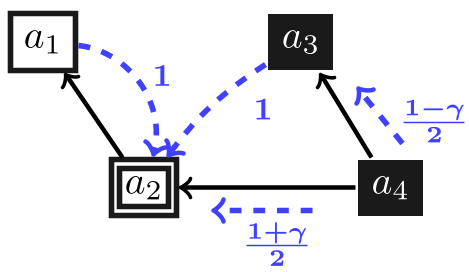 Figure: The decomposition of the SAN into friendship, activity-following, and user-activity mapping graphs.
Why Sybil SAN Wins: The Source Normalization
A major pitfall in activity-based detection is that inactive honest users look like sybils—they don't interact much. Sybil SAN solves this by normalizing trust scores based on the "number of sources" (). This ensures that a user isn't penalized for being quiet, but is instead evaluated based on the quality of the few connections they do have.
Experimental Battleground
The researchers tested Sybil SAN against industry heavyweights like SybilRank and SybilScar.
Key Findings:
- Robustness to "Friendship Attacks": As the number of attack edges () increases, traditional methods' AUC (Area Under Curve) collapses toward 0.5 (random guessing). Sybil SAN stays remarkably steady above 0.8.
- Real-World Performance: On a massive Twitter crawl (450k users), Sybil SAN achieved an AUC of 0.73.
 Table: Sybil SAN outperforms all baselines on real data, with an "improved ratio" as high as 386% over belief-propagation methods like SScar.
Critical Insight & Conclusion
The mathematical convergence proof provided in the paper (using Markov Chain Mixing Time) guarantees that the iterative algorithm will actually settle on a stable trust score, making it viable for large-scale production environments.
Takeaway: The "Friendship Graph" is compromised. To protect the integrity of social platforms, we must look deeper into the activity manifold. Sybil SAN provides the mathematical and algorithmic framework to do exactly that, proving that even as bots get "friendlier," their lack of genuine social interaction remains their Achilles' heel.
Limitations: The system still relies on a small set of "trusted seeds." If the initial seed set is compromised or biased, the trust propagation could theoretically be subverted, though the authors' sensitivity analysis using Matrix Perturbation Theory suggests a high degree of resilience.