
Sybil SAN: Rethinking Fake Account Detection via Interaction Dynamics
Sybil Detection in Social-Activity Networks: Modeling, Algorithms and Evaluations
This paper introduces Sybil SAN, a novel framework for detecting fake accounts (sybils) by unifying social friendships and user activities into a two-layer hyper-graph. It utilizes a coupled random walk mechanism to achieve State-of-the-Art (SOTA) performance, improving detection accuracy (AUC) by at least 17.7% over existing graph-based methods on real-world datasets.
TL;DR
The classic "limited-attack-edges" assumption is dead. Modern sybils are social engineers that can embed themselves deep into friendship graphs. Sybil SAN solves this by moving beyond the friendship graph, integrating a two-layer hyper-graph of user activities. By coupling three distinct random walks, it achieves an AUC of 0.73 on real-world datasets, surpassing traditional SOTA methods by nearly 20% in accuracy and order of magnitude in robustness.
Problem & Motivation: The Collapse of the Friendship Bottleneck
For over a decade, the academic community relied on a simple premise: a "bottleneck" exists between honest users and sybils. If you can find the sparse cut in the graph, you find the fakes.
However, as the authors note, in networks like Facebook and Twitter, social bots achieve acceptance rates of up to 80%. When sybils are "well-connected," structural detection algorithms like SybilRank and SybilGuard treat them as honest users. The author's key insight (Motivation) is that while an honest user might accept a random friend request out of politeness (Friendship Attack), they are far more discriminating about who they actually retweet or mention (Activity Attack). Interaction requires cognitive effort and genuine interest, making it the "gold standard" for trust.
Methodology: The Social and Activity Network (SAN)
The core of the paper is the construction of a Social and Activity Network (SAN). This isn't just a simple weighted graph; it's a multi-layer structure:
- Layer 1 (Friendship): Traditional undirected edges.
- Layer 2 (Activity): A complex mapping of activity nodes (tweets/posts) and users, capturing creator-activity, mention, and following (retweet/reply) relationships.
The Coupled Random Walk
Instead of a single walk, Sybil SAN "couples" three transitions:
- Walk on Friendship Graph: Explores social connections.
- Walk on Activity-Following Graph: Propagates trust when one tweet "follows" another.
- Walk on User-Activity Mapping: Connects users to the content they generate, creating a mutual reinforcement loop (trusted users create trusted activities, which certify the users back).
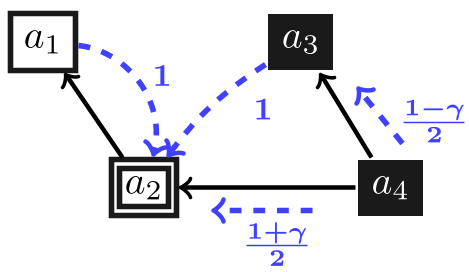 Above: The decomposition of the SAN into friendship, following, and mapping subgraphs.
Mathematically, the convergence is guaranteed through a unified transition matrix : This formula ensures that the trust score "settles" into a unique stationary distribution, allowing for stable ranking.
Experiments & Results
The authors tested the model against five SOTA algorithms (SR-U, SR-W, Inter, SScar, SWalk).
1. Robustness to "Friendship Attacks"
As the number of attack edges () increases, traditional methods collapse. Sybil SAN maintains an AUC above 0.8 even when sybils are heavily befriended by honest users.
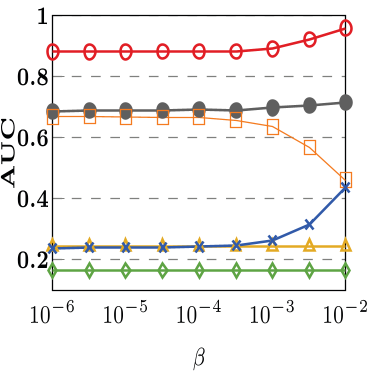 Note how Sybil SAN (top line) remains nearly flat while SybilRank and others plummet.
2. Real-World Validation
Using a crawled Twitter dataset of 450,000 users, the results were definitive. Most graph-based methods hovered around an AUC of 0.5 (no better than a coin flip), while Sybil SAN reached 0.73. This confirms that "naively" adding activities (like just weighting edges) isn't enough; the architectural coupling of the hyper-graph is the secret sauce.
Critical Analysis & Conclusion
Takeaway
Sybil SAN proves that heterogeneity is the enemy of sybils. By forcing an attacker to mimic not just a network structure but a complex web of time-stamped, content-driven interactions, the "cost" of a sybil attack becomes prohibitively high.
Limitations
The model assumes a "small set of known honest seeds." In highly polarized environments (like political Twitter), the choice of seeds could introduce bias. Furthermore, the iterative algorithm, while efficient, still requires significant memory to store the activity hyper-graph, which grows faster than the friendship graph.
Future Outlook
This work sets the stage for a new generation of "Zero-Trust" social architectures where your influence isn't dictated by the followers you have, but the meaningful interactions you generate.