
SybilLimit: Pushing Social Network Defense to its Theoretical Limit
SybilLimit: A Near-Optimal Social Network Defense Against Sybil Attacks
This paper introduces SybilLimit, a decentralized protocol leveraging social network trust relationships to defend against Sybil attacks. By utilizing multiple short random routes and a novel balance condition, it bounds accepted Sybil nodes to O(log n) per attack edge, achieving a near-optimal security guarantee.
TL;DR
SybilLimit is a breakthrough decentralized protocol designed to stop malicious users from flooding systems with fake identities (Sybil attacks). By leveraging the "fast-mixing" property of real-world social networks, it bounds the number of fake nodes to a near-optimal O(log n) per attack edge. In practical terms, it is 200 times more effective than its predecessor, SybilGuard, making it nearly impossible for an attacker to subvert a million-node network without establishing tens of thousands of real-world trust relationships.
Problem & Motivation: The Sybil Vulnerability
In open-access distributed systems like P2P networks or decentralized voting, "one-hop, one-vote" is easily exploited. An adversary can generate thousands of identities from a single computer to hijack consensus.
Existing defenses like CAPTCHAs or IP-limiting are easily bypassed by botnets or sophisticated attackers. The authors identified a structural truth: while an attacker can create infinite virtual nodes, they have a limited number of real trust relationships with honest people. These are the "Atack Edges."
The predecessor, SybilGuard, used long random walks to detect these edges, but it was inefficient. It allowed roughly 2000 Sybil nodes for every one real-world connection the attacker made. SybilLimit was designed to close this gap by order of magnitude.
Methodology: Short Walks and Balanced Loads
The core of SybilLimit rests on two innovative mechanisms that diverge from the "one-long-walk" approach.
1. Secure Random Routes (The O(log n) Shift)
Instead of one walk of length , SybilLimit uses multiple independent instances of much shorter walks (length ).
- Insight: Shorter walks are less likely to "escape" into the Sybil region.
- Edge Intersection: By performing intersections on edges (tails) rather than nodes, the protocol utilizes the uniform stationary distribution of edges, making the "Birthday Paradox" logic much tighter and more secure.
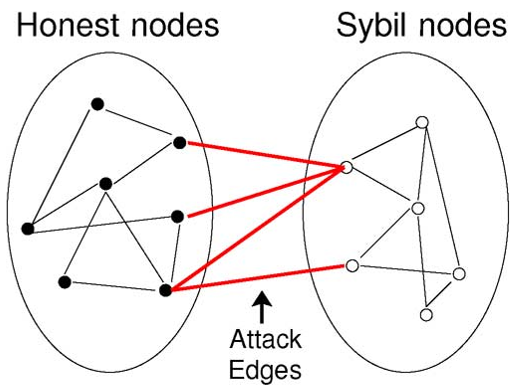 Fig 1: The Social Network Graph split into the Honest Region and the Sybil Region, connected by sparse Attack Edges.
2. The Balance Condition
The "Balance Condition" is SybilLimit's secret weapon. It prevents the adversary from cramming thousands of Sybil identities through a single "escaping" route. Every verifier monitors the "load" of its search tails. If a specific tail is being used to validate an unusual number of suspects, the protocol flags a "load spike" and rejects further nodes from that path.
Experiments & Results: Validating the Real World
One of the most significant contributions of this paper is the empirical validation of the Fast-Mixing Assumption. Critics once argued that real-world social networks, with their tight-knit communities, wouldn't mix fast enough for these protocols to work.
The authors tested SybilLimit against massive crawls of Friendster, LiveJournal, and DBLP.
- Fast-Mixing Confirmed: Even with communities, these networks mix well within 10-20 hops.
- Performance: In a million-node Kleinberg graph, SybilLimit reduced the "Sybil gain" from 1906 nodes per attack edge down to just 10.
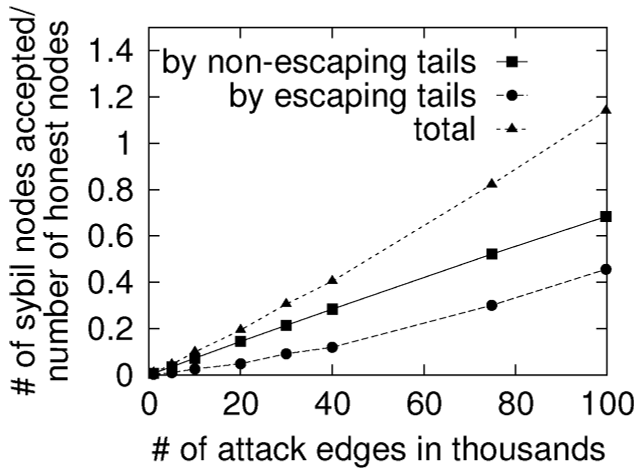 Fig 2: Results on the Friendster dataset showing the linear growth of Sybil acceptance vs. attack edges, maintaining a tight bound.
Deep Insight: Why it Works
SybilLimit works because it treats the Sybil defense problem as a graph expansion problem. In a fast-mixing graph, a random walk quickly disperses into the sea of nodes. However, the Sybil region is a "dead end" connected only by thin Attack Edges. By using shorter, multiple walks and enforcing a balanced load, SybilLimit ensures that the "entrance" to the Sybil region is so narrow that the adversary simply cannot push enough fake identities through it to matter.
Conclusion & Future Outlook
SybilLimit pushes decentralized identity to its theoretical limit. While it requires the overhead of maintaining social trust data, its near-optimal guarantees provide a blueprint for truly sybil-resilient systems. As we move toward more decentralized governance in Web3 and DAO structures, the lessons of SybilLimit—leveraging real-world human trust to secure digital systems—remain more relevant than ever.
Limitations: The protocol assumes nodes are somewhat online to verify paths and that the social network is relatively static. Future work could look at making these "Random Routes" even more lightweight for mobile-first environments.