
SybilRadar: Navigating Weak-Trust Social Networks with Graph-Based Intelligence
SybilRadar: A Graph-Structure Based Framework for Sybil Detection in On-line Social Networks
This paper introduces SybilRadar, a graph-structure-based framework for identifying Sybil accounts in Online Social Networks (OSNs). Unlike traditional methods that rely on "fast-mixing" and low "attack edge" count assumptions, SybilRadar uses structural similarity metrics and community detection to assign edge weights, achieving high detection accuracy (AUC > 0.95) even in weak-trust environments with tens of thousands of attack edges.
TL;DR
SybilRadar is a robust Sybil detection framework that moves beyond the idealistic assumptions of early "structure-based" defenses. By integrating community-aware similarity metrics (Adamic-Adar and WIC) into a weighted random walk process, it effectively isolates fake accounts in Online Social Networks (OSNs) even when they are heavily integrated with honest users. It maintains an AUC > 0.95 on real-world Twitter data, significantly outperforming classical baselines like SybilRank.
Problem & Motivation: The Collapse of "Fast-Mixing" Assumptions
The fundamental weapon for defending OSNs has long been the "Social Graph." Historically, researchers assumed that if you viewed a social network as a graph, honest users would form a "fast-mixing" cluster, and Sybils (fake accounts) would remain trapped in a separate, isolated region with only a few "attack edges" connecting them to real people.
However, modern adversaries are sophisticated. They buy "fake followers," participate in link farming, and use social engineering to trick real users into connecting with them. This results in:
- Weak-Trust Environments: The graph is no longer fast-mixing; the "bottleneck" (cut) between honest and Sybil regions disappears.
- Edge Flooding: Attackers create tens of thousands of attack edges, allowing "trust" to leak from honest seeds into the Sybil community, rendering ranking algorithms like SybilRank ineffective.
Methodology: Weighting the Path to Trust
The core intuition behind SybilRadar is that while Sybils can create edges, they struggle to replicate the organic structural similarity of real human communities.
1. The Multi-Stage Similarity Engine
Instead of treating all edges equally, SybilRadar calculates a weight for each edge based on two key metrics:
- Adamic-Adar Metric: This looks at common friends. The intuition is that two honest friends are likely to share "unique" mutual friends who aren't globally popular.
- Within-Inter-Community (WIC) Metric: Using the Louvain Method for community detection, SybilRadar analyzes whether common neighbors belong to the same community. Sybil-to-Honest connections (attack edges) rarely exhibit the same community cohesion as genuine friendships.
2. Weighted Trust Propagation
SybilRadar runs a modified Short Random Walk. Unlike standard walks where trust is distributed equally among neighbors, SybilRadar distributes trust proportionally to the edge weights.

By terminating the walk early ( steps) and normalizing by node degree, the system ensures that trust remains concentrated in the honest region, even when thousands of attack edges exist.
Experiments & Results: Resilience Under Fire
The authors tested SybilRadar against a synthetic network and a massive Twitter dataset (over 1.8 million edges).
Key Findings:
- Resilience to Scaling: As attack edges increased from 1,000 to 10,000, SybilRank’s AUC plummeted to 0.6 (nearly random), while SybilRadar stayed strong at 0.90+.
- Real-World Performance: On the Twitter dataset, which includes bidirectional relationships and verified fake accounts, SybilRadar achieved a near-perfect AUC of 0.95.
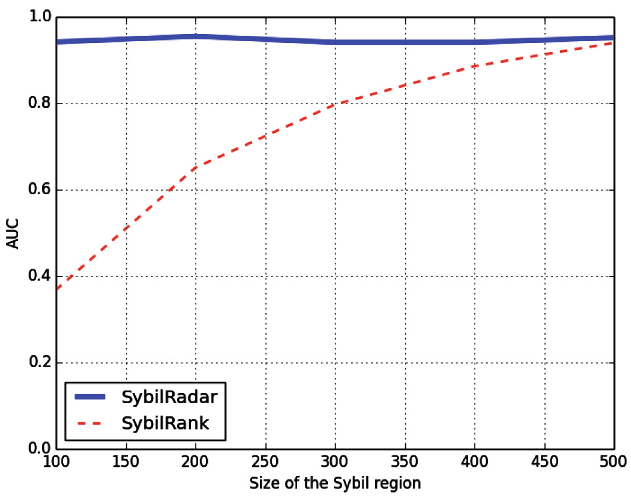 (Note: Figure 1a demonstrates the dramatic performance gap between SybilRadar and SybilRank as the number of attack edges increases.)
Critical Analysis & Conclusion
Takeaway
SybilRadar proves that the "structure-only" approach is still viable if we move from global properties (like mixing time) to local/mesoscopic properties (like community similarity). It provides a privacy-preserving alternative to "content-based" detection, as it doesn't need to read a user's private messages or profile data—it only needs to see who is talking to whom.
Limitations & Future Work
- Computation Speed: The two-stage similarity calculation and community detection add overhead compared to simple random walks.
- Temporal Evasion: Future adversaries might evolve their behavior over time. The authors suggest that adding a "temporal dimension"—analyzing how graph properties change week-over-week—is the next frontier for SybilRadar.
Ultimately, SybilRadar provides OSN administrators with a high-precision tool to protect their platforms without compromising user privacy.