
SybilVote: Quantifying the Inevitable Risk of Fake Identities in Social Voting
SybilVote: Formulas to Quantify the Success Probability of Sybil Attack in Online Social Network Voting
The paper introduces "SybilVote," a mathematical framework comprising exact and approximate closed-form formulas to quantify the success probability of Sybil attacks in Online Social Network (OSN) majority voting. It models voting behavior using multinomial distributions and provides a high-efficiency normal approximation for large-scale systems.
TL;DR
Online voting systems are notoriously easy to manipulate through "Sybil Attacks"—where one attacker creates thousands of fake accounts. This paper presents SybilVote, the first rigorous mathematical framework to calculate exactly how many fake accounts are needed to hijack a vote. It proves that even a small fraction of "Sybil" users can achieve nearly 100% success in swaying public opinion.
Background: Why Voting Isn't Safe
In Online Social Networks (OSNs), "majority wins" is the standard for everything from product ratings to community governance. However, the cost of creating fake accounts (Sybils) is often lower than the value of the influence gained. Previous research focused on detecting these bots, but until now, we lacked a precise way to measure the probability of their success before the damage is done.
The Mathematical Intuition: Winning the Tail
The core challenge in quantifying a Sybil attack is the Multinomial Maximum problem. If you have real users voting on choices, the distribution of their votes follows a multinomial pattern. For an attacker to win, their concentrated votes () plus any organic votes they receive () must exceed the maximum votes received by any other legitimate choice.
1. The Exact Approach
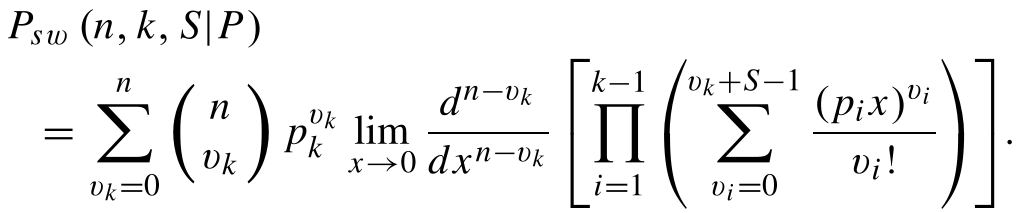
The authors use a sophisticated generating function approach. By defining the winning condition as a set of inequalities and translating them into polynomial coefficients, they arrived at a closed-form solution:
2. The Normal Approximation
For systems with thousands of users, calculating derivatives becomes computationally expensive (). The authors introduce a Normal Approximation based on the Central Limit Theorem. As grows, the difference between vote counts approaches a Gaussian distribution, simplifying the probability calculation to a standard CDF , which runs in time.
Critical Findings: The "Dilution" Paradox
The paper reveals a counter-intuitive behavior regarding the number of choices ():
- In small systems: Adding more choices can reduce attack success because it increases the statistical "noise," making it harder for a small Sybil block to guarantee a win.
- In large systems: Adding more choices increases attack success. Why? Because the legitimate votes are spread thin across many options (dilution), allowing a concentrated Sybil block to dominate with a lower total headcount.
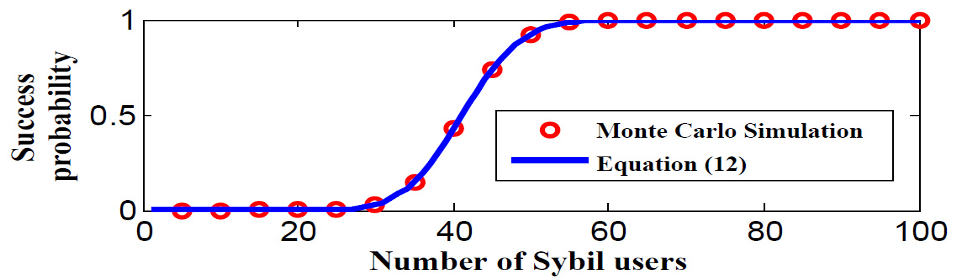 Fig 1: The exact formula matches 1 million Monte-Carlo simulations perfectly, proving its reliability over previous estimations.
The "25% Rule"
Perhaps the most alarming takeaway is the Sybil Ratio. The study shows that if an attacker controls just 25% of the total user base (a Sybil ratio of 0.25), the probability of them winning a majority vote in a population of 100 real users is practically 99%.
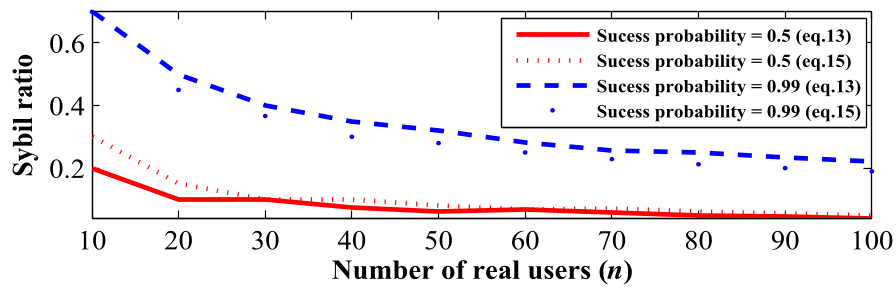 Fig 6: As the number of real users increases, the percentage of Sybils required to successfully attack the system stays surprisingly low.
Conclusion and Practical Implications
SybilVote provides the "breaking point" analysis for platform designers. The implications are clear:
- Don't rely on raw numbers: In multi-choice systems, legitimate votes dilute faster than concentrated attack votes.
- Threshold Setting: Platforms can use these formulas to set "confidence intervals" for polls. If the calculated success probability of a small Sybil group is too high, the platform may require stronger ID verification (e.g., PoP or KYC).
While the paper assumes an IID (Independent and Identically Distributed) behavior for real users, it serves as a crucial upper bound for security. In the real world, where human behavior is even more fragmented, the threat of Sybil identities is likely even higher than these formulas suggest.