
SybMatch: Balancing Privacy and Integrity in the Crowdsourcing Marketplace
SybMatch: Sybil Detection for Privacy-Preserving Task Matching in Crowdsourcing
SybMatch is a privacy-preserving task matching scheme for multi-user crowdsourcing that integrates Public Key Encryption with Keyword Search (PEKS) and ID-based signatures. It achieves secure task recommendation while simultaneously defending against Sybil attacks and enabling efficient user revocation.
TL;DR
SybMatch is a robust cryptographic framework designed for crowdsourcing platforms where neither the service provider nor the workers can be fully trusted. By combining identity-based signatures with searchable encryption, it ensures that task requirements and worker interests remain hidden from the platform, while preventing "greedy" workers from creating multiple fake identities (Sybil attacks) to hoard tasks.
Background & Motivation: The Trust Deficit
In a typical crowdsourcing ecosystem (like Amazon Mechanical Turk), a Crowdsourcing Service Provider (CSP) matches task publishers with subscribers. To do this efficiently, the CSP usually needs access to the raw data of both parties. However, this creates a massive privacy leak.
While Searchable Encryption (SE) has been used to allow "blind matching," existing solutions face two critical failures in real-world deployment:
- The Sybil Problem: A worker can change pseudonyms and resubmit subscriptions multiple times to increase their chances of getting tasks, effectively "gaming" the system.
- User Management: Most SE schemes struggle with revoking users efficiently without re-initializing the entire system.
SybMatch was born from the insight that accountability must coexist with privacy.
Methodology: The Core Mechanism
SybMatch utilizes a multi-entity architecture involving a Key Generation Center (KGC), Publishers, Subscribers, and the CSP. The technical "secret sauce" lies in the integration of PEKS (Public Key Encryption with Keyword Search) and ID-based Signatures.
1. The Sybil-Resistant Subscription
When a subscriber wants to follow a keyword , they don't just send an encrypted token. They generate a signature that is mathematically bound to their unique identity and the subscription .
2. Matching Without Peeking
The CSP performs matching via a Bilinear Map: This allow the CSP to verify if the subscription (worker interest) matches the ciphertext (task requirement) without ever knowing what the underlying keywords actually are.
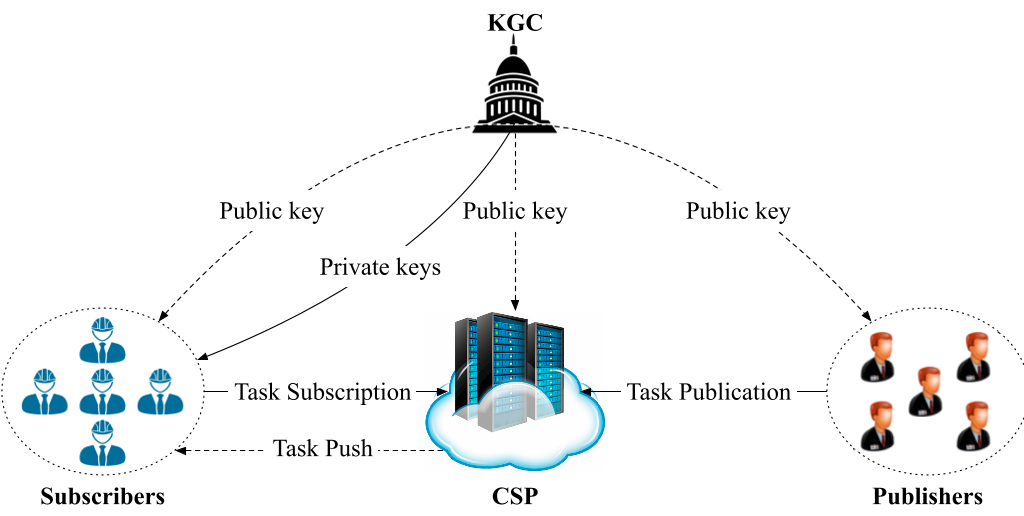 Figure 1: The interaction between KGC, CSP, and Users.
Performance & Experiments
The researchers compared SybMatch against two state-of-the-art schemes: MSDE and SEMEKS.
- Computation Efficiency: SybMatch uses a more streamlined
Matchalgorithm (only 1 pairing + 1 hash), making it significantly faster than the 5 pairings required by SEMEKS. - Batch Verification: The CSP can verify multiple subscription signatures simultaneously. As shown in the results, processing 100 users takes ~1.3 seconds, making it feasible for high-traffic platforms.
- Communication Overhead: SybMatch achieves constant-size subscriptions, which is a major win for mobile workers with limited bandwidth.
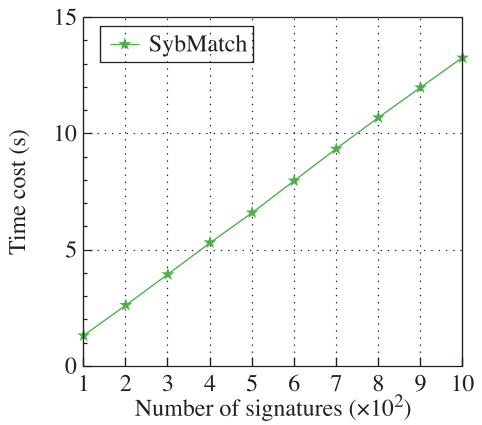 Figure 2: Efficiency of signature verification as the number of requests grows.
Critical Analysis & Conclusion
SybMatch successfully addresses the "greedy worker" problem, a dimension often ignored in pure cryptographic literature. By introducing a Revocation List (RL) and a Subscription Index (I), the CSP can effectively block malicious actors without breaking the encryption.
Limitations: Currently, SybMatch focuses on single-keyword matching. While the authors suggest extensions for Boolean or range queries, the computational cost for these complex matches in a multi-user environment remains a challenge for future work.
Final Takeaway: SybMatch proves that we don't have to choose between user privacy and platform integrity. By carefully layering identity-based signatures over searchable encryption, we can build crowdsourcing markets that are both blind to sensitive data and resistant to fraud.