
Embodied Atmospheres: Merging the Biological and Environmental through Wearable Artifacts
A Symbiosis of Body and Environmental Information in the Form of Wearable Artifacts
This paper introduces "Embodied Atmospheres," a PhD research project investigating wearable artifacts that synthesize physiological data (respiratory rate) and environmental data (air constituents). Utilizing the "canary in a coalmine" metaphor, the system employs kinetic movement and musical sonification to move beyond traditional data visualization toward a multisensory embodiment of invisible environmental information.
TL;DR
In an era of invisible environmental crises, Jessica Broscheit’s research project, Embodied Atmospheres, proposes a radical shift in how we perceive the world around us. By moving away from cold data points on a screen, this work uses wearable artifacts to create a visceral symbiosis between the human body’s rhythm (breathing) and atmospheric quality (particulates). It leverages the historical "canary in a coalmine" metaphor to transform invisible environmental data into a tangible, multisensory experience.
Problem & Motivation: The Perceptual Gap
We live in an "Anthropocene" where our impact on the environment is profound but often invisible to the naked eye. While we have more sensors than ever—from AQI monitors to smartwatches—the way we consume this data is largely through visual abstraction (graphs and numbers).
The author argues that this creates a detachment between the "Quantified Self" and the actual "Environment." The motivation stems from a personal experience in Beijing, where the fluctuating air quality led to an interest in making digital data a "moldable material." The core challenge is: How can we make these complex, invisible ecological shifts felt as part of our own physical existence?
Methodology: The Canary as a Medium
The research utilizes Tangible Interaction and Interface Metaphors to bridge the gap between human and non-human systems.
The Metaphorical Framework
The project adopts the concept of the "indicator species"—specifically the canary bird used by miners to detect hazardous carbon monoxide. By using this metaphor, the wearable artifact becomes a modern surrogate for the bird, reacting to environmental hazards through:
- Kinetic Movement: Servo motors that sync with the user's breathing or environmental density.
- Musical Sonification: Translating particle counts and respiratory rates into an auditory landscape.
System Architecture
The hardware design is purposefully modular to accommodate the "Living Place" lab's ethnographic studies. The core stack includes:
- Sensors: SDS011 particle sensors for environmental data and respiratory sensors for body data.
- Processing: A microcontroller that syncs these two disparate streams.
- Actuators: Speakers and servos that provide the "materialization" of the data.
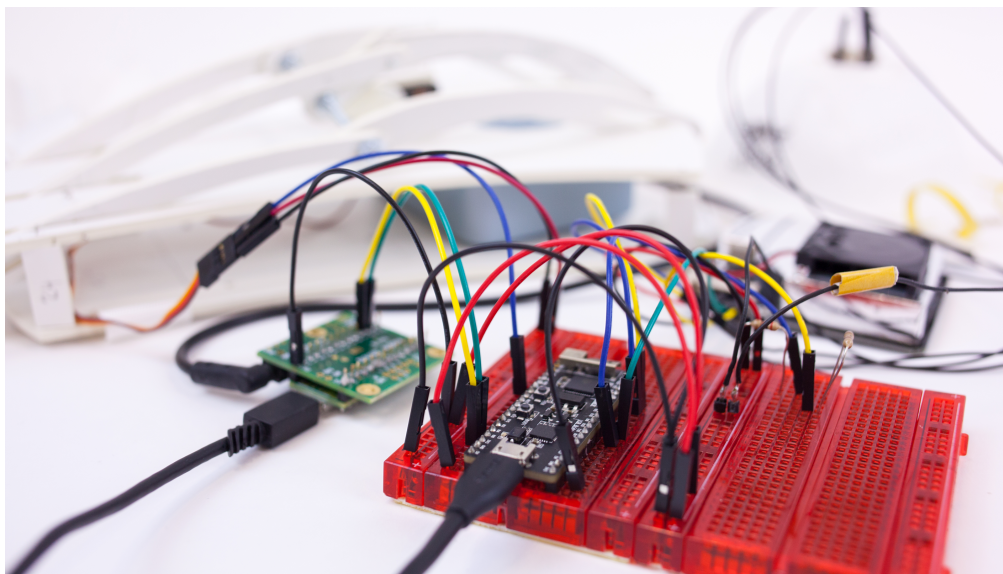 Figure: The internal hardware architecture showing the integration of sensors and actuators.
Experiments and Prototypes: From Air Mask to Ivory
The research builds on several iterative prototypes that demonstrate different facets of embodied interaction:
- Air Mask: A direct environmental monitoring tool that uses a simplified three-color warning system on the mask's filter, making private air data public to passersby.
- Ivory: A more artistic exploration where movement and audio feedback are triggered by vapor levels, simulating the distressed behavior of an indicator species when air quality drops.
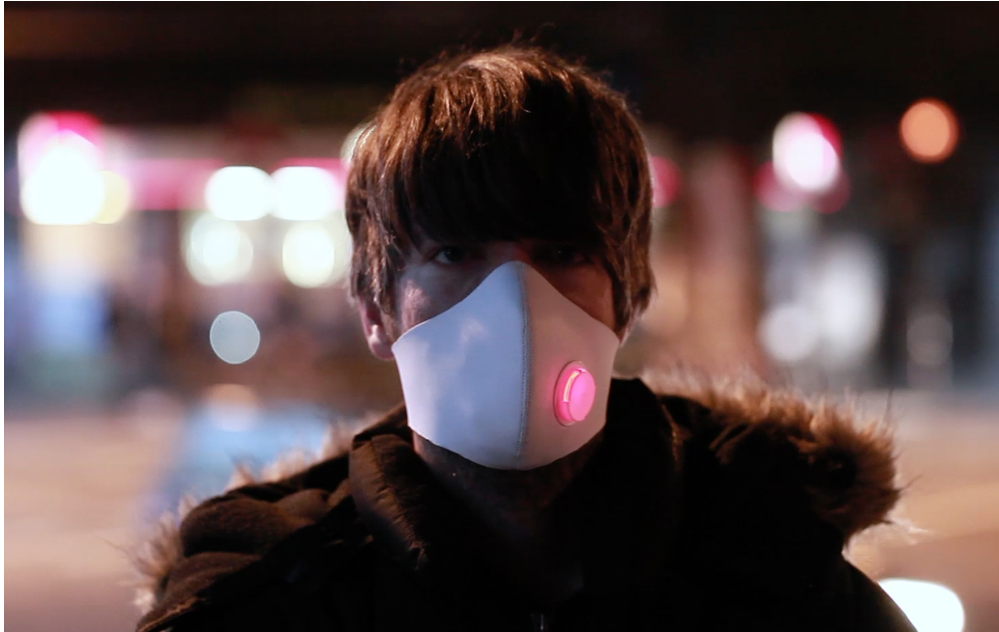 Figure: The Ivory artifact reacting to vapor, providing a tangible representation of changing air quality.
Critical Insight & Conclusion
The significance of Embodied Atmospheres lies in its interdisciplinary approach—intersecting computer science, digital sociology, and the arts.
Takeaways
- Beyond Visualization: Tangible interfaces allow for "situated action," where data becomes an experience rather than a distraction.
- Symbiosis: By linking human breathing with environmental particulate data, the artifact forces the user to acknowledge their biological dependence on the air they breathe.
Limitations & Future Work
The author acknowledges significant engineering hurdles, such as making the artifacts robust enough for various body types and managing power consumption for truly mobile "wearable" use. Future work will involve a full-scale ethnographic study at the Hamburg University of Applied Sciences to see how these artifacts alter a user's long-term environmental sensitivity.
In conclusion, Broscheit’s work suggests that our future wearables might not just track our steps, but serve as a "secondary skin" that breathes and reacts with the environment, ultimately leading to a more profound form of self-awareness.