
This paper investigates thermalization in quantum many-body systems with global SU(2) symmetry using a novel "symmetry-resolved trace distance" as an eigenstate-level diagnostic. The authors demonstrate that this metric decomposes into probability and configurational components, effectively bridging the non-Abelian Eigenstate Thermalization Hypothesis (ETH) with subsystem-level observables.
TL;DR
How do quantum systems with "complex" symmetries like SU(2) reach equilibrium? This paper introduces symmetry-resolved trace distance, a diagnostic tool that splits the difference between neighboring quantum states into two parts: sector probabilities and configuration fluctuations. The authors prove that the "probability" part vanishes exponentially in the thermodynamic limit due to the non-Abelian ETH, meaning that at large scales, the symmetry sectors become perfectly predictable.
Background: The Non-Abelian Frontier
Thermalization in isolated quantum systems is usually governed by the Eigenstate Thermalization Hypothesis (ETH). However, when a system possesses non-commuting charges (like the total spin components $S_x, S_y, S_z$ in an SU(2) symmetric chain), the nature of the equilibrium state changes. We move from traditional Gibbs ensembles to non-Abelian thermal states.
The core challenge addressed here is: Can we see the signature of these non-Abelian constraints in how a subsystem "distinguishes" between two nearly identical global energy eigenstates?
Methodology: Decomposing Distinguishability
The authors use the trace distance—a standard metric for how different two density matrices are. For a subsystem $A$, the reduced density matrix $\rho_A$ in an SU(2) system is block-diagonal, where each block corresponds to a different total spin $S_A$.
They define two critical components:
- $D_{\alpha, ext{prob}}$ (Probability Trace Distance): Measures changes in the likelihood of finding a certain spin $S_A$ in the subsystem.
- $D_{\alpha, ext{conf}}$ (Configurational Trace Distance): Measures the changes within those spin sectors.
The Non-Abelian ETH Bound
The most significant theoretical contribution is showing that $D_{\alpha, ext{prob}}$ is directly constrained by the non-Abelian ETH. Since the diagonal matrix elements of symmetry-invariant operators are "smooth" across energy states, the fluctuations in sector probabilities must be tiny. Specifically, they scale as $e^{-S_{th}/2}$, where $S_{th}$ is the thermodynamic entropy.
 The non-Abelian ETH formula (Eq. 1) used to derive the suppression of probability fluctuations.
Experimental Validation: The $J_1-J_2$ Chain
The authors tested their theory using Exact Diagonalization (ED) on the $J_1-J_2$ Heisenberg chain, a staple model for studying quantum chaos and thermalization.
Key Findings:
- Exponential Decay: As the system size $N$ grows from 12 to 18, the fluctuations in spin-sector probabilities $ ext{Var}(P_{S_A})$ show a clear exponential drop-off (see Fig 1 below).
- Asymptotic Dominance: The "configurational" part of the distance eventually accounts for almost the entire trace distance. This suggests that the "symmetry labels" of the state thermalize much faster or more "completely" than the internal configurations.
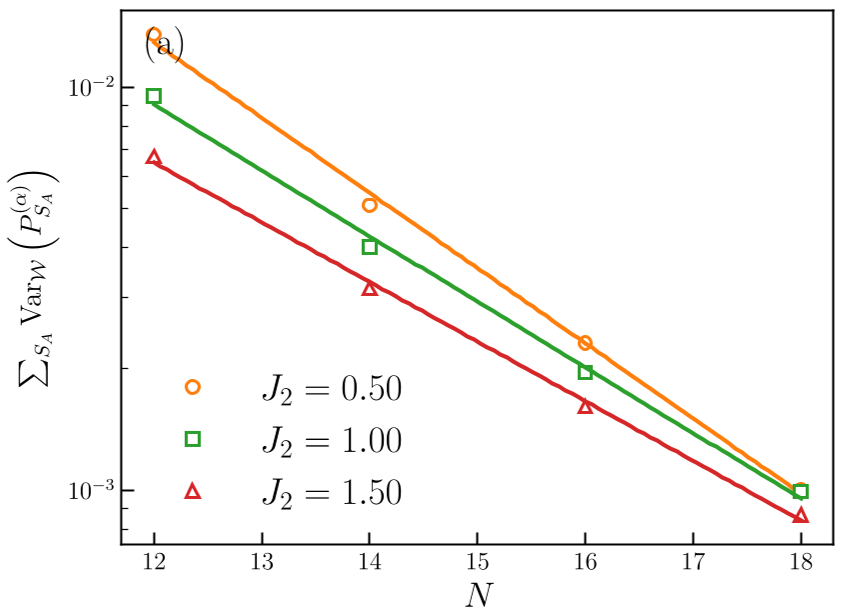 Figure 1: Numerical evidence shows the variance of sector probabilities vanishing as system size increases, validating the non-Abelian ETH prediction.
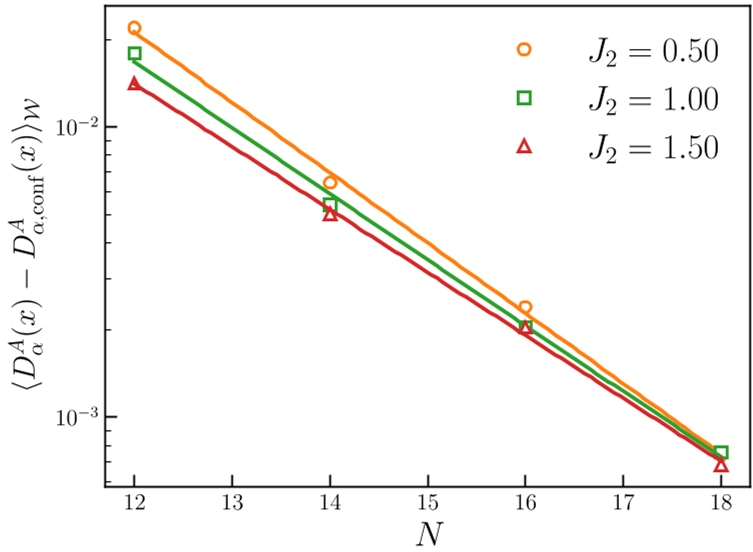 Figure 2: The difference between total trace distance and its configurational part approaches zero, indicating the latter is the dominant diagnostic at large N.
Critical Insight: Why This Matters
This work provides a bridge between Information Theory (trace distance) and Group Theory (SU(2) symmetry) in the context of statistical mechanics.
The takeaway for the community is that in the presence of non-Abelian symmetries, "thermalization" is not a uniform process. The global symmetry sectors (the "Probability" part) adhere strictly to the smooth predictions of ETH very early on. The "Configurational" part contains the more complex, many-body information that defines the state's fine-grained structure.
Future Outlook
While this paper focuses on the thermal regime, the symmetry-resolved trace distance could be a potent "fingerprint" for identifying Many-Body Localization (MBL) or Quantum Many-Body Scars. In those non-thermalizing regimes, we would expect the probability distance $D_{\alpha, ext{prob}}$ to non-vanish, providing a clear mathematical signal of the breakdown of the non-Abelian ETH.