
SymptomAI: Reimagining the Digital Front Door of Healthcare with Agentic AI
SymptomAI: Towards a Conversational AI Agent for Everyday Symptom Assessment
Researchers from Google introduced SymptomAI, a set of conversational AI agents built on Gemini 2.0 Flash designed for end-to-end patient interviewing and differential diagnosis (DDx). Deployed to over 13,000 users in a real-world setting via the Fitbit app, the system achieved significantly higher diagnostic accuracy than independent clinicians (OR = 2.47) and successfully correlated AI-generated diagnoses with objective physiological shifts in wearable data.
TL;DR
Digital symptom checkers have long been the "weak link" in healthcare, often providing inaccurate or alarming results. SymptomAI, a research initiative from Google, changes the narrative by deploying Gemini-based agents to 13,917 real-world users. The study proves that when AI takes the lead—conducting a structured medical interview rather than just "chatting"—it matches or exceeds the diagnostic accuracy of human physicians, with an Odds Ratio of 2.47 in blinded comparisons.
The "Layperson Gap" in Medical AI
While AI has reached "Gold Medal" status on medical exams (USMLE) and curated vignettes, a massive gap remains: Real patients don't talk like medical textbooks.
Prior research showed AI accuracy dropping from 94% on vignettes to 34% when talking to laypeople. Why? Because users don't know which details matter. They might mention "fatigue" but forget to mention a "recent flight" or "sharp chest pain." SymptomAI's core insight is that the AI must act as a Proactive Interviewer, mirroring the "History of Present Illness" (HPI) process taught in medical school.
Methodology: Agency is Everything
The researchers randomized participants into five "Arms" to test different interaction styles:
- The Baseline: Standard user-guided chat (Like asking a base LLM).
- Structured Agents: Followed strict medical question protocols (Onset, Location, Quality, etc.).
- Dynamic Agents: Used a "reasoning loop" to decide which questions would best narrow down the diagnosis.
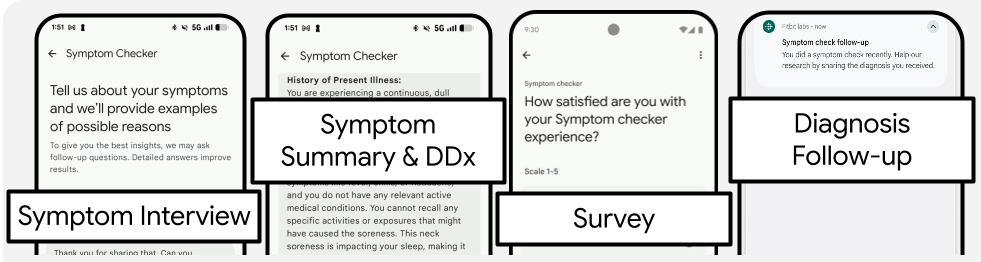 Figure 1: The end-to-end study flow from initial user symptoms to DDx and clinical validation.
The results were clear: Prompting strategies that "forced" the interview performed significantly better. By asking the right questions, the model reduced the "noise" of layperson communication.
Human vs. AI: The Blind Test
In perhaps the most rigorous part of the study, board-certified clinicians reviewed 517 cases. They were given a transcript and asked to provide their own Differential Diagnosis (DDx). Then, a third-party "clinical rater" (also a doctor) compared the AI's list against the human doctor's list, without knowing which was which.
SymptomAI didn't just compete; it won.
- Accuracy: AI DDx was significantly more accurate (p < 0.001).
- Robustness: When information was sparse—cases where human doctors felt "not confident"—SymptomAI maintained its performance, showcasing its ability to leverage broad statistical priors from its training data.
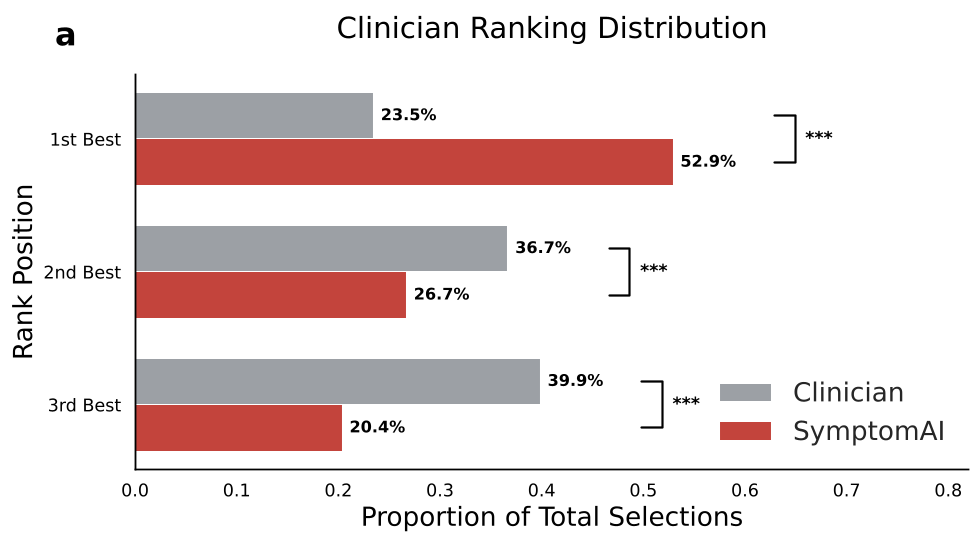 Figure 2: (b) Accuracy compared to clinicians; (e) Robustness across conversation quality tiers.
Beyond Speech: The Biomarker Connection
Because the study was conducted via Fitbit, researchers could correlate AI diagnoses with heart rate, sleep, and respiration data. This "Phenome-wide Association Study" (PheWAS) confirmed that AI-labeled cases of respiratory infections showed objective shifts in resting heart rate and sleep disturbances days before the user even started the chat.
This suggests a future where wearable sensors could trigger a SymptomAI check-in, catching illnesses before they spread.
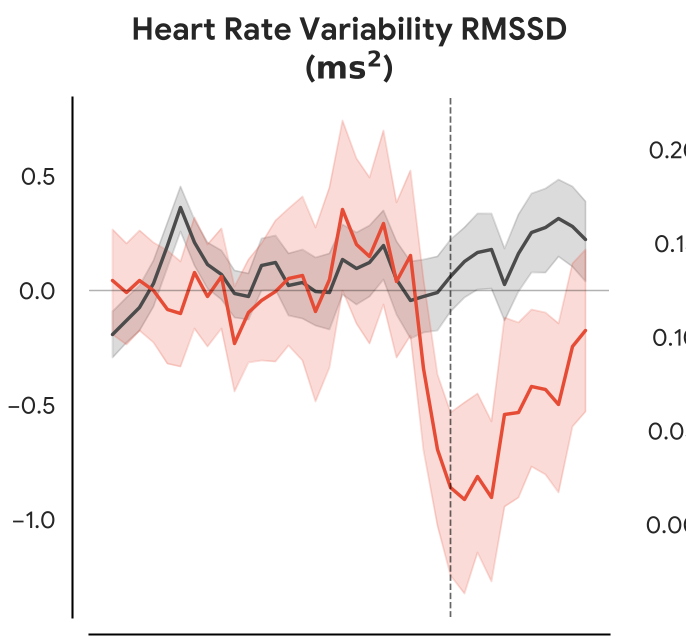 Figure 3: Biosignal trends relative to the day of SymptomAI conversation.
Critical Insight & Future Outlook
The industry takeaway is profound: Agentic workflows matter more than model size. The researchers found that even slightly smaller models (Gemini Flash) became highly capable "doctors" simply by being instructed how to interview.
Limitations: The study still relies on self-reported ground truth, and many conditions require physical labs for 100% certainty. However, as a "digital front door," SymptomAI demonstrates that we can provide hospital-grade triage to anyone with a smartphone, bridging the gap between home-based wellness and clinical care.
Summary: For the first time, we have evidence that a proactive AI interviewer can outperform human history-taking in a massive, real-world population. The status quo of "user-guided" medical chat is officially obsolete.