
SYNC: Breaking Echo Chambers through Crowd-Powered News Synthesis
SYNC: A Crowdsourcing Platform for News Co-editing
This paper introduces SYNC, a collaborative crowdsourcing platform designed for news co-editing and aggregation. By utilizing a block-based structure and a temporal timeline, SYNC enables diverse contributors to synthesize news from multiple sources into a unified, multi-perspective narrative to combat information fragmentation.
TL;DR
In an era of ideological fragmentation and algorithmic filter bubbles, SYNC emerges as a specialized crowdsourcing platform that allows the public to collectively curate, aggregate, and edit news. By shifting from static articles to a block-based temporal structure, it enables readers to synchronize their understanding of complex events through diverse perspectives and integrated source verification.
The "Filter Bubble" Problem in Modern News
The digital news landscape is currently "unsynchronized." Algorithms designed for engagement often trap users in echo chambers, presenting only one side of a story. Previous attempts to diversify viewpoints relied on visualization or manual curation by professional editors. However, these solutions often lack the scale of the crowd or the specific tooling required to handle the fast-paced, high-volume nature of modern news cycles.
The authors identified three key pain points:
- Fragmented Information: News is scattered across ideologically polarized sites.
- High Interaction Cost: Editors must constantly switch between search engines, source materials, and editing windows.
- Context Collapse: It is difficult for readers to track the evolution of a story over time without a clear temporal structure.
Methodology: The Architecture of Synchronized Editing
SYNC introduces a user-centered design that caters to two roles: the Audience (consuming aggregated news) and the Editor (contributing and organizing information).
1. Block-Based Editor & Timeline
Unlike traditional CMS platforms, SYNC uses a modular "block" system. Each block represents a specific sub-topic or update within a larger news event. These blocks are automatically mapped to a Timeline, which serves as both a navigation menu and a visual representation of how the crowd perceives the storyline's progression.
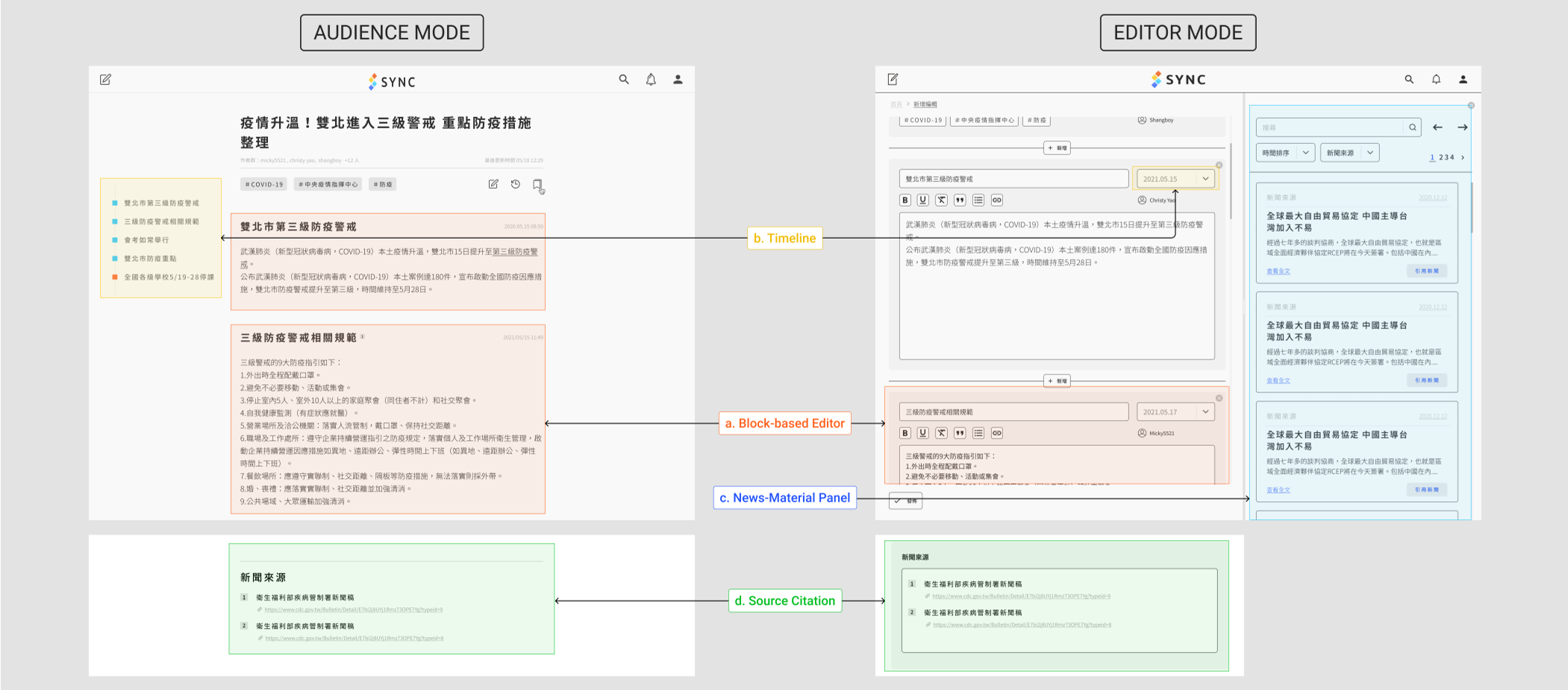 Figure 1: The synergy between the Block-Based Editor, Timeline, and News-Material Panel.
2. Streamlined Material Sourcing
To reduce the "copy-paste" fatigue, the platform includes a News-Material Panel. This sidebar allows editors to search across 15 different news sources (scraped every 60 minutes) and import text directly. The system automatically creates Source Citations, maintaining journalistic integrity while maximizing efficiency.
Experimental Insights
The researchers conducted a user study focusing on the societal impact and usability of the platform. Key findings included:
- Efficiency: Participants noted that having aggregated news in one place acted as a significant "time-saver" for citizens concerned with public affairs.
- Contextual Clarity: The Timeline was praised for helping users "quickly clarify the temporal context" of evolving stories, providing a mental map that traditional news feeds lack.
- Iterative Design: Early prototypes revealed that users preferred searching within the same interface, leading to the refinement of the News-Material Panel.
Critical Analysis & Future Outlook
While SYNC provides a robust framework for news synthesis, the authors acknowledge the challenges of version control and conflict resolution as the user base grows.
The most compelling takeaway is the potential for Human-AI Co-editing. The structured "block" data generated by human editors on SYNC is a goldmine for training generative models. In the future, AI could suggest drafts for new blocks, while humans provide the oversight and multi-perspective nuance that algorithms currently lack. SYNC isn't just a tool for today's news; it’s a blueprint for a more collaborative and objective information ecology.
Conclusion
SYNC moves the needle from passive consumption to active, collaborative synthesis. By organizing news around events and timelines rather than sources and clicks, it offers a path out of the echo chamber and toward a more "synchronized" public discourse.