
[NeurIPS 2024] SynCode: Bridging the Gap Between LLM Hallucinations and Formal Syntax
SynCode: LLM Generation with Grammar Augmentation
SynCode is a novel framework for grammar-augmented LLM decoding that ensures generated outputs strictly adhere to Context-Free Grammars (CFG). By utilizing an offline-constructed DFA mask store and an incremental LR(1) parser, it eliminates 100% of syntax errors in JSON tasks and reduces over 96% of syntax errors in complex Python and Go code generation.
TL;DR
SynCode is a high-performance framework that forces LLMs to speak the "language of machines" (JSON, Python, SQL) with 100% syntactical precision. By combining traditional LR(1) parsing with a GPU-accelerated DFA Mask Store, it eliminates syntax errors while actually speeding up generation compared to unconstrained models.
Core Impact: It transforms small, open-source models (like Llama-3 or Gemma) into reliable components for compound AI systems that require strict data formats.
The "Token Misalignment" Nightmare
The fundamental reason LLMs struggle with code isn't just "intelligence"—it's a structural mismatch.
- The Lexical Gap: A single LLM token (like
urn) might be a fragment of a keyword (return). - The Context Gap: Transformers struggle to track deeply nested structures (like parentheses in LISP or braces in JSON) over long distances.
- The Efficiency Gap: Checking every vocabulary token (~32k to 128k entries) against a grammar at every step is traditionally a CPU-intensive bottleneck.
SynCode addresses the Why (Soundness) and the How (Efficiency) simultaneously.
Methodology: The Two-Step Precision Engine
1. Incremental Parsing & Accept Sequences
Unlike prior work that re-parses the entire output every time, SynCode uses an Incremental LR(1) Parser. It identifies:
- Fixed Prefix: Code that is already lexically closed.
- The Remainder (): The trailing characters (like
ret) that might change meaning depending on the next token. - Accept Sequences (): A set of valid future terminals (e.g., after
def, the parser knows only aNAMEterminal is allowed).
2. The DFA Mask Store (The Secret Sauce)
This is where SynCode outruns its competitors. Instead of computing validity on the fly, it pre-computes a DFA Mask Store offline.
- Every terminal in a language (like a String literal or an Integer) is a Deterministic Finite Automaton (DFA).
- SynCode maps every possible state in these DFAs to a bitmask of the entire LLM vocabulary.
- At inference time, it just performs a simple bitwise UNION of these masks. Since bitwise operations are natively parallelizable on GPUs, the overhead is almost negligible.
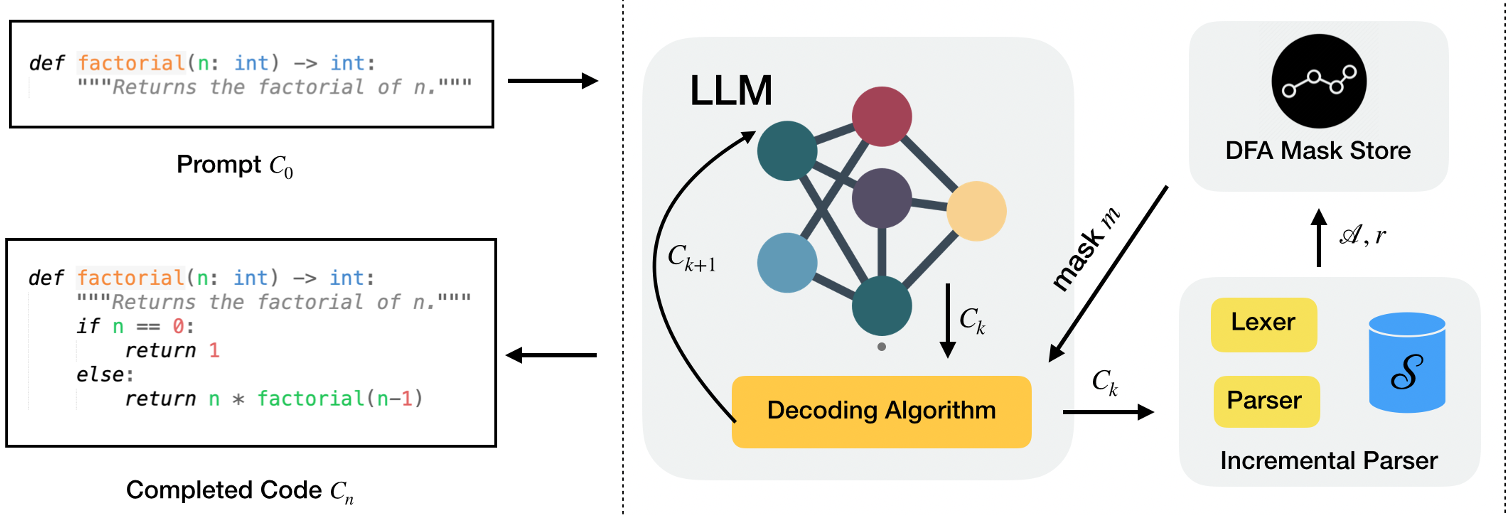 Figure 1: The SynCode workflow integrating the LLM, Parser, and DFA Mask Store.
Experimental Showdown: JSON, SQL, and Beyond
JSON: Zero Hallucination
In the JSON-Mode-Eval benchmark, standard Llama-2-7B-chat failed over 98% of original prompts by adding natural language chatter. SynCode reduced syntax errors to zero. Even more impressively, it improved schema validation accuracy (ensuring the JSON had the right keys/types) from 41% to 100% for Gemma-2B.
Programming Languages (GPLs)
Most constrained decoders only handle simple JSON. SynCode scales to Python and Go.
- Python: 96%+ reduction in syntax errors across HumanEval.
- Go: Since Go is often under-represented in training data, SynCode's impact was even higher, protecting the model from its own lack of training.
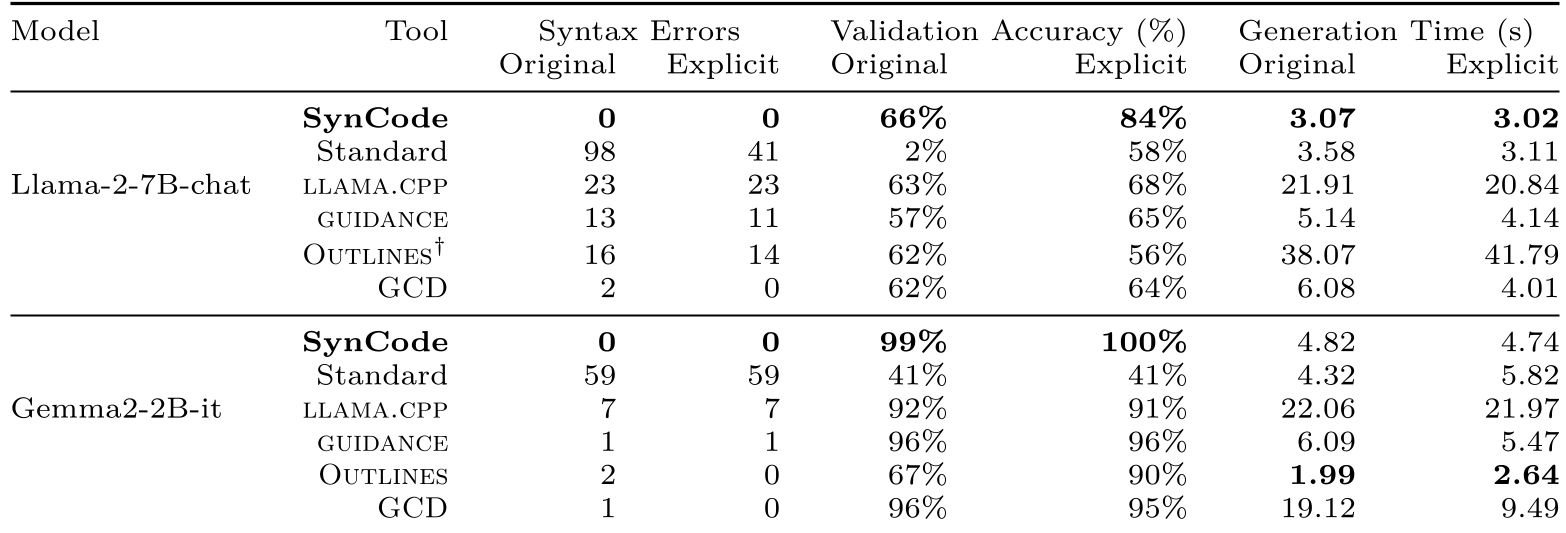 Table 1: Comparison of SynCode vs. Baselines (llama.cpp, Guidance, Outlines) in JSON generation.
Implementation Insight: Why It's Faster
You might expect adding a parser to slow down the model. Paradoxically, SynCode often reduces Total Generation Time. Why? Because it prevents the model from "blathering"—it stops the LLM from generating irrelevant natural language outside the requested JSON/Code block. By reducing the number of tokens generated, the end-to-end latency drops.
Critical Analysis & Future Outlook
Limitations
- Semantic Constraints: SynCode ensures code is syntactically correct (it compiles), but it cannot guarantee semantic correctness (e.g., that a variable was declared before use).
- Infinite Lookahead: While current LR(1) lookahead is sufficient for most cases, extreme edge cases in complex grammars might still require parsing.
Conclusion
SynCode is a masterclass in applying "old school" compiler theory to "new school" generative AI. It proves that we don't need massive 70B parameter models just to generate valid JSON; we need better control over the decoding process of smaller, more efficient models.
For developers building Agentic workflows or LLM-based tool integration, SynCode provides the "safety rails" necessary to move from prototypes to production-ready systems.