
Synthetic Collective Intelligence: Engineering the Microbial Superorganism
Synthetic collective intelligence
This paper introduces the concept of Synthetic Collective Intelligence (SCI), a novel framework that uses synthetic biology to engineer unicellular organisms into distributed, decision-making "swarms." By implementing genetic circuits inspired by social insects, the authors demonstrate how engineered microbes can achieve complex behaviors such as symmetry breaking, task allocation, and synchronized oscillations.
TL;DR
What if we could program a colony of bacteria to think like an ant colony? This paper introduces Synthetic Collective Intelligence (SCI), a framework that leverages synthetic biology to transform unicellular organisms into "living micro-robots." By rewriting genetic circuits, researchers have demonstrated that microbes can move beyond simple sensing to perform complex collective computations, including symmetry breaking, robust task allocation, and synchronized activity bursts.
Problem & Motivation: Beyond the Neural Individual
Intelligence in our biosphere has traditionally followed two distinct paths:
- The Neural Individual: Highly integrated systems (like the human brain) capable of rapid, centralized processing.
- The Superorganism: Distributed systems (like ants or bees) where intelligence emerges from the local interactions of relatively simple agents.
While swarm robotics has successfully mimicked these patterns in silicon, biological systems offer a unique "fluid" architecture where agents are autonomous, regenerative, and highly sensitive to chemical cues. The authors hypothesize that by using synthetic biology, we can bridge these worlds—engineering microbes to display the "emergent" decision-making powers of a swarm.
Methodology: The Core Motifs of SCI
The authors identify three pillars of swarm intelligence and translate them into genetic hardware:
1. Quorum Sensing as the "Neural Link"
Quorum Sensing (QS) is the biological equivalent of a pheromone trail. It involves the production, diffusion, and sensing of signaling molecules (like HSL). When a population reaches a critical density (), a nonlinear feedback loop triggers a colony-wide behavior change.
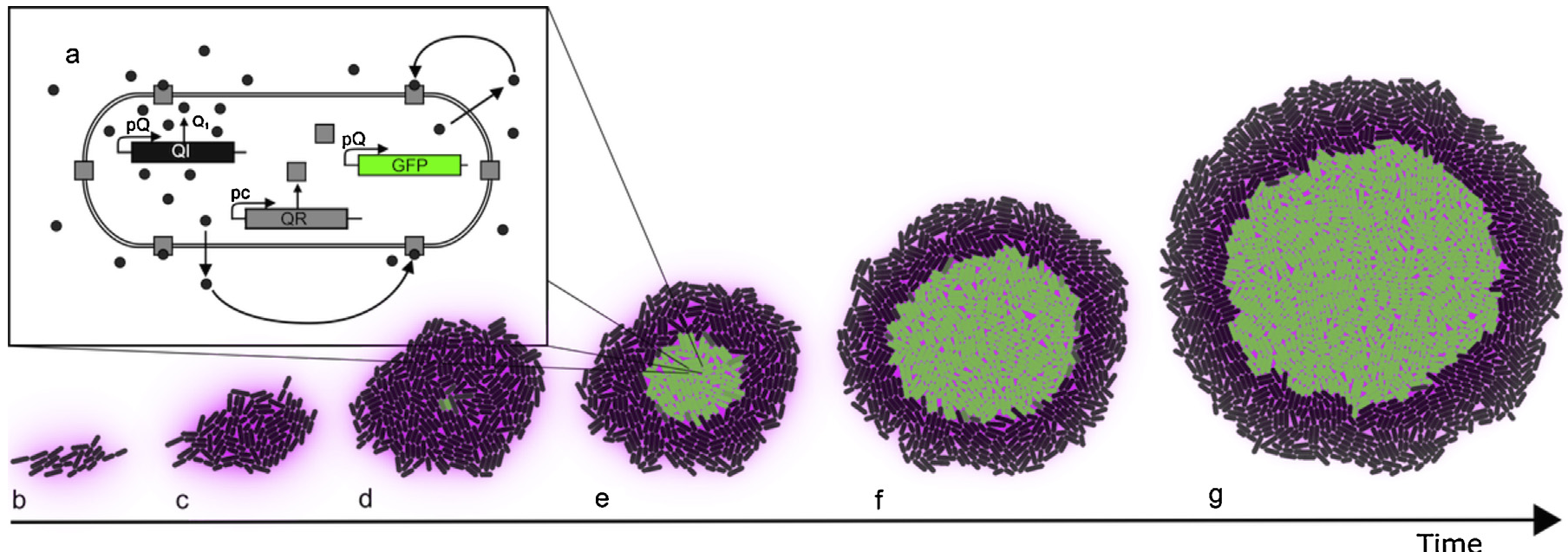 Figure: The basic QS circuit. Cells produce a signal (Q) that enhances its own production, creating a multicellular feedback loop.
2. Majority Detection via Symmetry Breaking
How does a colony choose between two options (e.g., path A vs. path B)? The authors designed a circuit where two signals inhibit each other’s receptors. Much like the "two-bridge experiment" in ants, a slight initial fluctuation in signal concentration is amplified, forcing the entire colony to reach a consensus on one of the two states.
3. Task Allocation (The Fixed Threshold Model)
In social insects, different "castes" respond to tasks based on internal thresholds. The authors mimicked this by creating a synthetic "division of labor." Two cell types respond to the same stimulus but at different sensitivities. If the "specialist" cells are overwhelmed or removed, the "generalist" cells with a higher threshold automatically kick in, ensuring robust colony-level homeostasis.
Experiments & Results: Emerging Complexity
The power of SCI is best visualized in the collective patterns produced in agent-based models:
- Symmetry Breaking: Even with only a 10% difference in initial signal strength, the cross-inhibitory circuit allowed the colony to consolidate under a single reporter (either Red or Green), effectively "making a choice."
- Collective Oscillations: Perhaps the most striking result is the generation of collective pulses in organisms that are not individual oscillators. By combining HSL-based activation with ClpXP-mediated protein degradation, the colony achieved synchronized bursts of activity—a phenomenon previously observed in Leptothorax ant colonies.
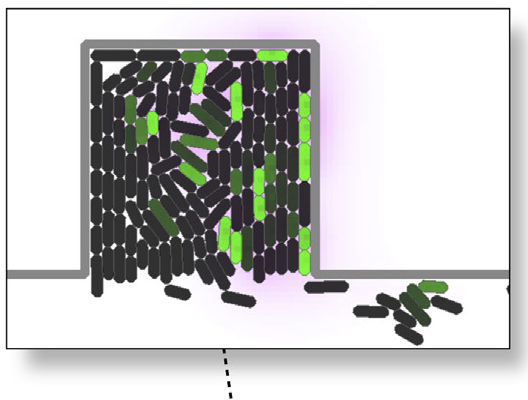 Figure: Synchronized microbial activity. Note how local stochastic activations propagate into a coherent global frequency (400 min period).
Critical Analysis & Conclusion
Takeaway
The true value of this work lies in the shift from cellular logic (AND/OR gates) to population-level dynamics. By treating a microbial colony as a distributed computer, we can build systems that are more robust than single-agent models.
Limitations & Future Work
- Signal Cross-talk: Current models rely on lactone molecules, which often interfere with one another. Expanding SCI will require "orthogonal" chemical channels.
- Evolutionary Stability: Over time, "cheater" cells that do not contribute to the collective cost of signaling could outcompete the "intelligent" swarm.
- Physical Stigmergy: Future research must explore how microbes modify their physical environment (e.g., building 3D biofilm structures) to store collective memory, similar to how termites build mounds.
In conclusion, Synthetic Collective Intelligence provides a roadmap for "Bioengineering the Biosphere." Whether it is targeting tumors that hide in acidic environments or stabilizing degrading ecosystems, the future of engineering may lie not in bigger brains, but in smarter swarms.