
OSN Synthetic Data: Balancing Privacy and Realism in Social Graphs
A synthetic data generator for online social network graphs
2016-07-01
Summary
Problem
Method
Results
Takeaways
Abstract
This paper introduces a stochastic modeling framework for generating realistic synthetic data to populate Online Social Network (OSN) graph topologies. The method utilizes a hierarchical "seed-and-propagate" approach to assign diverse yet correlated attributes (demographics, interests, and interaction weights) to both synthetic RMat graphs and real-world "ground truth" topologies from Amazon, YouTube, and LiveJournal.
## TL;DR
Researchers struggle to access real-world social network data due to privacy laws. This paper presents a sophisticated generator that takes an empty graph topology and populates it with realistic personal data (age, politics, interests) using a "seed-based propagation" method. It works on both synthetic and real-world datasets like YouTube and Amazon, allowing researchers to tune the "noise" and "dispersion" of the data for better simulation.
## The Research Gap: Structure vs. Content
While the academic community has become adept at simulating the *structure* of social networks (how people connect), we have lagged in simulating the *content* (who those people are). Most existing generators create "naked" graphs. This paper argues that for privacy-preserving research, we need "data-rich" synthetic graphs where node attributes (like religion or profession) are statistically correlated with the network structure.
## Methodology: The Seed-and-Propagate Core
The author’s contribution lies in a three-step stochastic process designed to populate existing topologies:
1. **Seed Selection**: Instead of random assignment, the system identifies "Medoid" nodes—the most central members of a community. These act as the "genetic source" for that community’s data.
2. **Profile Mapping**: Pre-defined demographic profiles (e.g., "Young Urban Pro) are assigned to these seeds based on desired global distributions.
3. **Attribute Propagation & Dispersion**: This is the "secret sauce." The algorithm assigns data to neighbors based on proximity to the seed.
### The Dispersion Levels
The system uses a variable **Control Parameter Set ($\mathbb{CP}$)** to determine how "alike" neighbors are:
* **Level 1 (Low Diversity)**: Neighbors are highly similar to seeds (60% identical).
* **Level 2 (Medium)**: A realistic blend used for most experiments.
* **Level 3 (High Chaos)**: High noise, making community detection more challenging.
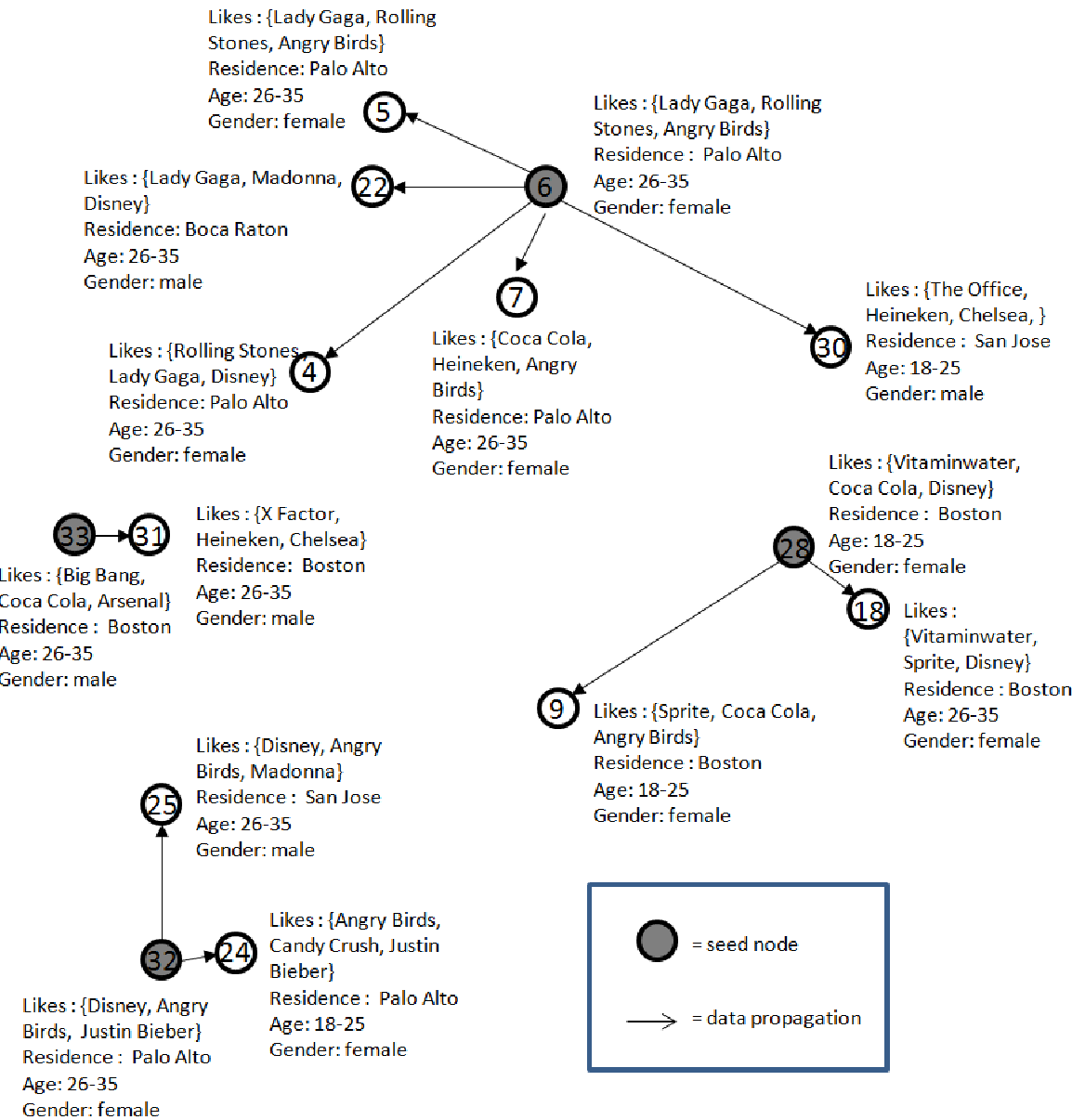
*Fig: Visual representation of data propagation from seed nodes to immediate neighbors within a topology.*
## Experiments: Synthetic vs. Ground Truth
The author tested the generator against two vastly different scenarios:
### 1. R-MAT Synthetic Topology
Using the R-MAT algorithm to create a 1,000-node graph, the study applied the **Louvain method** for community detection. The generator successfully mapped profiles to these clusters, proven by a C4.5 decision tree which could "guess" a user's community based on their synthetic data with ~65% accuracy—high enough to show correlation, low enough to reflect real-world "noise."
### 2. Large-Scale Overlapping Graphs
The real test involved the **SNAP datasets** (Amazon, YouTube, LiveJournal). These are "Ground Truth" topologies where users belong to multiple categories simultaneously.
* **Amazon**: 14k nodes, highly overlapping.
* **LiveJournal**: 84k nodes, 3 million edges.
The generator proved scalable, maintaining global attribute proportions even when a single user (node) belonged to 50+ different communities.
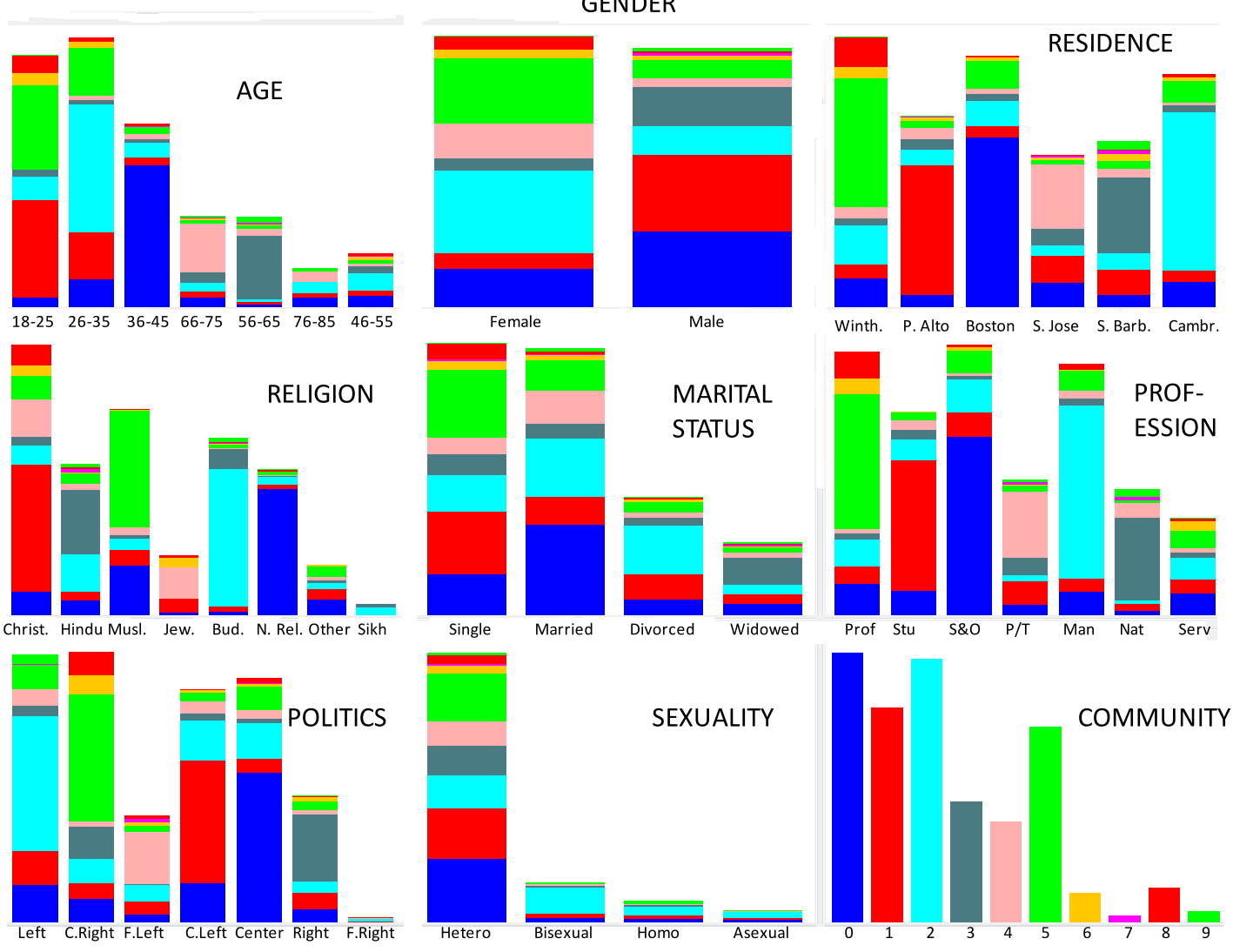
*Fig: Global distribution of attribute-values for the complete graph, demonstrating successful target frequency matching.*
## Critical Insight: The "Chaos" of Overlap
A fascinating finding in the paper is how **overlapping communities** naturally increase "chaos." In a non-overlapping R-MAT graph, a community is homogeneous. In the YouTube dataset, because users belong to many groups, a node might get its "Age" from Group A but its "Interest" might be influenced by its membership in Group B. This inter-community interference actually makes the synthetic data *more* realistic, as it captures the multifaceted nature of human identity.
## Conclusion & Future Directions
This generator provides a vital tool for the "Data Mining" era, where privacy concerns often halt progress. By providing a Java-based implementation that handles millions of edges and thousands of overlapping communities, the author facilitates a safer way to test algorithms for recommendation engines, fraud detection, and social influence modeling.
**Limitations**: The distance rules for attributes (e.g., politics, residence) are currently hard-coded. Future work could involve learning these distance metrics directly from small samples of real data to further enhance realism.