
BGAN-Health: Scaling Smart Healthcare with Private Synthetic Data
Synthetic and Private Smart Health Care Data Generation using GANs
The paper proposes a framework for generating synthetic and private smart healthcare data using Boundary-seeking GANs (BGANs) integrated with Differential Privacy (DP). Validated on real-world Fitbit datasets, the method successfully synthesizes complex tabular time-series data while maintaining statistical fidelity and providing provable privacy guarantees.
TL;DR
The transition from reactive treatment to preventive medicine relies on massive IoT health datasets, but privacy laws often lock this data away. This paper introduces a specialized generative framework using Boundary-seeking GANs (BGANs) and Differential Privacy (DP) to create high-fidelity synthetic Fitbit datasets. The result? Data that looks and acts like real patient records but carries zero risk of re-identification.
Context & Positioning
In the hierarchy of synthetic data, healthcare is the "final boss" due to its mix of static (age, height) and behavioral (heart rate, activity) variables. Most prior work focused on Electronic Health Records (EHR). This paper shifts the focus to Smart Health Care—high-velocity sensor data from wearables. It positions itself as an end-to-end pipeline: from raw Fitbit collection to DP-sanitized synthetic output.
The Core Challenge: Why is Tabular IoT Data Hard?
Generating images is one thing; generating a daily log of a user's life is another. The authors identify three major hurdles:
- Mixed Distributions: Dealing with continuous (Weight) and discrete (Steps) variables simultaneously.
- Imbalanced Categoricals: Diverse ethnicities and dietary patterns lead to highly skewed data.
- The Privacy Paradox: Adding enough noise to satisfy DP often destroys the "utility" (usefulness) of the data for ML models.
Methodology: The BGAN Advantage
While many researchers default to WGAN (Wasserstein GAN), the authors found that Boundary-seeking GANs (BGAN) offer faster convergence and better stability for tabular data. BGANs work by minimizing the distance between the discriminator's output and the decision boundary ().
The Privacy Implementation
The authors don't just add noise; they strategically apply the Laplacian Mechanism in two ways:
- Noisy Input: Perturbing the original data before training. According to the Post-processing Theorem, any data sampled from a model trained on DP data is itself DP.
- Noisy Output: Training the GAN on clean data but adding noise to the generated results, allowing for fine-grained control over specific feature sensitivity (e.g., higher noise for than for ).
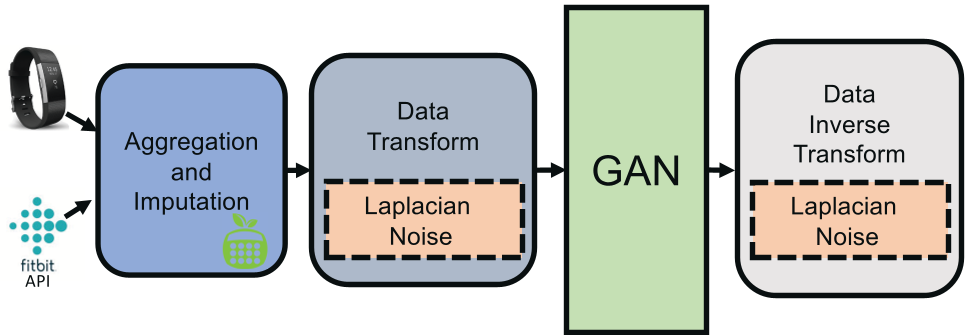 Figure 1: The proposed pipeline from Fitbit collection to DP-synthetic generation.
Experimental Validation
Using a real-world dataset of 17M measurements from participants in Belgium and Sweden, the authors compared the original data distributions against the BGAN-generated ones.
Results at a Glance:
- Statistical Fidelity: The Kolmogorov-Smirnov (KS) test, which measures if two samples come from the same distribution, returned a p-value of 0.98 for calories burned.
- Model Stability: Discriminator and Generator losses stabilized between epochs 420 and 600, suggesting a robust learning process even under noise constraints.
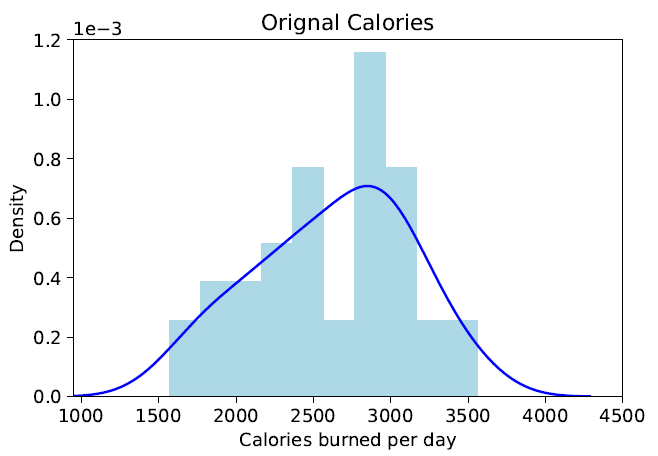 Figure 2: Histogram comparisons between original (a) and synthetic (b) distributions show remarkable alignment.
Critical Analysis & Takeaways
The strength of this work lies in its practical application of the DP Post-processing Theorem. By showing that GANs can effectively "learn from noise," the authors provide a way to offload synthetic generation to third-party servers without ever sharing raw user data.
Limitations: The study used a relatively small participant pool (25 subjects), though it generated a high volume of measurements. Future work will need to address "Mode Collapse" common in GANs when dealing with even more sparse categorical features.
Conclusion: This framework isn't just a theoretical exercise; it's a blueprint for the industry. It proves that we can democratize healthcare research by sharing "realistic" data that satisfies the strictest legal privacy requirements.