
Designing the Human Element: Synthetic Behavior Datasets for Next-Gen Wireless Networks
A Synthetic User Behavior Dataset Design for Data-Driven AI-Based Personalized Wireless Networks
The paper proposes a novel synthetic dataset design methodology for personalized wireless networks, aiming to predict user satisfaction based on context. It introduces the "Tree Data Generator" and "User Persona" concepts to create high-fidelity, labeled behavioral data while protecting privacy, achieving high prediction accuracy across multiple ML models.
TL;DR
To enable truly personalized wireless networks, AI models need to understand "User Satisfaction"—a subjective metric that is notoriously hard to collect due to privacy laws. This paper presents a methodology to synthesize realistic user behavior data using Tree Data Generators and User Personas, bridging the gap between raw QoS metrics and actual human experience without compromising privacy.
Background: Beyond Quality of Service (QoS)
The traditional focus of network engineering has been QoS (e.g., throughput, latency). However, a high-speed connection doesn't always equal a happy user; a student streaming a lecture has different expectations than a professional in a Zoom call. To move toward Personalized Wireless Networks, we must model the Quality of Experience (QoE). The authors position this work as a critical infrastructure step: providing the data necessary to train the AI "brains" of future networks.
The Problem: The Privacy-Utility Paradox
Researchers face a "cold start" problem:
- Privacy Barriers: Real user data is sensitive and rarely shared by ISPs.
- Complexity: User satisfaction is non-linear and context-dependent.
- Data Scarcity: There are no public datasets that link network performance (QoS) with ground-truth satisfaction labels.
Methodology: The Synthetic Blueprint
The authors don't just generate random numbers; they build a structured world model based on three pillars:
1. The Zone of Tolerance (ZoT) Model
The foundation is a mathematical mapper that translates the difference between demanded and provided QoS () into a satisfaction score (0–5).
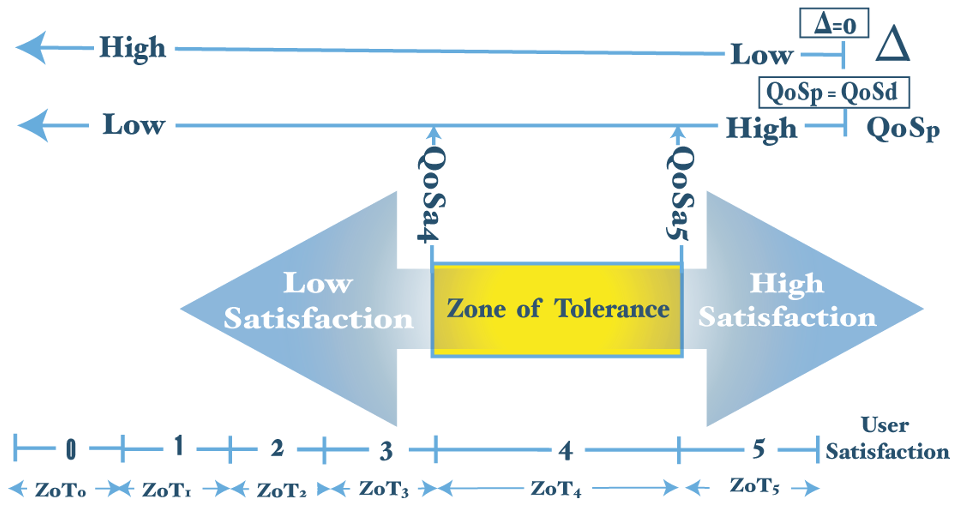 Fig 1: The non-linear relationship where satisfaction drops as the gap between demand and provision increases.
2. Tree Data Generator (TG) & Personas
To ensure the data "makes sense" (e.g., you shouldn't be "Running" while at "Work" in a "Meeting"), they use a TG structure.
- HMM Nodes: Use Hidden Markov Models to decide the next state based on probabilities.
- Personas: They define archetypes like Working Professional or University Student to give the data realistic temporal and spatial patterns.
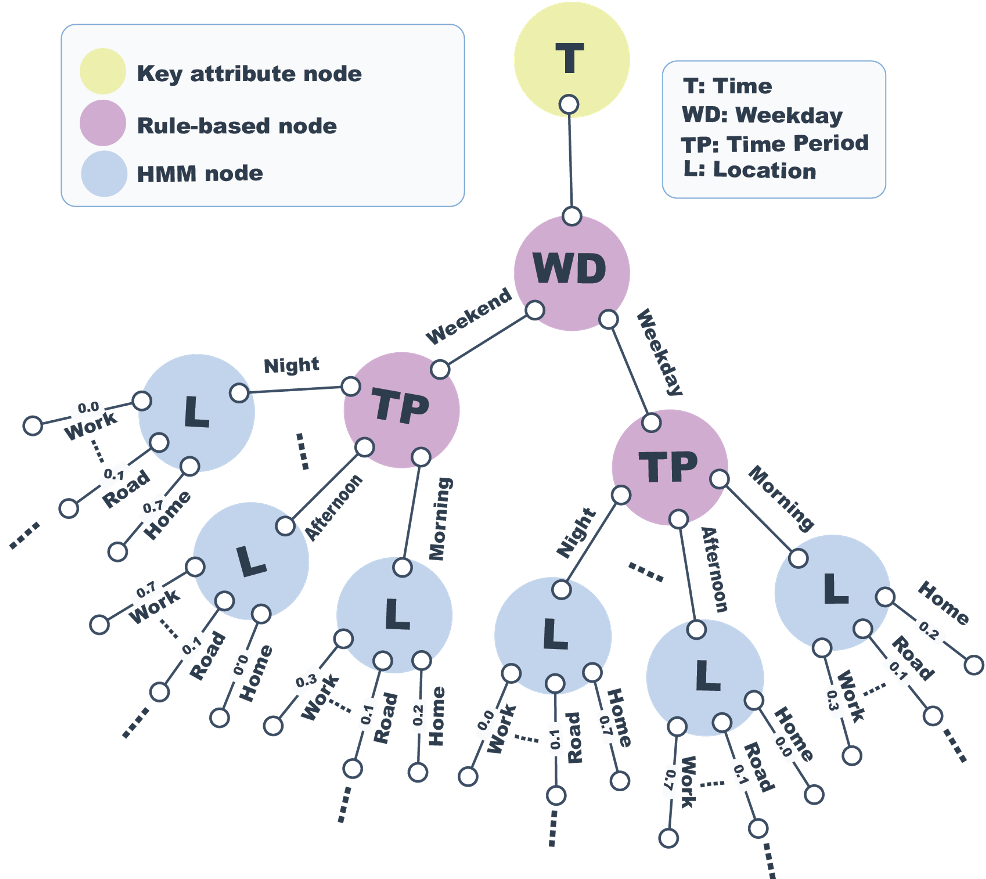 Fig 2: A logical tree ensuring context variables like Location and Activity are correlated realistically.
3. Injecting "Realism" Through Noise
A perfectly clean dataset is a researcher's dream but a production model's nightmare. The authors solve this by:
- Real Sensor Data: Incorporating actual accelerometer and gravity data from smartphone sensor datasets to mimic hardware noise.
- Uncertainty Modeling: Adding Gaussian error () to the satisfaction mapper to represent the "unpredictable" nature of human mood.
Experimental Validation
To prove the dataset's worth, the authors trained several ML classifiers (Decision Tree, KNN, Random Forest) to see if the satisfaction levels could be recovered from the context.
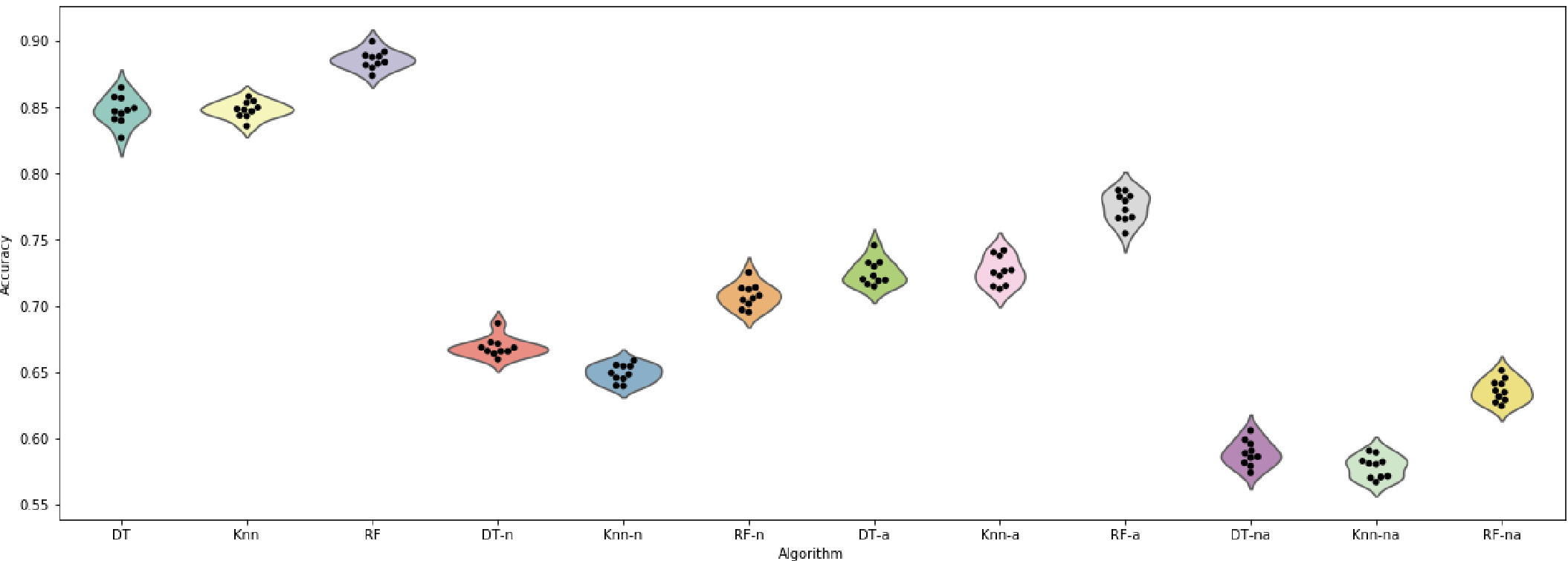 Fig 3: Performance across different scenarios. Note how accuracy decreases as "Noisy Satisfaction" (n) and "Augmented Sensors" (a) are added, reflecting a more realistic and challenging environment.
Key finding: Even with added noise, the models significantly outperformed random guessing, proving that the underlying patterns in the synthetic data are learnable.
Critical Insight: The Value of "Structured" Synthesis
What makes this work stand out from simple data augmentation is the Tree Data Generator. By using HMMs within a logical hierarchy, the authors create a "Digital Twin" of user behavior. This allows researchers to stress-test network management algorithms in a "What-If" fashion—for example, "How does the network perform if we have 50% more 'High School Students' on the weekend?"
Conclusion & Future Work
The proposed methodology offers a robust solution to the data bottleneck in wireless AI. By releasing these datasets (available on GitHub), the authors provide a sandbox for the community to develop finer-grained micro-management of network resources. Future work could look into generative AI (GANs/Diffusers) to create even more complex behavioral nuances.