
Why We Share: Decoding System Characteristics and Self-Disclosure in Social Networks
Effects of System Characteristics on Users' Self-Disclosure in Social Networking Sites
This research investigates the drivers of user information sharing on Social Networking Sites (SNSs) by applying the Technology Acceptance Model (TAM). Using data from 113 Renren users, the study demonstrates that Perceived Usefulness (PU) and Perceived Ease of Use (PEOU) are critical determinants of self-disclosure intentions and subsequent behaviors.
TL;DR
Why do some users fill out every detail on their social media profiles while others leave them blank? This study applies the Technology Acceptance Model (TAM) to the Chinese SNS Renren, finding that the perceived "usefulness" and "ease of use" of a platform are the primary triggers for disclosure. However, a significant gap remains between wanting to share and actually doing it.
Background Positioning
In the ecosystem of Social Networking Sites (SNS), personal data is the "oil" that fuels both social connectivity and targeted business intelligence. While TAM has been used to study why people use software, this paper is a pivotal application of the model to the human act of self-disclosure, shifting the focus from "system adoption" to "information contribution."
The Core Challenge: The Inactive User Problem
Despite millions of registrations, platforms often suffer from "zombie accounts" or users who refuse to disclose personal details.
- The Business Pain: Without data, targeted advertising fails.
- The Social Pain: Without profiles, users cannot find "friends" with shared interests, leading to a stagnant network.
- The Theoretical Gap: Prior work rarely linked the usability of the system directly to the vulnerability of sharing personal secrets.
Methodology: Bridging Perceptions and Reality
The authors utilized a dual-source methodology to ensure high academic rigor. They didn't just ask users if they shared information; they verified it.
1. The Model
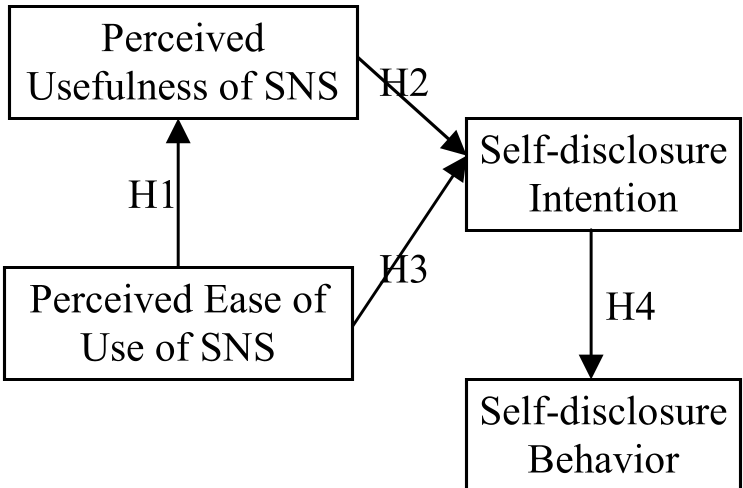
The study posits that if a system is easy to use (PEOU), users find it more useful (PU). These factors build an intention (SDI), which theoretically leads to actual behavior (SDB).
2. Objective Measurement
To avoid "Common Method Bias" (where survey respondents exaggerate their actions), the researchers:
- Collected perception data via 7-point Likert scales.
- Crawl the actual profiles of the respondents to count contact methods (QQ, MSN, Mobile) and check for birthday visibility ().
Key Results & Insights
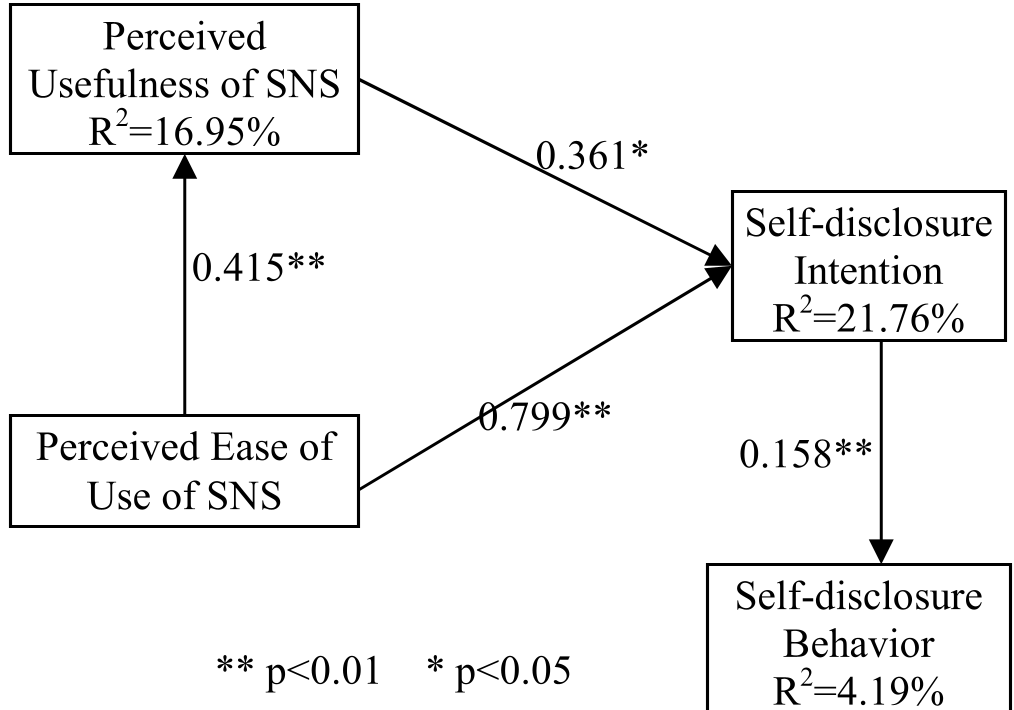
The data from 105 valid respondents revealed a successful fit for the TAM framework:
- PEOU PU: A system that is easy to navigate is perceived as a more effective social tool.
- The Intent Triggers: Both utility and ease significantly drove the willingness to share sensitive info.
- The Disclosure Gap: Paradoxically, while the model explained 21.76% of intention, it only explained 4.19% of actual behavior.
Critical Analysis: Why the Gap?
The authors suggest that for the target demographic (university students), real-life pressure (job hunting, exams) creates a "time poverty" effect. Even if they intend to update their profiles because the platform is useful, the friction of daily life prevents the actual execution of the behavior.
Critical Insight & Conclusion
Takeaway for Product Designers
If you want more data from your users, don't just "ask" for it. Reduce the cognitive load.
- Perceived Ease of Use acts as a gateway; it reduces the psychological "cost" of entering data.
- Perceived Usefulness provides the "reward" for the risk of disclosure.
Limitations & Future Work
The study is focused on a specific cultural context (China) and a specific era of Renren. Modern research would need to integrate Privacy Calculus (the trade-off between risk and reward) and Trust, which the authors acknowledge as a necessary future step.
Final Thought: The success of a social network is not just about its algorithm; it's about how the system interface lowers the barrier to human vulnerability.