
Decoding Mineral Investment: A System Dynamics Perspective on Policy and Complexity
An insight into the system dynamics method: a case study in the dynamics of international minerals investment
This paper develops a comprehensive system dynamics simulation model to evaluate how environmental, fiscal, and corporate policies influence the flow of international mineral investment. Utilizing the Powersim modeling environment, the study specifically examines the competitiveness of the Irish mining sector relative to international markets.
TL;DR
Mineral investment is not just about geology; it is a high-stakes game of feedback loops, shifting perceptions, and regulatory delays. This paper introduces a sophisticated System Dynamics (SD) model that simulates the interplay between multinational mining firms, competing host countries (with a focus on Ireland), and volatile global markets to reveal why traditional mineral policies often miss the mark.
Background: Beyond Linear Thinking
The mining industry is notoriously cyclical. As highlighted by the Irish National Minerals Policy Review Group (NMPRG), the sector’s success is dictated by a "complex web of factors." Historically, policy analysts viewed environmental regulations as simple cost additions. However, this paper argues that such a view ignores the dynamic resistance of the system. The authors transition from a "What" (what are the costs?) to a "Why" and "How" (how does the system respond over time?).
Problem & Motivation: The Feedback Trap
The authors identify a primary pain point: System Oscillation. In the mining sector, trends in prospecting licenses and output value aren't steady; they swing wildly. These oscillations are caused by balancing loops that are out of equilibrium due to massive time delays between investment decisions and actual ore extraction.
The "mental models" often used by policymakers fail to account for:
- The perception gap: Decisions are made based on perceived geological potential, which may take years to align with actual data.
- Compensating feedback: Stringent environmental laws might initially drive investment away, but they eventually trigger R&D into cleaner technologies, potentially restoring a firm's competitive edge in the long run.
Methodology: The Core Architecture
The model is built on three tightly coupled pillars: the Mining Firm, the Host Country, and the International Market.
1. The Multi-Dimensional Structure
Using array features in Powersim, the authors move beyond a single-actor simulation. They aggregate multiple firms and countries, allowing for a "flight simulator" experience where users can see how a change in Ireland's tax rate affects investment relative to, say, Canada or Australia.
2. Information Delays and Smoothing
A critical technical contribution is the modeling of perceived vs. actual variables. The authors use first-order exponential smoothing to bridge this gap, recognizing that actual geological truth or market stability only reveals itself through the fog of time.
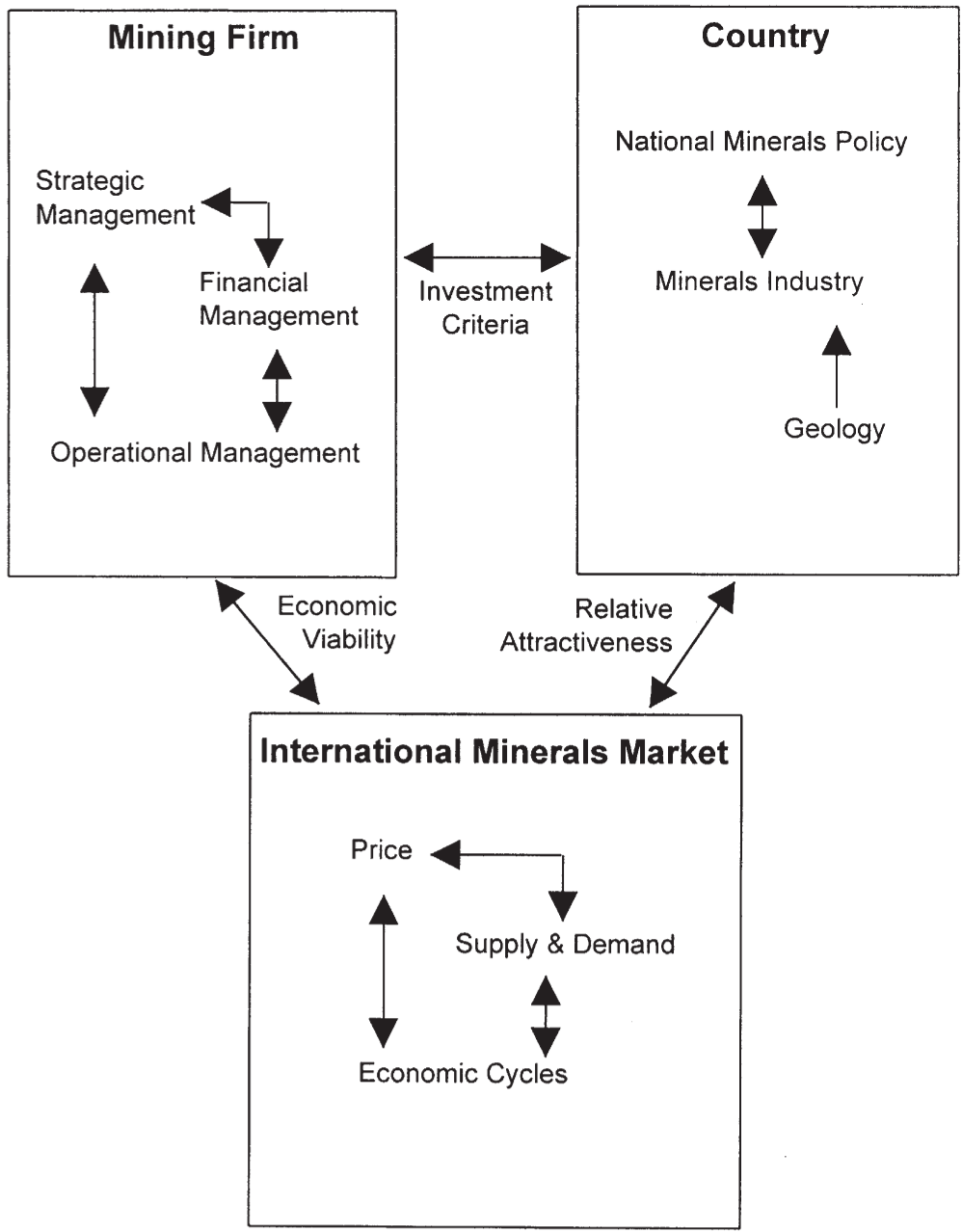 Figure 1: High-level sector map showing the interaction between market forces, firm decisions, and country-level policies.
Experiments & Results: What Drives the System?
The model’s sensitivity analysis revealed that the system is most vulnerable to Paid-in Capital, Actual Geology, and Interest Rates.
- The "Survival Threshold": If a firm’s initial capital is lower than the average cost of exploration, it almost inevitably ceases operation before it can reach a profit-making state.
- Policy Sensitivity: The model suggests that the impact of environmental policy is "state-dependent." For instance, an increase in planning delays during a period of high metal prices might be manageable. However, the same delay during a market downturn can be the "death knell" for a marginal deposit.
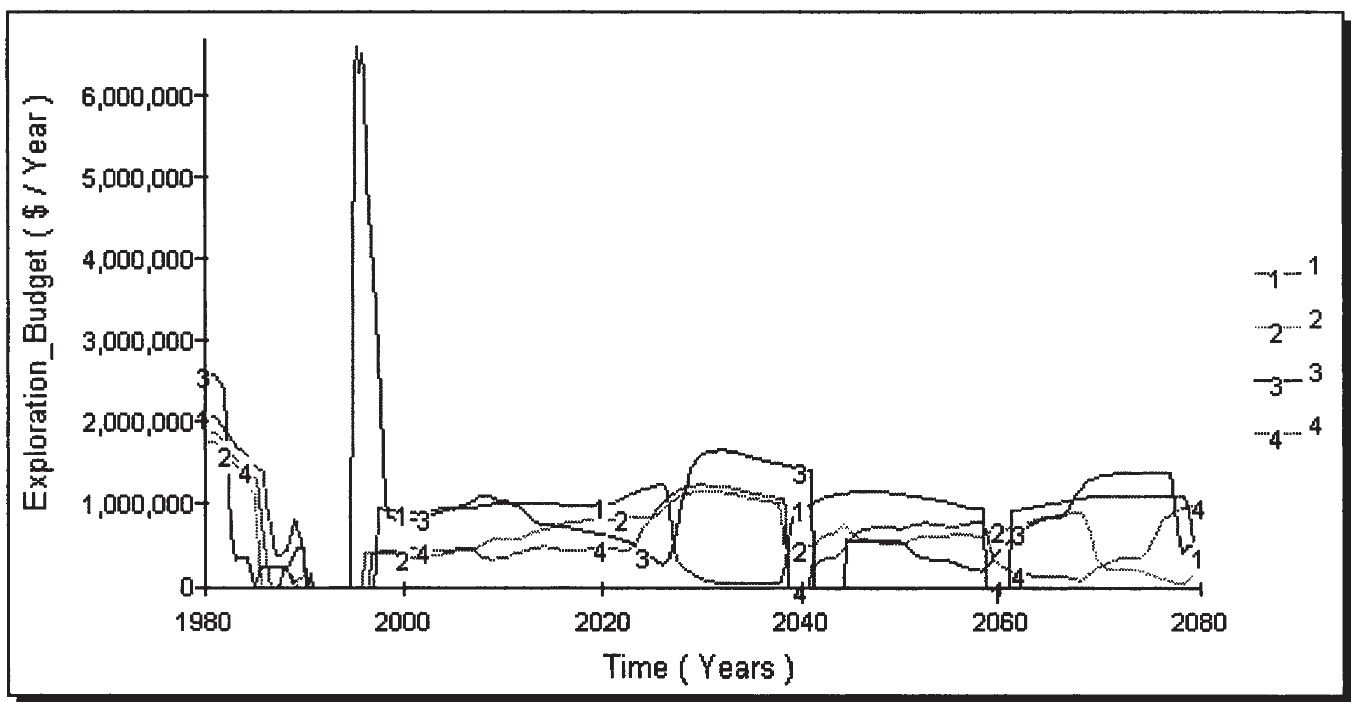 Figure 2: Simulation results showing how interest rate spikes negatively impact exploration spending across different firms (Firm 1-4).
Critical Analysis & Conclusion
This work acts as a bridge between abstract system theory and the gritty reality of the minerals industry.
Key Takeaways:
- Transparency of Assumptions: Unlike verbal policy reports, the SD model forces every assumption (e.g., "how much does price affect the budget?") to be quantified.
- Learning over Prediction: The authors are humble—they admit the model is an "aid to understanding" rather than a crystal ball. Its value lies in exposing the structure that prevents policy from reaching its goals.
Limitations & Future Work:
The authors note a lack of direct involvement from high-level industry executives during development, which may limit the "real-world" nuance of certain parameters. Future iterations could disaggregate the model further to tackle specific issues like waste management or carbon taxation with higher granularity.
In conclusion, the paper demonstrates that in a world of mobile international capital, a country’s "attractiveness" is a moving target defined by the state of the market, the speed of its bureaucracy, and the resilience of its geological data.