
Cascading Shocks: How Economic Sanctions Paralyze Industrial Supply Chains
A system dynamics model on the reasons of car price shocks after economic sanctions
This paper presents a System Dynamics (SD) model to analyze the macroeconomic mechanisms behind car price shocks following international sanctions. Focused on the 2012 Iranian case, the study integrates oil market dynamics with domestic automotive supply chains to simulate how oil-dependent economies react to trade restrictions.
TL;DR
This research investigates the 2012 Iranian economic crisis to explain why car prices tripled after sanctions targeted oil exports. By employing a System Dynamics (SD) model, the authors reveal that the shock wasn't just a simple supply-demand shift, but a systemic failure where oil revenue shortages triggered a currency collapse, which in turn skyrocketed the cost of imported raw materials for "domestic" car production.
Background: The Oil-Industry Dependency
When a country’s economy is heavily weighted toward a single export—in this case, crude oil—any external disruption acts as a metabolic shock. The paper positions itself as a bridge between macroeconomic energy modeling and microeconomic industrial impact analysis. It moves beyond static observations to show the fluid movement of value through the Iranian market.
The "Bullwhip" of Causal Loops
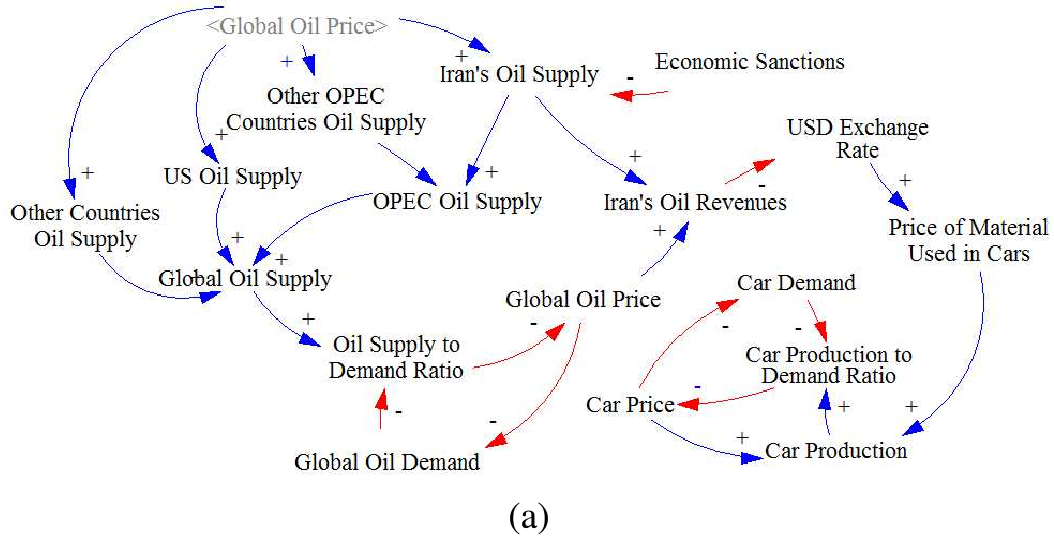
The authors argue that the car price shock is a secondary symptom of a primary energy industry wound. The logic follows a rigid causal chain:
- Sanctions lead to a collapse in Oil Production/Exports.
- Decreased exports dry up the Foreign Currency (USD) supply.
- A shortage of USD causes a massive Devaluation of the local currency (Rial).
- The automotive industry, despite being "local," relies on Imported Raw Materials, the cost of which scales with the exchange rate.
As shown in the causal loop diagram above, the model captures the balancing feedback: as prices rise, demand eventually drops, which acts as a late-stage brake on further price increases, eventually stabilizing the market at a much higher price floor.
Methodology: System Dynamics and Vensim
Unlike traditional linear regression, System Dynamics allows for the modeling of Stocks (accumulation of currency) and Flows (rate of imports/exports). By utilizing the Vensim PLE environment, the authors were able to simulate the "damped fluctuations" of oil prices and see how they propagate—with a distinct time delay—into the automotive sector.
Simulation Results: A 200% Surge
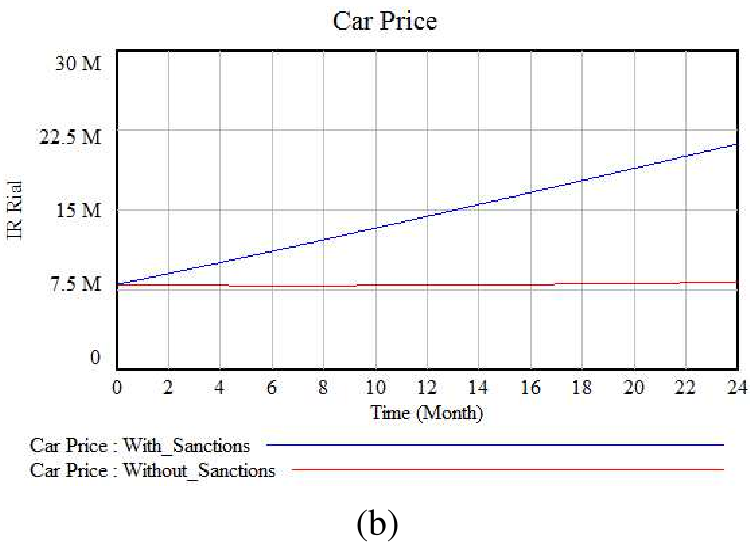
The simulation results are striking in their alignment with historical data. Upon the initialization of sanctions, the car price moves from a flat trajectory to a sharp upward curve.
Key takeaways from the simulation:
- Price Tripling: The car price reached approximately 3x its pre-sanction value.
- Propagation Delay: There is a visible lag between the oil export drop and the peak car price, representing the time it takes for currency reserves to deplete and for supply chains to process higher material costs.
- Equilibrium: The model predicts that the market eventually reaches a "new normal," where supply and demand balance out at the higher price point, albeit at a significantly lower volume of trade.
Critical Analysis & Future Outlook
This paper provides a robust framework for understanding Inductive Bias in economic modeling—the assumption that domestic industries are insulated from trade sanctions is proven false. The "domestic" label is often a facade; the underlying raw material and machine-tool dependencies create a hidden vulnerability to exchange rate volatility.
Limitations: The current model focuses heavily on the exchange rate mechanism. It does not fully account for psychological factors, such as speculative hoarding or the "black market" premiums that often emerge during hyperinflationary periods.
Future Directions: Extending this model to include multiple industrial sectors (electronics, pharmaceuticals) could provide a "Sensitivity Map" for nations to identify which parts of their domestic economy are most at risk during geopolitical tensions.