
Deciphering Digital Health: A System Dynamics Perspective on Smartphone ECG Monitoring
System Dynamics Modeling for Smartphone-Based Healthcare Tools: Case Study on ECG Monitoring
This paper introduces a System Dynamics (SD) framework to evaluate the effectiveness of smartphone-based ECG monitoring tools. By integrating technical metrics with socioeconomic factors, it models the nonlinear behavior and feedback loops of personal healthcare systems to guide patient and provider decision-making.
TL;DR
As mobile health (mHealth) applications explode in number, choosing the most effective tool becomes a complex engineering challenge. This paper moves beyond simple "feature lists" by applying System Dynamics (SD) to model smartphone-based ECG monitoring. It reveals how technical performance, cost, and patient wellbeing interact over time through nonlinear feedback loops, providing a blueprint for designing truly effective digital care tools.
Background Positioning
In the landscape of healthcare informatics, this work is a systemic framework contribution. It bridges the gap between low-level digital signal processing (DSP) of heartbeats and high-level public health management. By treating an ECG app not just as software, but as a component in a complex socio-technical system, the authors provide a rigorous methodology for "Visualizing Effectiveness."
The Core Challenge: Complexity Beyond the Algorithm
The primary motivation stems from a critical clinical window: most heart damage occurs within 30–90 minutes of an occlusion. While smartphone ECGs offer real-time monitoring, their "effectiveness" is often hampered by factors ignored in lab settings—battery life, user frustration, data privacy concerns, and cost. Traditional linear models cannot account for the delayed feedback loops where improved wellbeing eventually drives down costs and increases long-term demand.
Methodology: The Causal Architecture
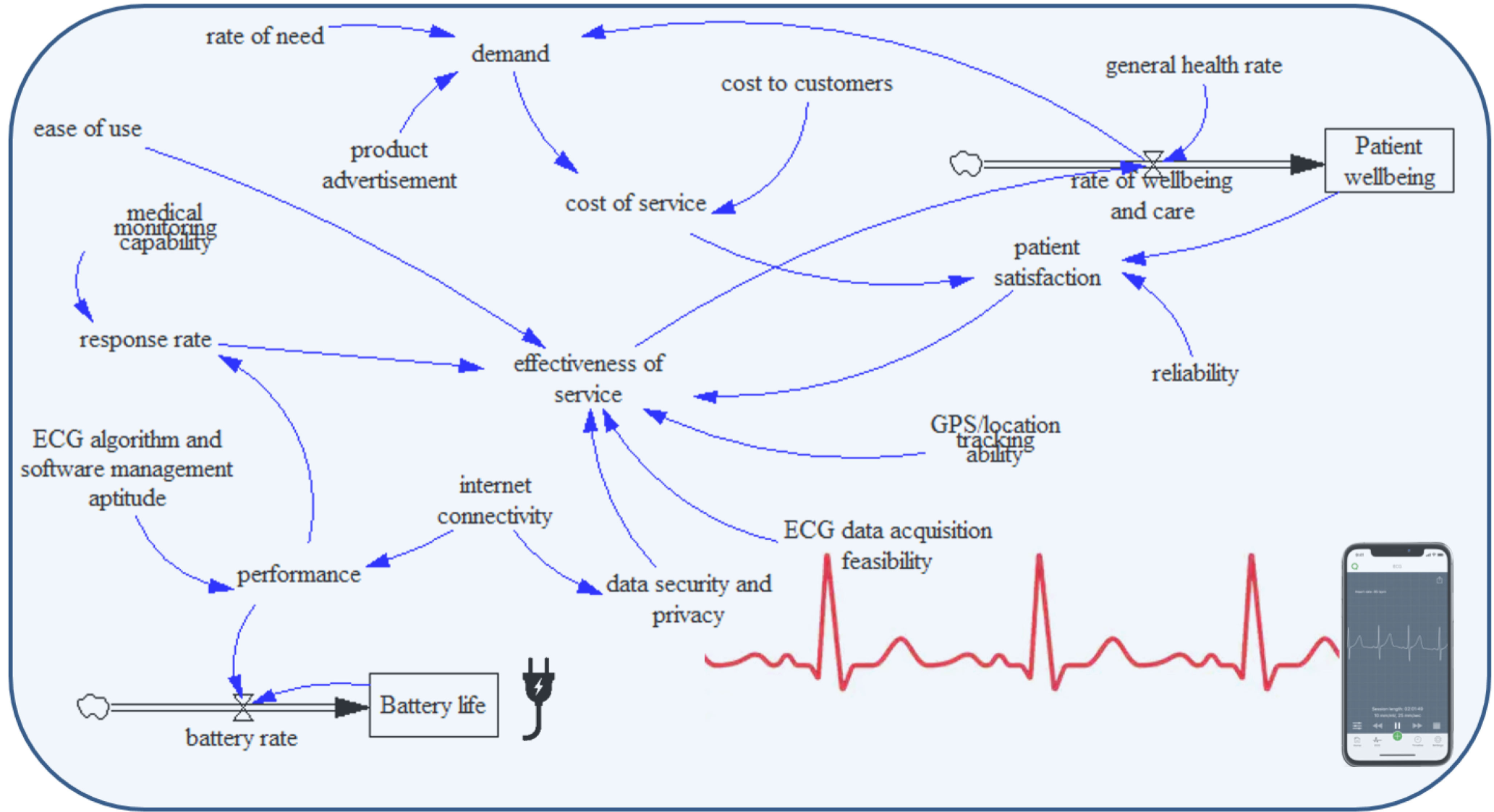
The authors propose a dual-layer approach: a Causal Model to map qualitative relationships and an SD Model to simulate quantitative behavior.
1. Causal Mapping
The framework identifies two critical feedback loops:
- The Wellness Loop: Effective service improves patient wellbeing, which boosts satisfaction, leading to higher perceived effectiveness—a reinforcing positive loop.
- The Economic Loop: Higher demand reduces per-user costs, which increases satisfaction and further drives effectiveness.
2. Mathematical Modeling
The "Effectiveness of Service" is modeled as a nonlinear product of several factors: This structure ensures that if any critical factor (like security) drops to zero, the total effectiveness collapses, mirroring real-world failure points.
Experimental Insights: What Actually Drives Success?
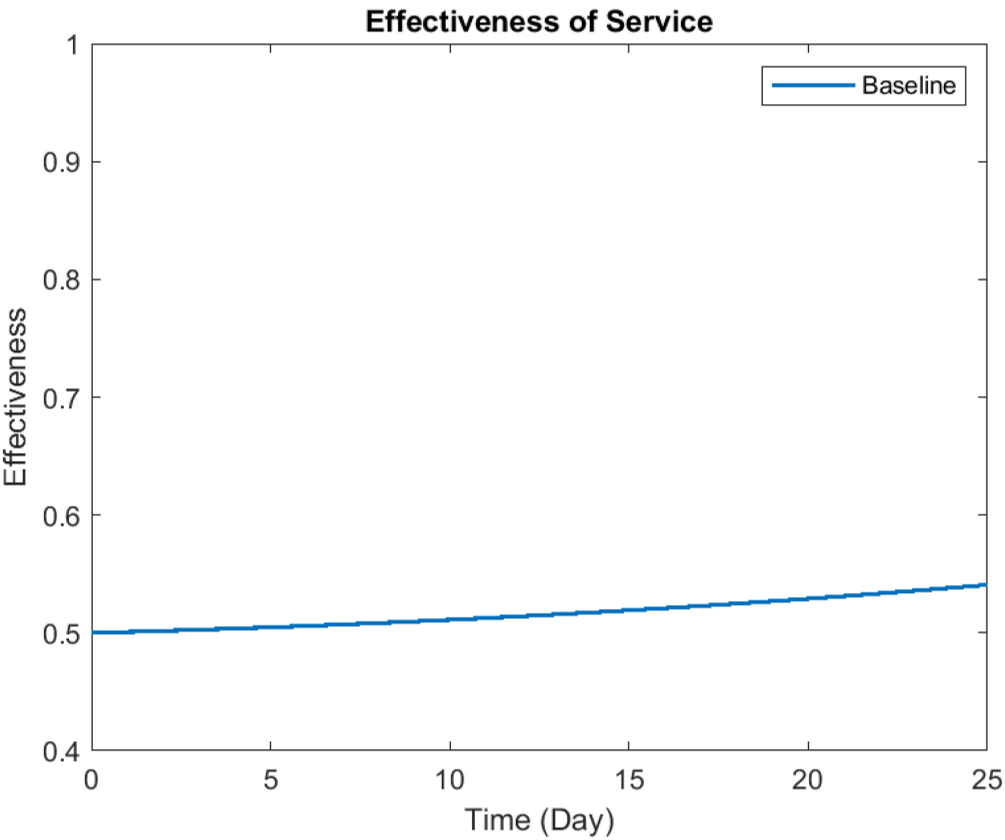
The study simulated seven scenarios to test the sensitivity of the system.
- Design Trumps Cost: Comparing Scenario 3 (High Cost) and Scenario 4 (High Design Focus), the simulation proves that improvements in "Ease of Use" and "ECG Data Feasibility" lead to a far more dramatic exponential rise in service effectiveness than just lowering the price point.
- The Battery Threshold: The model explicitly accounts for hardware constraints. If performance is optimized at the cost of excessive power consumption, the "Battery Rate" factor eventually forces the effectiveness to zero, providing a realistic assessment of embedded system limitations.
Professional Insight & Critical Analysis
The brilliance of this work lies in its Inductive Bias toward systems engineering. Most AI/ML papers in this field fixate on "R-peak detection accuracy." This paper reminds us that an accurate algorithm in an unusable app is effectively useless.
Limitations: The current model relies on normalized percentages (0.0 to 1.0) due to a lack of long-term clinical data. To reach its full potential, the "Stocks and Flows" would need to be populated with real-world longitudinal data from thousands of users over years.
Conclusion: A Future for Systemic Health
This paper serves as a vital signal for mHealth developers: effectiveness is a dynamic, not a static, metric. Future iterations of this model could incorporate "Physician Satisfaction" and "Algorithm Complexity" to provide an even more granular view of the healthcare ecosystem. For researchers, it opens a path to use Vensim-style modeling to predict which healthcare technologies will survive the "valley of death" between clinical trial and market adoption.