
WeiheSD: Decoupling Economic Growth from Ecological Decay via System Dynamics
System dynamics simulation model for assessing socio-economic impacts of different levels of environmental flow allocation in the Weihe River Basin, China
This paper develops "WeiheSD," a complex system dynamics simulation model to assess the interactions between water resources, Environmental Flow (EF) requirements, and socio-economic growth in the Weihe River Basin, China. Using the Vensim PLE platform, it simulates 16 scenarios across four growth patterns and four levels of EF allocation to identify sustainable development pathways.
TL;DR
Researchers have developed a comprehensive System Dynamics (SD) model for the Weihe River Basin to resolve the escalating conflict between rapid industrialization and river health. The study demonstrates that while current growth patterns lead to catastrophic water shortages, an optimized path (Growth Mode B4) featuring advanced wastewater recycling can support both a high-tech economy and high-level environmental flows.
Context: The "Mother River" at a Crossroads
The Weihe River is the largest tributary of the Yellow River and the lifeblood of Shaanxi Province. However, rapid socio-economic expansion has stripped the river of its ecosystem functions. The fundamental challenge is Water Carrying Capacity: how much growth can the basin support while maintaining "Environmental Flow" (EF)—the water needed to keep the river alive?
The Problem: Static Models in a Dynamic World
Most hydrological models are static; they treat water demand as a fixed input. In reality, population growth, industrial efficiency, and wastewater policy form a complex web of feedbacks. Existing studies often focused solely on "self-produced" water, ignoring the critical role of inflows and the potential for a "circular water economy."
Methodology: The WeiheSD Framework
The authors built a model consisting of 160 variables across nine subsystems. A key technical contribution is the hierarchical definition of Environmental Flow levels:
- A1 (Minimum): 10% of multi-annual flow for basic aquatic life.
- A4 (Sediment Transport): The highest requirement (68.1 x 10^8 m³/year) to prevent the riverbed from clogging in this high-sediment region.
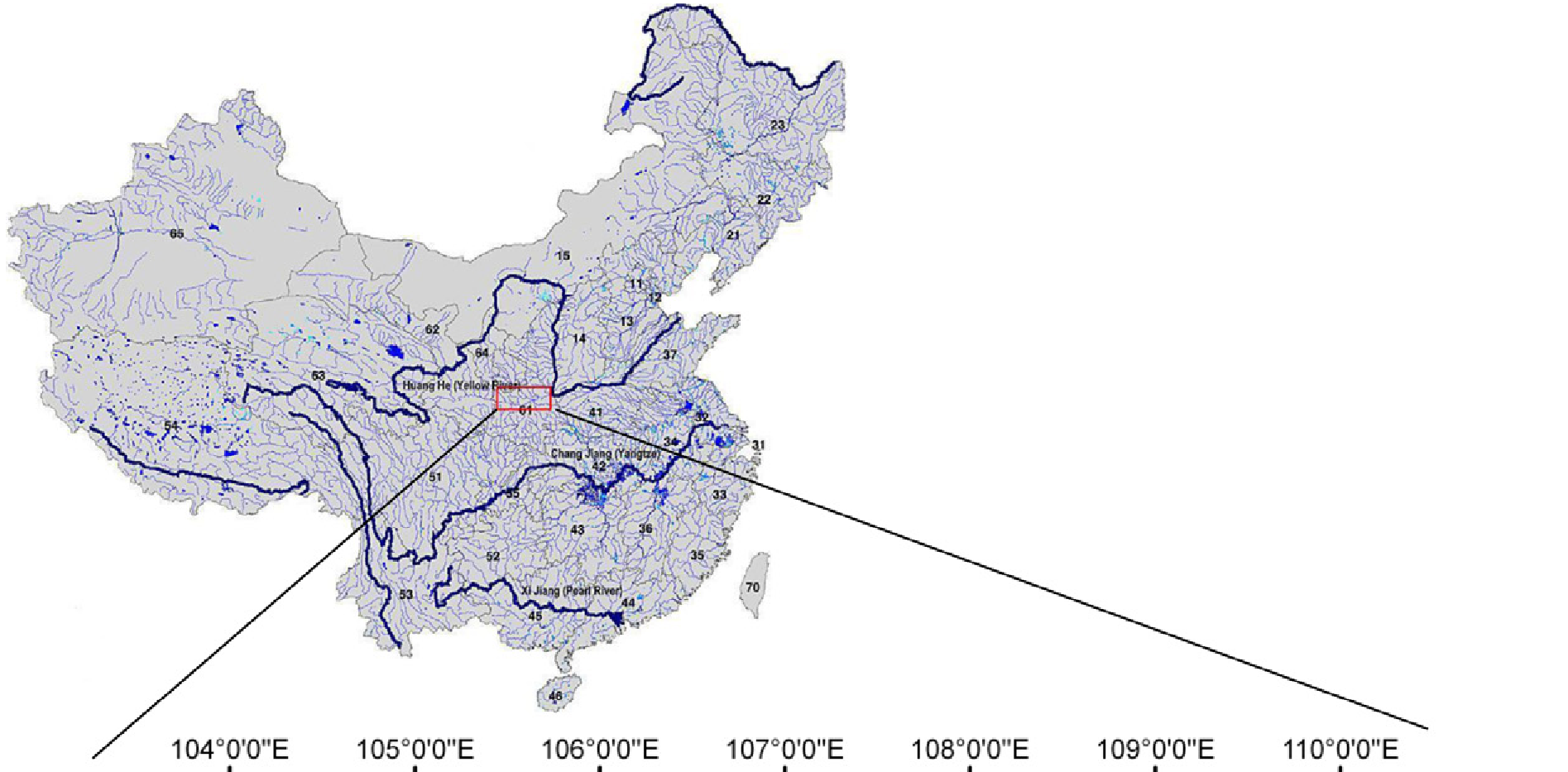 The internal feedback structure of the WeiheSD model, illustrating the coupling between population, water demand, and wastewater treatment.
Experimental Insights: Scenarios of Growth
The team tested 16 scenarios combining development modes (B1-B4) with EF levels (A1-A4).
- Business as Usual (B1): Leads to a "hard ceiling." As water is diverted for irrigation and industry, the ecological flow drops, eventually triggering a decline in the region's total carrying capacity (Population and GDP peak and then crash).
- The Middle Path (B3): Reducing growth rates eases water stress but at the cost of local welfare.
- The Optimized Strategy (B4): This is the breakthrough. By simulating aggressive technology adoption—such as increasing industrial wastewater reuse to 98% and raising treatment rates to 95%—the model shows that the basin can satisfy even the strictest sediment transport requirements (A4) without hindering economic prosperity.
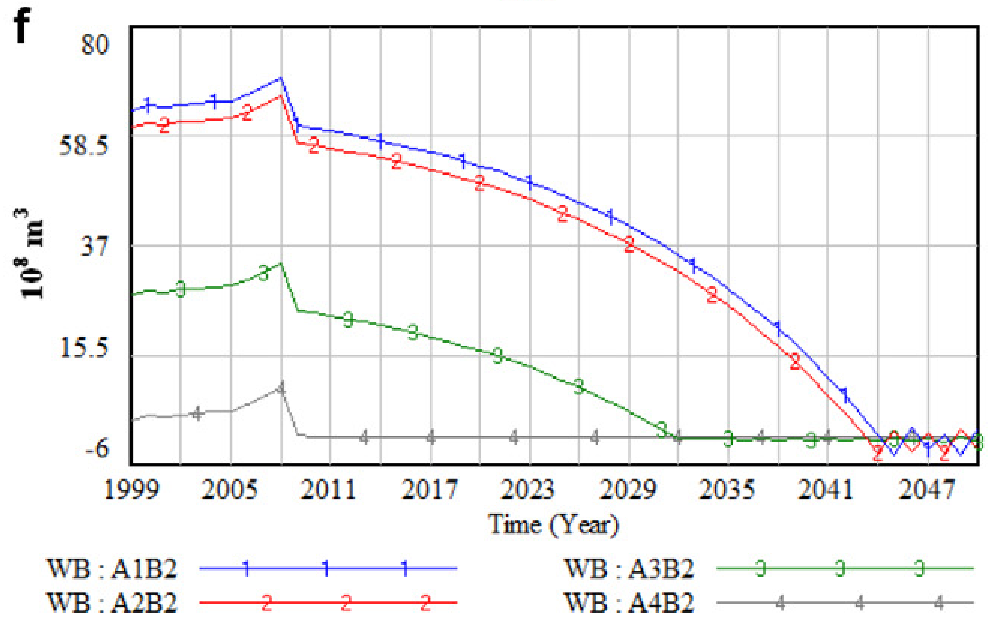 Simulation results showing total population (PT) and GDP trends. Note how higher EF allocations (A4) sharply curtail growth under current technology, but are mitigated in advanced scenarios.
Global Sensitivity Analysis
The "Tornado Diagram" analysis revealed that the Coefficient of Industrial Wastewater Discharged into Rivers (CRI) is the most sensitive parameter. This highlights that water quality management and the prevention of direct discharge are more influential on the system's stability than simple population control.
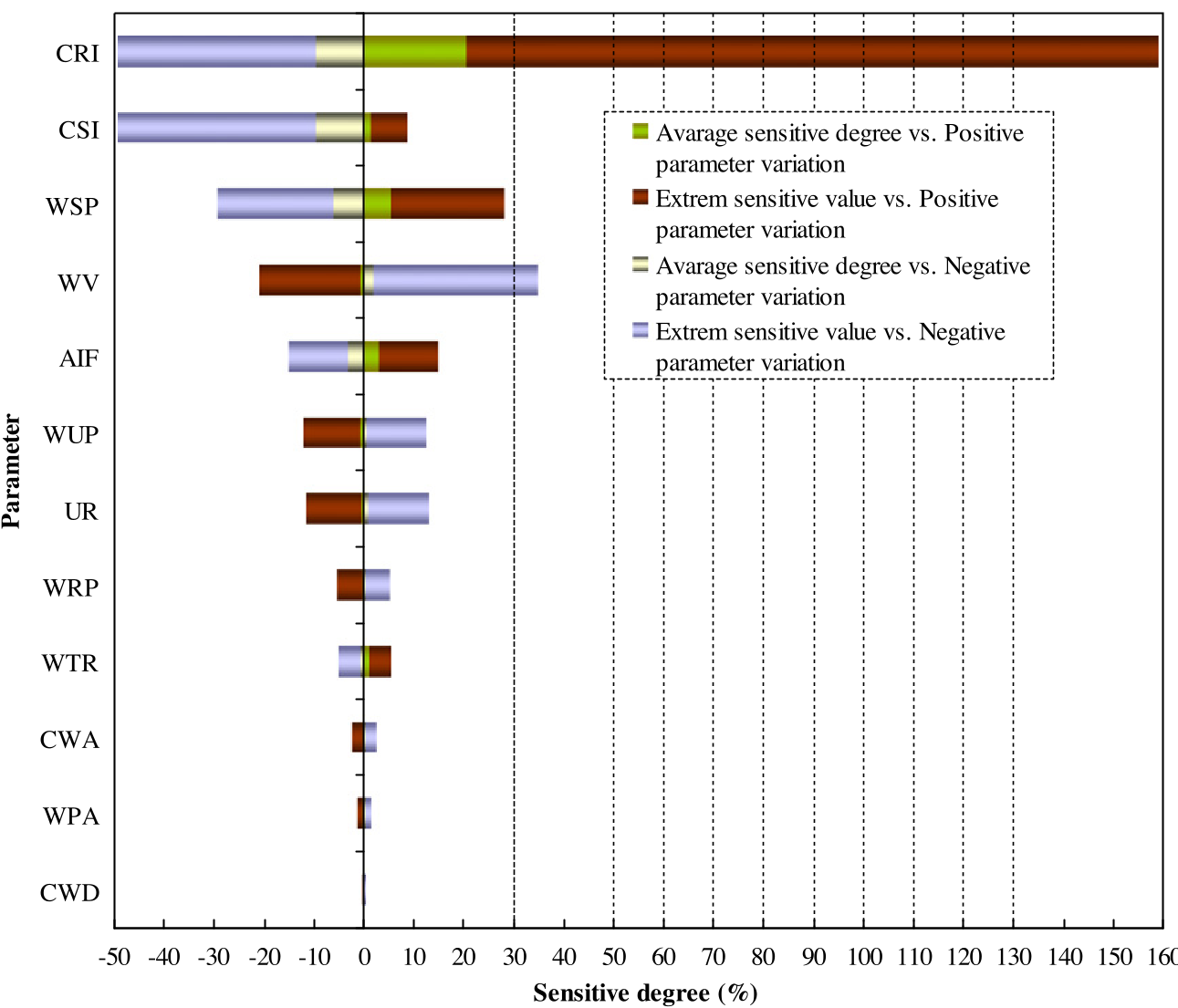 Tornado diagram identifying CRI and CSI as the primary levers for system health.
Final Critical Analysis
Takeaway
The paper shifts the narrative from "conservation vs. development" to "efficiency-driven sustainability." It proves that the Weihe River's crisis is not just one of volume, but of structural efficiency in the water cycle.
Limitations
- Data Reliability: The authors note that official statistics on wastewater treatment may be overly optimistic compared to field observations.
- External Factors: The model does not yet account for the volatility of Climate Change or the impact of Water Pricing on consumer behavior.
Future Outlook
The WeiheSD serves as a "socio-economic laboratory." Future iterations that integrate climate-driven hydrological variability and the economic elasticity of water demand will be essential for real-world policy drafting in water-scarce regions globally.