
Dynamic Networking: Why the Secret to SME Internationalization Lies in the Balance of Trust and Flexibility
A System Dynamics Approach for SMEs Internationalization Networking Process
This paper introduces a System Dynamics framework to analyze the networking process of Small and Medium-sized Enterprises (SMEs) internationalization. It integrates logistics capabilities, trust, commitment, and Supply Chain Flexibility (SCF) to model how these variables interact to drive global expansion.
TL;DR
For SMEs, going global isn't just about selling abroad—it's about surviving a complex web of relationships. This paper applies System Dynamics to show that while trust and commitment are the engines of internationalization, they come with a hidden cost: reduced flexibility. By modeling the interaction between logistics capabilities and supply chain flexibility (SCF), the authors provide a roadmap for SMEs to scale globally without getting trapped by dependency.
The "Liability of Outsider-ship"
Small and Medium-sized Enterprises (SMEs) face a fundamental paradox. They need to go international to grow, yet they lack the massive capital of multinationals. Their traditional weapon is Flexibility, but as they enter foreign markets, they must build deep Trust and Commitment with local partners to mitigate risks.
The problem? Prior research has mostly looked at these factors in isolation. We haven't fully understood the dynamic interplay: How does better logistics lead to more trust? And does being "too committed" to a foreign distributor actually make an SME slower to react to market shifts?
Methodology: The System Dynamics Lens
The authors move beyond static "snapshot" theories and adopt a System Dynamics approach. This methodology is uniquely suited for this problem because it focuses on Feedback Loops—how an increase in one variable (like logistics capabilities) cycles back to influence the others.
The Core Framework
The model identifies four categories of logistics capabilities that serve as the "input" for international success:
- Information Exchange
- Integration Capabilities
- Supply-Management
- Demand-Management
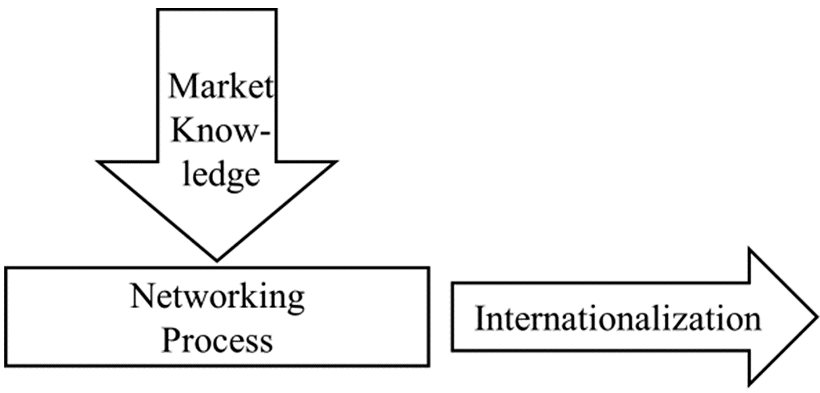
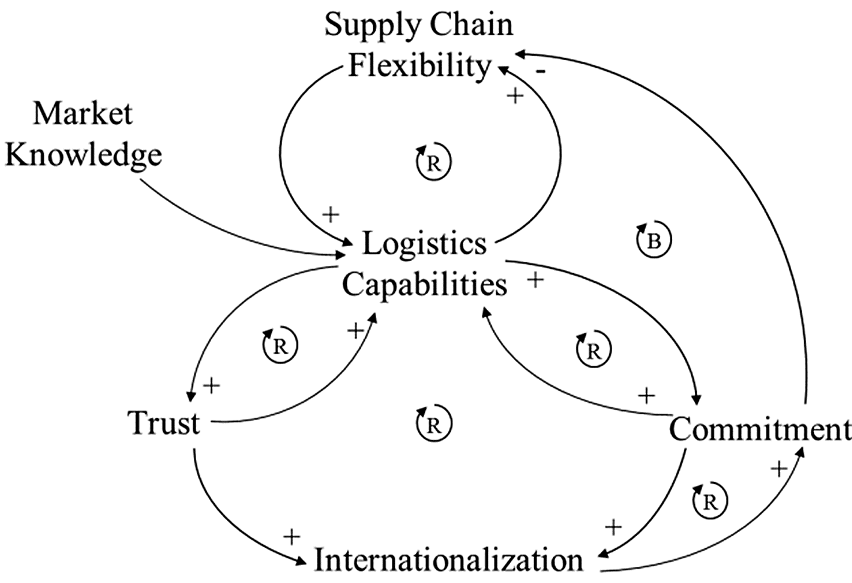
The logic is elegant: Market knowledge facilitates logistics capabilities, which build trust. Trust leads to commitment. But as the system iterates, these relationships become reinforcing.
Key Insights: The Paradox of Commitment
The most striking finding of this study is the inverse relationship between Commitment and Supply Chain Flexibility (SCF).
1. The Reinforcing Success Loop
High logistics capabilities (e.g., great demand management) build a track record of reliability. This fosters Trust, which encourages partners to invest more in the relationship (Commitment). This "Success Loop" accelerates the internationalization process.
2. The Rigidity Trap
As an SME becomes more committed to a specific supplier or market, it invests specialized resources into that single relationship. While this yields efficiency, it creates dependency. The paper demonstrates that as commitment peaks, the firm’s ability to "pivot" or reorganize (SCF) effectively decreases.
Critical Analysis & Conclusion
This work provides a sophisticated academic foundation for what many SME owners feel instinctively: "Don't put all your eggs in one basket."
Takeaways for Practitioners:
- Logistics is a Social Catalyst: Don't view logistics merely as "moving boxes." View it as the mechanism that builds the trust required for international expansion.
- Manage the Commitment-Flexibility Trade-off: High commitment is necessary to lower "outsider" risk, but it must be balanced. Managers should deliberately cultivate "Integration Capabilities" that allow for modularity even within committed partnerships.
Limitations & Future Work: As a conceptual System Dynamics model, the next step—already signaled by the authors—is empirical validation. Future research should apply real-world data from SMEs in developing countries to quantify the exact "tipping point" where commitment begins to erode flexibility to a dangerous degree.
In the era of volatile global trade, understanding these hidden dynamics isn't just academic—it's a matter of survival.