
[Nature 2025] CELLFIE: Orchestrating an Artificial Evolution to Engineer Superior CAR T Cells
Systematic discovery of CRISPR-boosted CAR T cell immunotherapies
The study introduces CELLFIE, a high-content CRISPR screening platform designed to optimize human primary Chimeric Antigen Receptor (CAR) T cells. By integrating genome-wide discovery with a novel in vivo CROP-seq method, the researchers identified RHOG knockout as a potent enhancer of CAR T cell efficacy, demonstrating superior tumor clearance and survival across multiple cancer models.
TL;DR
Researchers have unveiled CELLFIE, a comprehensive CRISPR screening ecosystem that systematically "evolves" CAR T cells to overcome clinical failures. By identifying and knocking out the RHOG gene—a gene paradoxically essential for normal immunity but a "brake" on engineered cells—they achieved unprecedented anti-tumor activity and long-term survival in aggressive leukemia models.
Deep Dive into the Motivation: Why Evolutionary Bias Limits Therapy
Chimeric Antigen Receptor (CAR) T cells are a triumph of synthetic biology, yet they often fail in the clinic. The reason? T cells have been optimized by millions of years of evolution for a human lifetime, not for the intensive, short-term "seek and destroy" missions required in oncology.
The authors' central insight is that some genes essential for normal T cell biology may actively restrict therapeutic performance. To find these "brakes," they needed a platform capable of genome-wide exploration not just in a plastic dish, but within the living, breathing complexity of a tumor-bearing organism.
Methodology: The CELLFIE Architecture and In Vivo CROP-seq
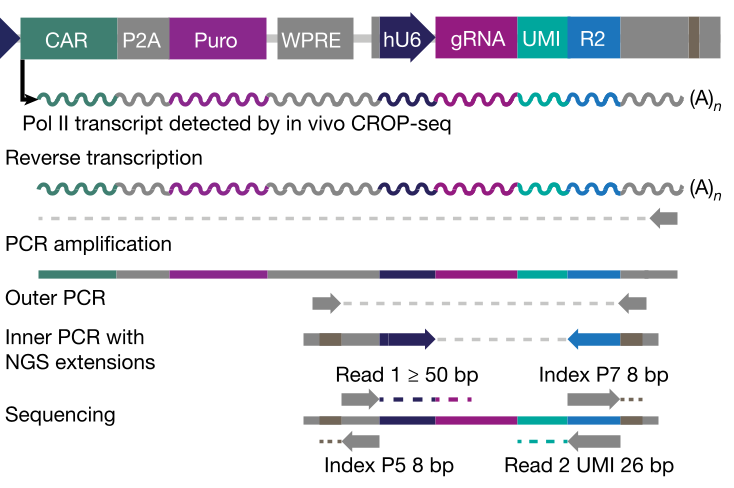
The technical core of CELLFIE is a modular CROP-seq-CAR vector. Unlike traditional screens that rely on DNA sequencing of gRNAs (which is notoriously difficult to recover from small amounts of tissue in mice), this platform transcribes the gRNA into an mRNA transcript.
Key Technical Innovations:
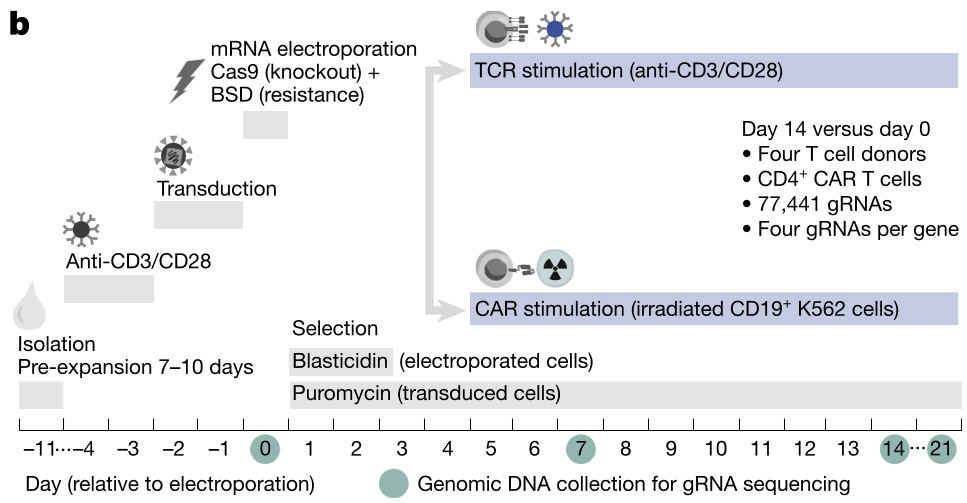
- mRNA CRISPR Delivery: Instead of lentiviral Cas9 (which is bulky and inefficient), they used custom-made mRNA to deliver Cas9, base editors (ABE/CBE), and activators. This cut costs by 10x while maintaining >80% editing efficiency.
- In Vivo CROP-seq with UMIs: By adding Unique Molecular Identifiers (UMIs) to each cell, the team could track thousands of individual T cell clones in a mouse, distinguishing true biological "winners" from lucky survivors of random drift.
The Discovery: RHOG as the Unexpected Booster
Through 58 genome-wide screens, one gene stood out: RHOG. This was a shock to the system. In standard human biology, RHOG deficiency causes immunodeficiency. However, in the context of CAR T cells, its loss is a superpower.
How RHOG-KO works:
- Enhanced Proliferation: KO cells reach 6-10x higher abundance in the spleen and bone marrow.
- Memory Phenotype: It shifts cells toward a Central Memory state (CD62L+), which is highly correlated with clinical success.
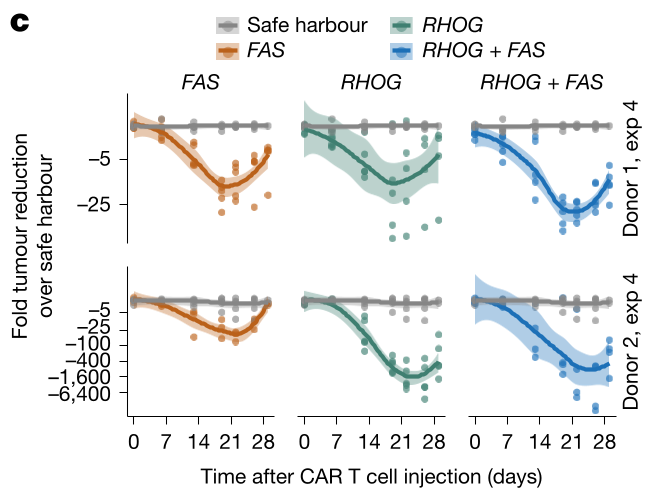
- Synergy with FAS: While RHOG-KO boosts proliferation, knocking out FAS stops the cells from killing themselves (anti-apoptosis). Together, this "gas and no brake" combination provided curative results in models where standard CAR T cells were universally fatal.
Experimental Results: Breaking the Benchmarks
In head-to-head comparisons, the RHOG + FAS double-knockout was the clear victor. In a "suboptimal dose" challenge—designed to ensure standard CAR T cells would fail—the boosted cells cleared the leukemia and prevented relapse for over 300 days.
Furthermore, the team used Base Editing tiling screens to map the catalytic pocket of the RHOG protein. This allowed them to identify precise, single-nucleotide changes that could "break" RHOG's inhibitory effect without making double-strand DNA breaks—a critical step for moving toward safer clinical trials.
Critical Insight & Conclusion
The CELLFIE platform represents a shift from "trial and error" cell engineering to systematic, data-driven evolution.
Takeaway: The discovery of RHOG highlights that we cannot rely on "normal" immunology to guide the engineering of synthetic cells. By using platforms like CELLFIE to find where natural evolution left off, we can program the next generation of curative therapies.
Limitations: While the xenograft models are a industry standard, they use immunodeficient mice (NSG). Future work must move into immunocompetent models to see how these "boosted" cells interact with a full host immune system.