
Deciphering the Digital Pulse: A Framework for Dynamic and Heterogeneous Social Analysis
Systematic Dynamic and Heterogeneous Analysis of Rich Social Network Data
This paper presents a computational framework for the systematic analysis of dynamic and heterogeneous social network data. Validated on a multi-modal dataset from 150 college students over 18 months, the study evaluates network evolution and cross-type dependencies (SMS, Call, Facebook, Proximity) using four distinct similarity measures (CE, ACE, PDD, GDD).
TL;DR
Researchers have developed a rigorous framework to analyze how our social lives evolve over time across multiple communication "layers" (SMS, Calls, Facebook, Face-to-Face). By analyzing 18 months of data from college students, the study reveals that while our physical interactions are highly sensitive to schedules like holidays, our digital shadows on Facebook follow an entirely different, less "personal" rhythm.
Contextual Positioning
In the landscape of Network Science, this work moves beyond the "static snapshot" limitation. It positions itself as a methodology-first paper that bridges the gap between homogenous analysis (one link type) and multiplex analysis (interdependent link types). It challenges the arbitrary nature of parameter selection in temporal networks, offering a systematic way to define "meaningful" snapshots.
Motivation: The Arbitrary Snapshot Problem
Most dynamic network studies slice time into buckets (e.g., one week or one month) without validating if these slices capture reality. If the bucket is too large, you lose "high-frequency" events like a Thanksgiving break; if it's too small, the network becomes a collection of disconnected dots. The authors argue that understanding the mechanisms of these choices is as critical as the analysis itself.
Methodology: The Core Framework
The framework utilizes two primary levers for network construction:
- Timescale (): Determining the window length for a snapshot.
- Link Strength (): Setting a threshold for the number of interactions required to establish an edge.
To compare these slices, the authors use a sophisticated battery of tests:
- Node-Label Dependent: Common Edges (CE) and Adjusted Common Edges (ACE). These check if the same people are talking to each other.
- Topological (Label-Independent): Pearson Correlation of Degree Distributions (PDD) and Graphlet Degree Distribution (GDD). These check if the shape of the social circle is the same, even if the individuals change.
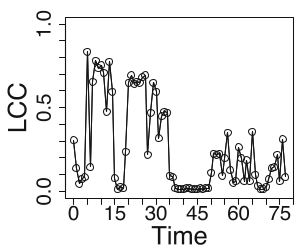 Figure 1: Evaluating the effect of on the Largest Connected Component (LCC) to find the "Goldilocks" zone of connectivity.
Experiments: What the Data Reveals
The study analyzed 150 students from the "NetSense" study, uncovering several high-impact insights:
1. The "Real-World" vs. "Digital" Divide
SMS, Phone Calls, and physical proximity (Bluetooth) are tightly coupled. They evolve together and react sharply to external events. In contrast, Facebook and Email were found to be "structurally disconnected" from these personal channels.
2. The Persistence of Communication
Consecutive time periods are naturally more similar, but SMS and Phone Calls show higher "persistence" than physical proximity. You might stop hanging out with a person physically over a break, but you keep texting them—bridging the temporal gap.
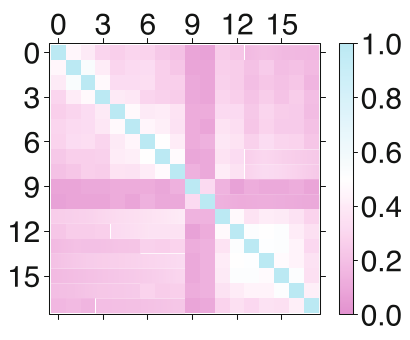 Figure 2: Heatmaps showing network similarity over 18 months. Note the distinct "voids" during summer breaks (slots 9-10).
3. Holiday Sensitivity
During summer breaks, Facebook and Email usage patterns remained largely unchanged, whereas physical proximity networks nearly vanished. This suggests that Facebook acts as a "low-intensity" social layer that doesn't strictly reflect the "high-intensity" bonds observed in face-to-face interactions.
Critical Analysis & Takeaways
The most profound contribution here is the validation of GDD as a robust measure for social networks, a tool originally popular in bioinformatics.
Limitations:
- The study treats all networks as unweighted and undirected, potentially losing the "direction of influence" in communication.
- The sample size (150 students) is robust for a controlled study but small compared to modern "Big Data" social graphs.
Future Outlook: This framework paves the way for more accurate Link Prediction. By knowing that a "near proximity" link today is highly likely to correlate with a "phone call" link tomorrow, AI models can better predict social tie formation in multiplex environments.