
Mapping the Pulse of Innovation: A Systematic Review of ML in Healthcare
Systematic Mapping Study of AI/Machine Learning in Healthcare and Future Directions
This paper presents a Systematic Mapping Study (SMS) of AI and Machine Learning applications in healthcare, analyzing 1,400 publications filtered down to 42 core studies. It categorizes the landscape into five key domains: medical image evaluation, EHR processing, interpretable ML, security frameworks, and transfer learning, identifying current research clusters and underserved diseases.
TL;DR
Artificial Intelligence is no longer just a buzzword in medicine; it is a diagnostic powerhouse. This study systematically maps the current state of Machine Learning (ML) across 1,400 papers, filtering them into 42 landmark studies. The results show a heavy bias toward Oncology and Medical Imaging, while uncovering a desperate need for Interpretable ML and research into neglected diseases like Epilepsy.
The "Black Box" Motivation
Despite the SOTA (State-of-the-Art) performance of models like Google DeepMind and IBM Watson, healthcare professionals remain hesitant. Why? Because most high-performing models are "Black Boxes."
The authors argue that for ML to move from a research curiosity to a bedside assistant, we must understand the why behind the what. This motivation drives their systematic map—identifying where we have succeeded (Imaging) and where we are failing (Interpretability and Security).
Methodology: The Mapping Process
The paper follows a rigorous 5-step Systematic Mapping Process to ensure an unbiased view of the academic landscape.

The researchers analyzed the papers across five dimensions:
- Interpretable ML: Methods that explain model behavior.
- Medical Image Evaluation: Analyzing X-rays, MRIs, and CT scans.
- Processing of EHR: Mining Electronic Health Records for predictive insights.
- Security/Privacy: Frameworks like Blockchain or Federated Learning to protect patient data.
- Transfer Learning: Adapting pre-trained models (like ImageNet) for specific medical tasks.
Key Results & Taxonomies
The data reveals a significant imbalance in current research priorities.
1. Technical Domain Clusters
| Category | Research Density |
|---|---|
| Evaluation of Medical Images | High (17 Papers) |
| Processing of EHR | Medium (14 Papers) |
| Interpretable ML | Emerging (7 Papers) |
| Transfer Learning | Low (4 Papers) |
2. Clinical Gaps
The disease-specific frequency chart (shown below) indicates that while Cancer and Heart Disease have high visibility, neurological conditions are largely ignored in the ML literature.
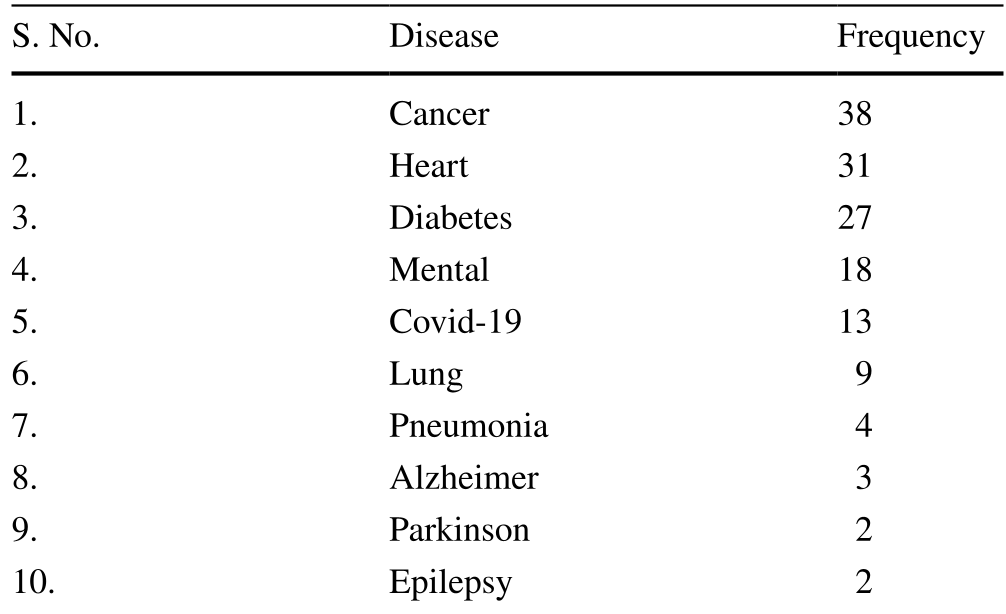
Deep Insight: Why Medical Imaging Dominates
The paper attributes the dominance of Medical Imaging (found in nearly 40% of the core papers) to the availability of datasets. Platforms like Kaggle and various medical imaging biobanks provide the "fuel" for Deep Learning models.
However, the authors point out a critical Inductive Bias: we are getting better at identifying patterns in pixels (Imaging) than we are at identifying causality in textual notes (EHR) or ensuring security in data transmission.
Critical Analysis & Future Outlook
The Interpretability Frontier: The study concludes that Interpretable ML is the most promising future direction. Clinicians don't just need a high F1-score; they need a "Visual Indicator" or a "Reasoning Logic" that justifies a diagnosis.
Limitations:
- The sample size of 42 "core" papers might be too narrow given the thousands of pre-prints appearing on ArXiv monthly.
- The survey focuses heavily on Google Scholar, potentially missing niche clinical journals or industry-specific whitepapers.
Conclusion: If you are a researcher looking for your next project, look away from Breast Cancer imaging—it is saturated. Instead, focus on Explainable AI for Epilepsy or Federated Learning for Secure EHR sharing. That is where the next frontier of healthcare innovation lies.