
Unlocking Educational Insights: Three Decades of Clustering in EDM
A Systematic Review on Educational Data Mining
This paper presents a comprehensive systematic literature review of Educational Data Mining (EDM), specifically focusing on clustering algorithms from 1983 to 2016. It identifies how unsupervised learning techniques are applied to educational attributes like learning styles, student behavior, and collaborative patterns to improve institutional effectiveness and the learning experience.
TL;DR
This systematic review explores the evolution of Educational Data Mining (EDM) from 1983 to 2016, focusing on how clustering algorithms transform raw institutional data into actionable pedagogical strategies. The paper concludes that while K-means remains the "workhorse" of the field, the future lies in addressing the complex, hierarchical nature of learner data through specialized preprocessing and collaborative filtering.
Problem & Motivation: Why General Data Mining Fails Education
Standard data mining algorithms often assume data points are independent and identically distributed. However, educational data is inherently hierarchical (students within classes, classes within schools) and non-independent.
The authors argue that the unique types of data—ranging from "brick and mortar" classroom interactions to "virtual" Learning Management System (LMS) logs—require a specialized approach called Educational Data Clustering (EDC). The core motivation is to move beyond simple reporting to predictive analytics: identifying at-risk students and personalizing learning paths before exam failure occurs.
Methodology: The EDC Framework
The paper utilizes a systematic methodology to categorize research across three decades. The authors emphasize that clustering in education is not just about the algorithm, but the Educational Data Clustering Process.
The Clustering Taxonomy
The review categorizes methods based on their structural approach:
- Partitional (Hard/Soft): K-means and Fuzzy C-means, used for grouping learners with similar cognitive styles.
- Hierarchical: Agglomerative methods, often used to model learner participation profiles in online forums.
- Density & Grid-based: Specialized for handling noise in large datasets (e.g., DBSCAN).
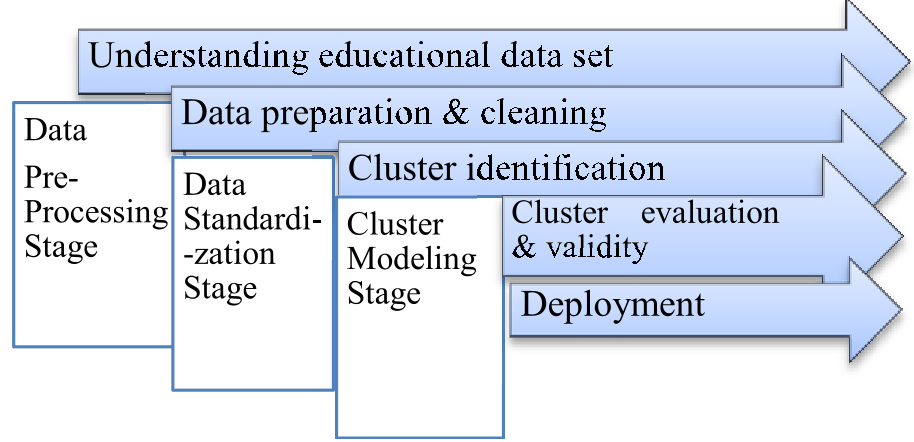 Figure 1: The standard workflow for EDM, moving from raw educational databases to validated model application.
Key Insights and Experimental Results
The review uncovers several fascinating correlations between physical/digital behavior and academic success:
- Spatial Deployment: Research indicated that students' physical seating choices are not random; those with high levels of spatial choice deployment scored 10% higher in assessments than their peers in low-choice groups.
- Collaborative Dynamics: Using Expectation-Maximization (EM) algorithms, researchers could distinguish between active and passive collaborators in online forums. This is crucial for "mirroring tools" that help small groups improve their teamwork skills in real-time.
- Learning Portfolios: Clustering students by "click frequency" and "engagement duration" in LMS environments (like Moodle) showed a direct positive correlation with final grades, emphasizing the value of consistent online participation.
 Table 2: A snapshot of diverse EDM applications, from predicting exam failure to analyzing classroom decoration.
Critical Analysis & Future Outlook
While the field has matured significantly, the authors identify a "Silo Effect." Most research focuses on E-Learning because the data is easy to collect (LMS logs), while critical areas like student motivation, classroom decoration effects, and education affordability remain under-researched.
The Roadmap for Future EDM
- Semi-supervised Clustering: Purely unsupervised models often produce clusters that make mathematical sense but lack pedagogical value. Incorporating "user-given constraints" (from teachers) will bridge this gap.
- Beyond K-means: There is a need for algorithms that can handle high-dimensional, noisy data without pre-defining the number of clusters (k).
- Semantic Web Integration: Leveraging ontologies to make educational content "discoverable" and "reusable" across different platforms.
Conclusion (Takeaway)
The systematic review proves that clustering is not just a statistical tool but a lens through which we can understand the hidden dynamics of the classroom. For educational institutions to evolve, they must move toward a data-driven culture where clustering informs everything from seating arrangements to personalized curriculum design.