
Beyond Tools: Reconfiguring the Landscape of Human-AI Partnership
Systemic Oversimplification Limits the Potential for Human-AI Partnership
The paper introduces the "Landscape of Human-AI Partnership," a theoretical framework that maps individual and joint capabilities across three dimensions: information certainty, response time, and task complexity. It moves beyond traditional "Human-or-AI" function allocation to propose an "Intelligent Sociotechnical Ecosystem" where AI and humans operate as interdependent teammates.
TL;DR
Is AI a threat, a tool, or a teammate? This paper argues that our current "Human-or-AI" binary is a systemic oversimplification that stunts technological potential. By introducing the Landscape of Human-AI Partnership, the authors provide a 3D framework (Time, Certainty, Complexity) to transition from simple task replacement to an Intelligent Sociotechnical Ecosystem where humans and AI evolve together.
The "Either-Or" Trap: Probing the Motivation
For decades, we’ve relied on the "Fitts List" or HABA-MABA (Humans-Are-Better-At, Machines-Are-Better-At). We assume humans are flexible but slow, while AI is rigid but lightning-fast.
The authors argue this logic only holds in the Simple Domain. When tasks become "Complex"—ambiguous, unbounded, and data-heavy—these linear assumptions collapse. In the complex domain, more time doesn't always lead to better human decisions (information overload), and more processing power doesn't solve AI’s struggle with causal inference. The motivation here is to build a "Human-AND-AI" paradigm that thrives on interdependency.
Methodology: Mapping Capability
The core of the paper is the Landscape of Human-AI Partnership. It maps "Capability" as a function of:
- Information Certainty: How much data do we have, and how reliable is it?
- Response Time: How fast must the system act?
- Task Complexity: Is the problem analytically solvable or ambiguously structured?
Visualization of the Landscape
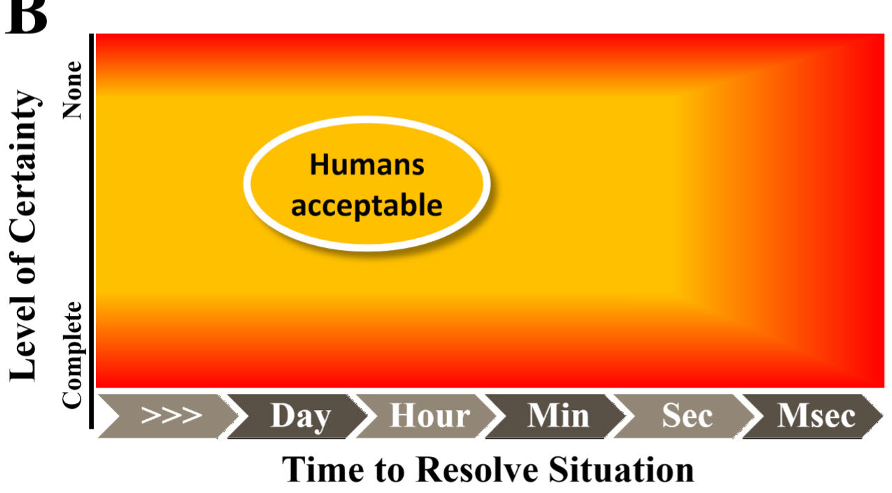 Figure 1: Panel A shows linear capability in simple tasks; Panel B shows the fragmented, non-linear capability in complex tasks.
The authors leverage the Privileged Sensing Framework (PSF). Instead of static roles, authority (or "privilege") is shifted dynamically. If the AI detects a pattern in milliseconds that a human can't, it takes the lead. If the situation requires "common sense" or ethical nuance, the AI cues the human.
The Case Study: The Driving Ecosystem
The paper illustrates this through a vehicle ecosystem. A standard driver is supported by three agents:
- Blind Spot Monitoring (BSMS): Operates well under high uncertainty (safety-first bias).
- Auto Emergency Braking (AEBS): Aggressive and fast, but only in low-time, high-certainty windows.
- Navigation Assistant (NAV): High capability across minutes, mapping dynamic traffic.
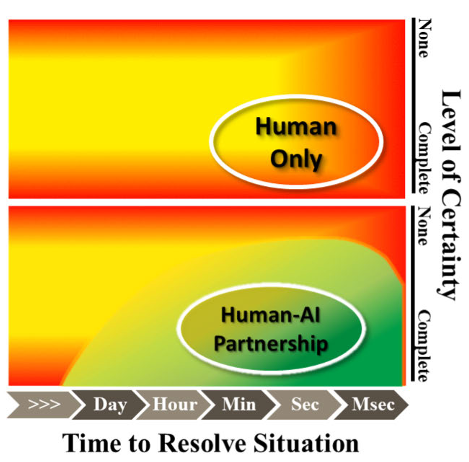 Figure 2: Contrast between human-only capability and the expanded emergent capability of the Human-AI ecosystem.
Six Strategies for Teaming
The paper defines a spectrum of interaction based on the time-certainty trade-off:
- Human-Biased AI: Human sets the "moral/style" parameters; AI executes at high speed.
- AI Cues Human: Pattern recognition signals the human to intervene in noisy data.
- Co-Development: Collaborative "Centaur" teams (like in Chess or Protein Folding) solving "AI-hard" problems.
- Co-Evolution: Long-term mutual adaptation where the AI learns from the human's "why" and the human learns the AI's "how."
Critical Insight: The Future of "Centaur" Teams
The "Takeaway" is profound: The whole is non-linearly greater than the sum of its parts.
Experimental data in fields like "Centaur Chess" and medical mission planning show that these hybrid teams outperform both the world’s best humans and the world’s best AIs. The limitation isn't the technology; it’s our refusal to let go of the "AI will make humans obsolete" myth.
Conclusion & Perspective
The authors conclude that we are at a "Singularity" of sociotechnical evolution. If we treat AI as an interdependent teammate, we unlock the ability to navigate high-complexity environments—from cybersecurity to urban warfare—that are currently "physically and informationally intractable."
Limitations: The paper notes that building these ecosystems requires a massive investment in Explainable AI (XAI). Without transparency, the "trust" required for dynamic privilege allocation will fracture, leading to system disuse or catastrophic misuse.