
T-OSN: Quantifying Trust Through Social Gravity and Interaction Frequency
T-OSN: A Trust Evaluation Model in Online Social Networks
The paper introduces T-OSN, a trust evaluation model for Online Social Networks (OSNs) that quantifies user trustworthiness using "Degree" (number of friends) and "Contact Interval" (communication frequency). Tested on real-world data from Bebo.com, the model provides a computationally efficient TL (Trust Level) metric to help users identify secure connections.
TL;DR
Trust is the invisible currency of social networks, yet it is notoriously difficult to measure. T-OSN (Trust-Online Social Network) is a lightweight mathematical model that calculates a Trust Level (TL) by combining a user's social reach (Degree) with their interaction consistency (Contact Interval). It moves away from complex path-finding algorithms to provide an easy-to-implement security metric for modern OSNs.
Motivation: The Paradox of Numbers
In a digital world, how do you verify a stranger? Existing methods often fall into two traps:
- The Popularity Trap: Assuming someone with many friends is trustworthy. However, attackers often "friend-collect" to scrape data.
- The Profile Trap: Relying on bioraphical data (school, interests), which can be forged with a few clicks.
The authors argue that true trust is reflected in behavioral patterns—not just who you are connected to, but how often you actually engage with them.
Methodology: The T-OSN Mathematical Engine
T-OSN relies on two pillars to calculate the TL value, ensuring that the final score is normalized between 0 and 1.
1. Degree Centrality (The "Social Reach")
Derived from Freeman’s centrality, this measures the number of direct edges (friends) a node has.
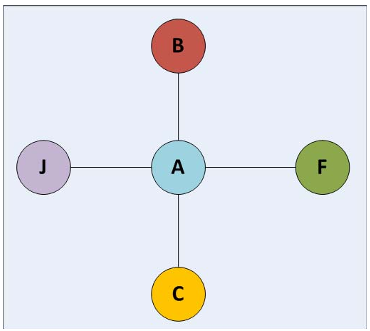 Figure 1: Traditional Degree Centrality where A is the hub.
2. Contact Interval (The "Active Pulse")
To filter out "fake hubs," the authors introduce the Contact Interval (CI). A shorter interval suggests a tighter, more active relationship. By combining these, the model ensures that a user must be both well-connected and consistently active to be deemed "Trustworthy."
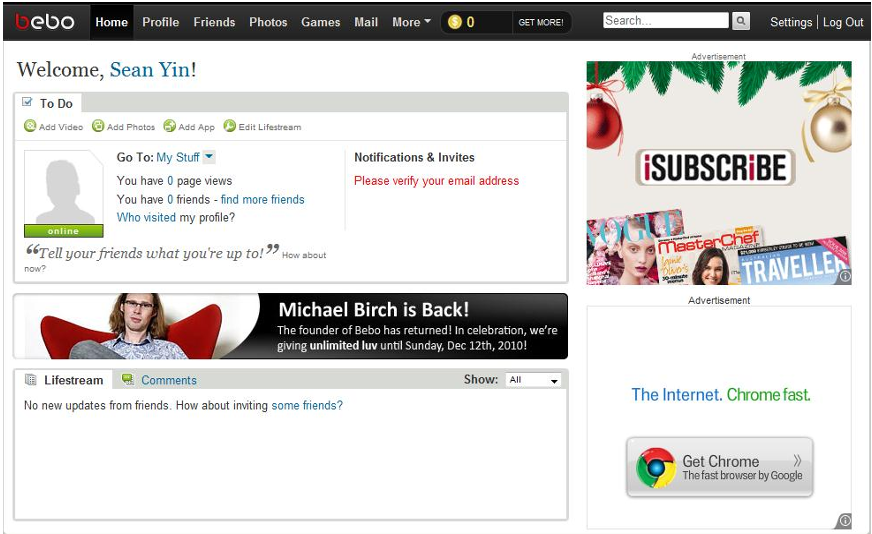 Figure 3: Visualizing Contact Interval as a trust validator.
Experiments: Validating on Real-World Data
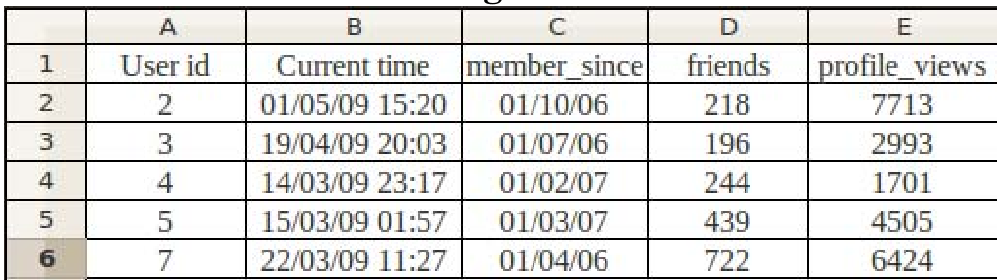
The authors tested T-OSN using historical data from Bebo.com. The challenge with raw data (Table 1) is that it's impossible to "eye-ball" who is trustworthy based on friend counts and profile views alone.
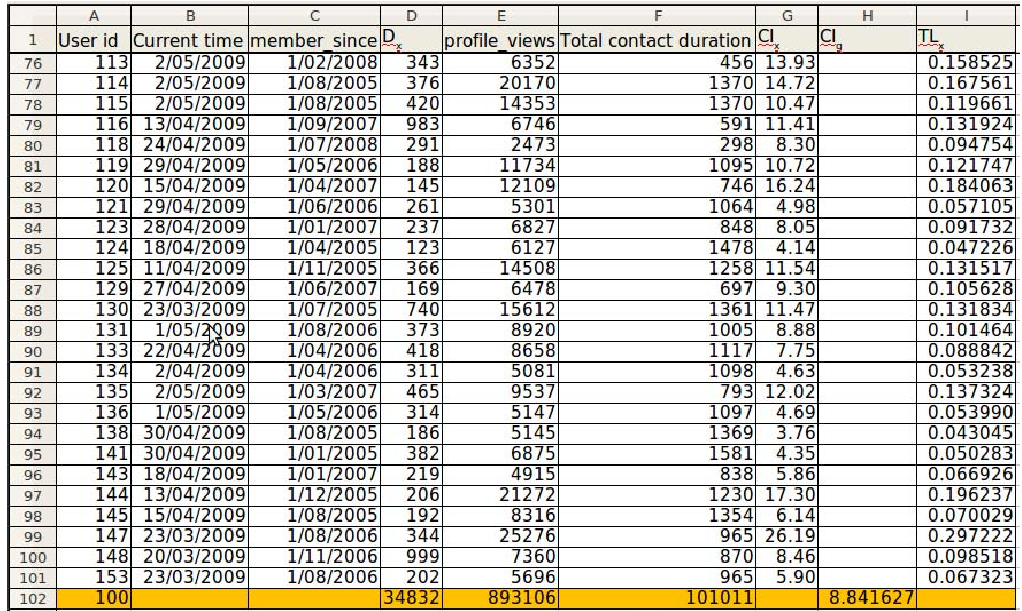
After applying the T-OSN formula to 100 users, the latent trust became visible. For example, User 147 achieved the highest TL of 0.297222, despite not having the highest number of friends. This proves the model's ability to prioritize quality of interaction over sheer quantity of connections.
Critical Insight & Conclusion
T-OSN's brilliance lies in its simplicity. It bypasses the "Cold Start" problem and the high computational cost of global graph analysis.
Takeaway: Effective OSN security doesn't always require deep packet inspection or complex AI; sometimes, the metadata of human interaction (Degree + Frequency) is the most honest signal.
Future Work: The authors suggest applying this to Mobile Ad-hoc Networks (MANETs) and Routing Protocols to identify "hot routers" that are consistently reliable for data forwarding.