
How the Tables Have Turned: The Sophisticated Evolution of Social Bots
How the tables have turned: studying the new wave of social bots on Twier using complex network analysis techniques
This paper presents a comparative study of the evolution of Twitter bots, transitioning from simple content polluters to sophisticated "Social Bots." By applying complex network analysis to political and advertisement datasets, the authors reveal how modern bots mimic human behavior through stable core-periphery structures and heterogeneous communication patterns.
TL;DR
The "arms race" between bot developers and social media platforms has entered a new phase. This research confirms that Twitter bots have evolved from loud, easily-blocked spammers into "Social Bots"—sophisticated entities that mimic human social structures, maintain high survival rates, and effectively hide within niche communities. Using complex network analysis, the authors prove that these bots are now more resilient and strategically organized than ever before.
Background: Beyond Simple Spam
Historically, bot detection relied on identifying "robotic" behavior: high-frequency posting, identical URLs, and strange account creation dates. However, the modern "Social Bot" has undergone a paradigm shift. They no longer act as isolated spray-and-pray spammers; they operate as coordinated, collective units that are nearly indistinguishable from humans, even to expert annotators.
The Evolution of Deception: Problem & Motivation
The core problem is that traditional detection algorithms—and even humans—suffer from low recall when facing these new entities.
- The Deception Gap: In crowdsourcing tests, humans identified these bots with less than 24% accuracy.
- The Survival Rate: Unlike traditional bots that are quickly suspended, 96.5% of the social bots studied remained active over long periods.
- The Methodology Flaw: Previous research focused on individual account features. This study argues that the secret to the bots' success lies in their collective network behavior.
Methodology: Mapping the Bot Social Fabric
The researchers didn't just look at tweets; they constructed five distinct networks: Social (Follower), Retweet (RT), Mention, URL, and Hashtag (HT).
1. Core-Periphery Stability
One of the most striking findings is how social bots organize. While traditional bots have unstable cores (the central players change depending on whether you look at retweets or mentions), social bots maintain a stable, strongly connected core across all communication channels.
 Note: The evolved core nodes stay intact across Retweet and Mention networks, mimicking robust human organizational structures.
2. Deep Embeddedness (K-Core Analysis)
Through K-Core decomposition, the study found that social bots are "shallow" in their follower networks but "deep" in their communication networks. They prioritize being central in conversations (hashtags/mentions) rather than just having a high follower count. This makes them cost-effective to produce but incredibly difficult and "expensive" for moderators to untangle.
Experimental Battleground: Network Robustness
The researchers subjected the bot networks to "targeted attacks"—simulating what happens when a platform suspends the most central accounts (leaders).
- Resilience: Social advertisement bots are remarkably robust. You would need to remove over 60% of their nodes to break the network group.
- Fragility of the Past: Traditional bot networks collapse almost immediately (before 40% removal) because they rely on a few obvious "hubs."
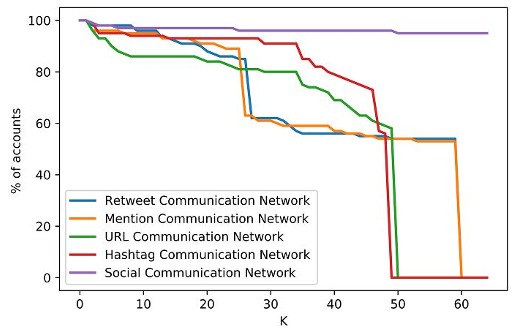 Social bots (solid lines) maintain a large connected component much longer than traditional bots under attack.
Content & Community: The "Niche" Strategy
Perhaps the most "human" trait discovered is the use of niche topic communities. Instead of only shouting about a political candidate or a product, social bots:
- Mix Content: They tweet about EDM music, web series, or local events.
- Information Cascades: They generate multi-user, sustained retweet chains that look like organic viral growth rather than a sudden spike of spam.
- Topical Stability: Using LDA topic modeling, the authors showed that social bots maintain a smooth, consistent distribution of topics over months, avoiding the "spiky" behavior of old-school spammers.
Deep Insights & Future Work
The study concludes that the "New Wave" of bots has successfully decentralized its leadership. By using different "leaders" for different communication roles (one account for mentions, another for retweets), they evade detection systems that look for single-point anomalies.
Key Takeaways for Developers & Researchers:
- Graph-based features are mandatory: Individual user metadata is no longer enough. We must analyze the "intersection of cores" across different interaction layers.
- Look for the "Normal": Bots that look too human (stable topics, niche interests) are often the most dangerous.
Final Thought
As we move into an era of LLM-powered bots, the "Social Bot" will only become more convincing. This paper provides the foundational network-level metrics needed to begin unmasking these coordinated actors in the wild.