
TACASHI: Harmonizing Social Trust and Path Integrity in the Internet of Vehicles
TACASHI: Trust-Aware Communication Architecture for Social Internet of Vehicles
This paper introduces TACASHI, a novel trust-aware communication architecture designed for the Social Internet of Vehicles (SIoV). It integrates inter-vehicle trust, human honesty factors derived from Online Social Networks (OSNs), and location-related honesty (LRH) to achieve high-accuracy misbehavior detection.
TL;DR
The Social Internet of Vehicles (SIoV) is no longer just about machines talking to machines; it is about the reliability of the humans behind those machines. TACASHI is a trust-aware architecture that evaluates vehicle reliability by looking at three dimensions: how a vehicle behaves on the road, how its driver behaves in online social networks (OSN), and whether its current path matches its historical patterns. It achieves a detection accuracy of up to 96%, effectively filtering out malicious actors that traditional models miss.
Problem & Motivation: The Human Element in SIoV
Traditional VANET (Vehicular Ad-hoc Network) security focuses on digital signatures and message integrity. However, the move toward IoV introduces a critical vulnerability: The Human Factor. A driver might be technically "authenticated" but socially "dishonest," potentially injecting false traffic data or participating in coordinated attacks to provoke "stolen vehicle" alerts or traffic chaos.
Existing solutions like RTM or AD-IoV often result in a high number of "doubtful" nodes—vehicles that don't satisfy the strict binary criteria of "good" or "bad." The authors' insight is that by cross-referencing a driver’s social reputation and their historical mobility habits, we can resolve these ambiguities.
Methodology: The Three Pillars of TACASHI
1. The Human Honesty Factor (HHF)
The most innovative part of TACASHI is its link to OSNs. It uses the Advogato trust metric, which is based on network flow (specifically the Ford-Fulkerson algorithm), to identify a "maximum set of trusted peers." If a node's behavior in the vehicle network is unclear, the system queries the driver's HHF.
- Logic: If you are a trusted developer or a reputable user in a social community, your reliability score helps "vouch" for your vehicle's behavior.
2. Location-Related Honesty (LRH)
TACASHI doesn't just trust that a vehicle is where it says it is. It compares the vehicle's current trajectory with an estimated path based on historical mobility profiles.
- Context Awareness: It accounts for social events (festivities, soccer games) and emergency situations that might justify a deviation from the normal path.
3. Lightweight In-Vehicle Security
Inter-device communication (e.g., between a passenger's phone and the vehicle) is secured using Chaotic Maps (Chebyshev polynomials). This is significantly more energy-efficient than traditional RSA or ECC, which is vital for battery-constrained mobile devices in an IoV ecosystem.
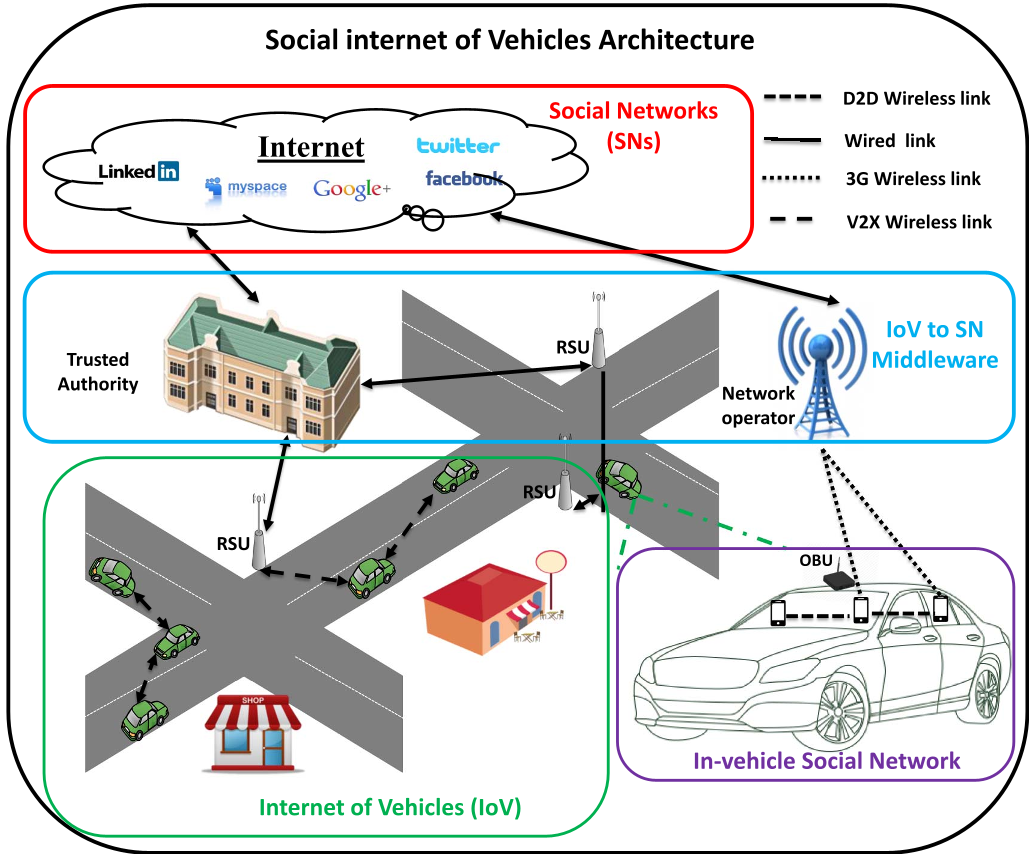 Figure 1: High-level overview of the TACASHI architecture involving OSNs, RSUs, and Path Prediction.
Experiments & Results
The authors tested TACASHI using the Epinions dataset (131k nodes) and the Citymob mobility model in a simulated 4 km² area of Laghouat city.
- Superior Detection: When human factors (HHF) are considered (TACASHI+), detection ratios reach nearly optimal performance (~96% for 10% malicious nodes), drastically reducing the confidence interval compared to versions without social data.
- Accuracy vs. Baselines: TACASHI significantly outperforms RTM and AD-IoV in filtering false evaluations (false positives).
- Latency Trade-off: Computing the social trust and path estimation adds approximately 2 to 5 seconds of delay. While this is too slow for "hard" real-time safety actions (like emergency braking), it is fast enough to prevent "soft" security threats like vehicle theft or system tampering.
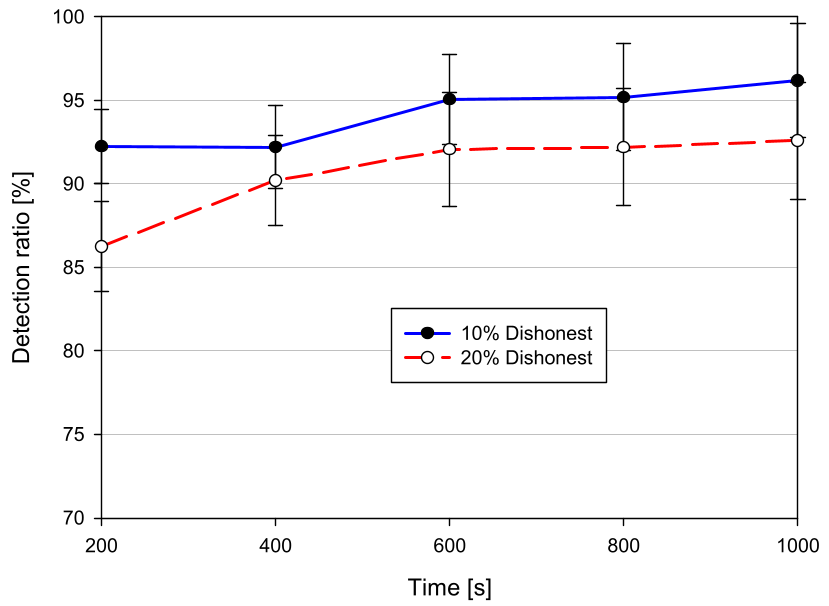 Figure 2: Performance comparison showing TACASHI reaching higher detection ratios than previous IoV trust management schemes.
Critical Analysis & Conclusion
Takeaway
TACASHI represents a significant step toward Human-Centric Security. By moving the trust anchor from the device to the user (via OSN), the system becomes more resilient to "device-only" compromises.
Limitations
- Privacy Concerns: Although the paper mentions anonymization, linking physical movements to social profiles raises massive GDPR and privacy red flags that would require robust Zero-Knowledge Proof (ZKP) implementations in a production setting.
- Cold Start: For new drivers without a social history or a mobility profile, the system reverts to standard inter-vehicle trust, losing its competitive edge.
Future Outlook
The authors plan to introduce Unmanned Aerial Vehicles (UAVs) as a new social dimension to this architecture. In this vision, drones could serve as mobile observers to confirm location honesty in areas without RSU coverage, creating a 3D social trust mesh.