
TacForeSight: Why Predicting the "Feel" of the Future is the Key to Robust Manipulation
TacForeSight: Force-Guided Tactile World Model for Contact-Rich Manipulation
TacForeSight is a force-conditioned tactile world model and policy framework designed for contact-rich robotic manipulation. It introduces TacForceWM, which predicts short-horizon tactile latent dynamics by leveraging high-frequency wrist force/torque signals as leading indicators, achieving state-of-the-art performance in complex tasks like bulb locking and wire insertion.
TL;DR
Robots often struggle with "contact-rich" tasks—like inserting a lightbulb or swiping a card—because they react to physical changes rather than anticipating them. TacForeSight changes this by introducing a tactile world model that uses wrist force signals to predict future finger-tip tactile sensations. By "foreseeing" how contact will evolve, the robot can proactively adjust its grip and motion, achieving nearly double the success rate of traditional reactive policies under disturbances.
The Problem: The Latency of Reactivity
In human biology, our brains use load-related cues to anticipate object interaction states before they happen. Current robots, however, are largely reactive. When a robot inserts a bulb and hits an obstruction, a traditional policy sees the error after it has occurred.
The authors identify a critical asymmetry: Wrist force/torque (wrench) signals act as "leading indicators." They change slightly before the tactile sensors on the fingertips register significant deformation. Most existing models ignore this temporal hierarchy, treating all sensors as a flat soup of data.
Methodology: Anticipatory Contact Priors
TacForeSight is built on the intuition that global force guides local tactile evolution.
1. TacForceWM (The World Model)
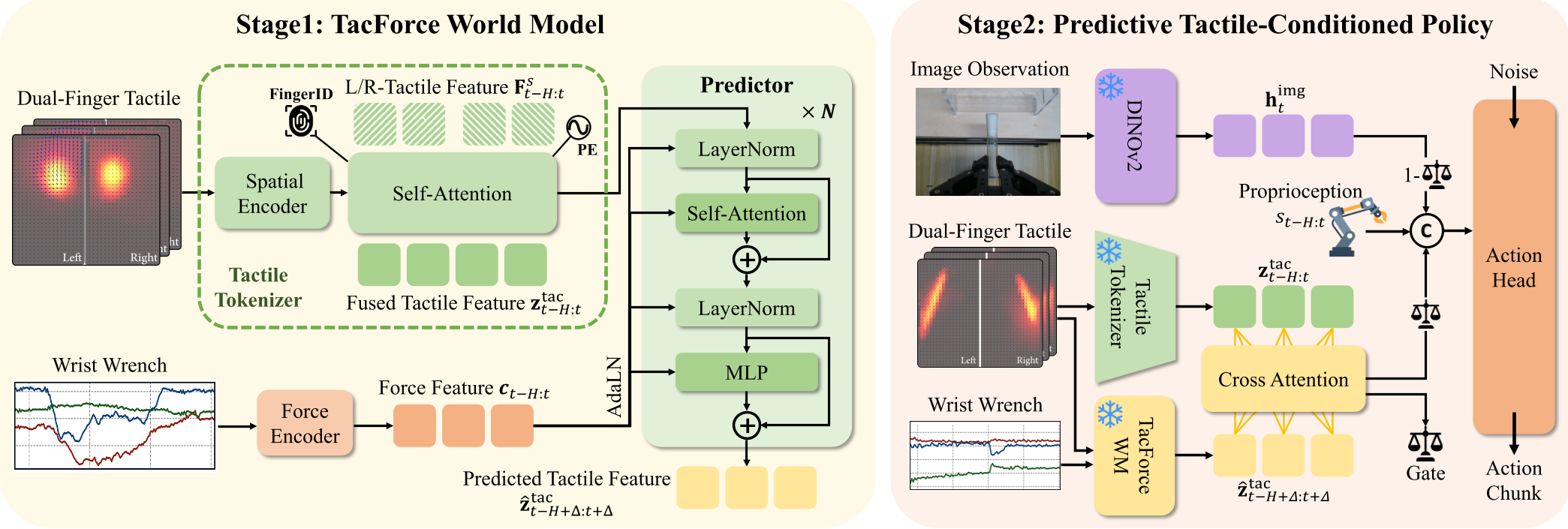
Instead of predicting high-dimensional video frames (which is slow), the authors use a Tactile Tokenizer to turn dense tactile maps into compact latents. A Transformer-based predictor then takes the current tactile state and "force conditions" it using high-frequency (120Hz) wrist wrench data.
2. Predictive Tactile-Conditioned Policy
The policy doesn't just look at what the fingers feel now. It uses Cross-Attention to compare the current tactile latent with the predicted future latent. This allows the robot to sense "Contact Transitions" (e.g., the moment the bulb threads catch) about 200ms before they actually occur.
3. Adaptive Gating
The robot doesn't always need tactile data. During free-space motion, vision dominates. During contact, tactile becomes critical. A Tactile-Guided Gate dynamically scales the importance of visual vs. tactile features based on the predicted interaction.
Experiments: Superior Robustness
The researchers tested TacForeSight on five grueling tasks: Vase Wiping, Card Swiping, Tube Adjustment, Bulb Locking, and Wire Insertion.
Performance Metrics
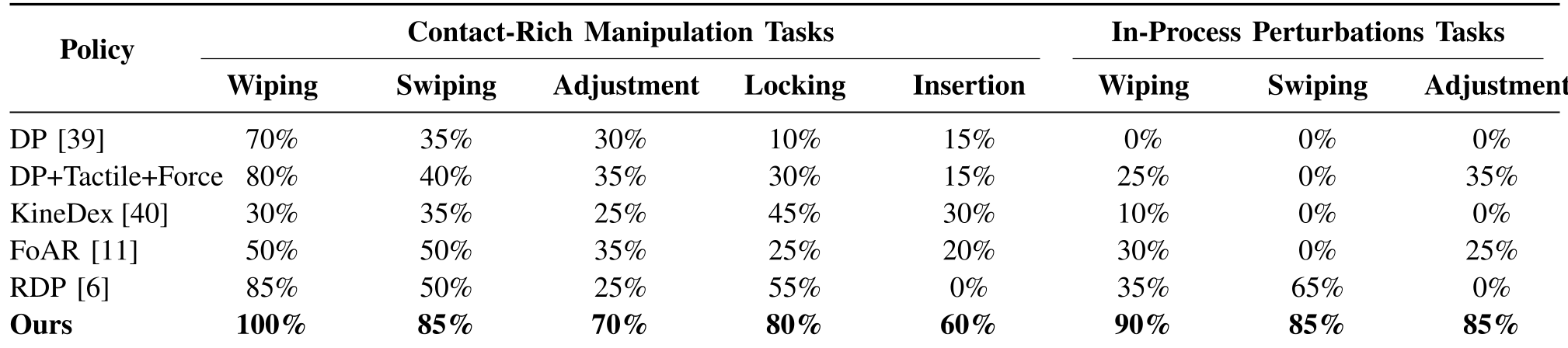
The gap between TacForeSight and standard Diffusion Policies (DP) is massive, especially when things go wrong:
- Nominal Tasks: 79.0% vs. 32% (KineDex).
- Perturbation (Disturbance): 86.7% vs. ~15-30% for others.
In "Bulb Insertion," when an external force nudged the robot, TacForeSight predicted the loss of contact and adjusted the trajectory to re-align, whereas reactive models simply got "stuck" or lost the part.
Critical Insights: The Value of Latent Prediction
One might ask: "Why not just predict raw tactile images?" The authors' ablation study proves that latent-space forecasting is not only more efficient (maintaining 20Hz real-time inference) but also more stable. By using the SIGReg (Sketched Isotropic Gaussian Regularizer), they prevent the model from "collapsing" (a common fail state in world models where the predictor starts outputting the same constant value).
Conclusion & Future Work
TacForeSight proves that for robots to move like humans, they must hallucinate the immediate physical future. While this work focuses on dual-finger grippers, the framework is architecturally generic. The next frontier? Applying this "Force-Conditioned Foresight" to whole-body manipulation or humanoid hands where the contact transitions are even more frequent and complex.
Keywords: Tactile Sensing, World Models, Robotic Manipulation, Force Control, Imitation Learning.