
Tactical Automation: Bridging the Gap Between Code and Quality Design
A tactic-centric approach for automating traceability of quality concerns
The paper introduces a tactic-centric approach for automating the traceability of quality concerns (security, reliability, performance) in software. It proposes a machine learning and structural analysis framework to identify "architectural tactics" in source code and map them to Tactic Traceability Information Models (tTIMs), achieving SOTA performance in preserving architectural integrity during maintenance.
Executive Summary
TL;DR: This paper tackles the age-old problem of "architectural erosion"—where software quality degrades because developers don't know why certain code exists. The authors propose an automated system to detect Architectural Tactics (reusable solutions for security, performance, etc.) using machine learning and structural analysis, essentially creating a "living map" of design decisions within the source code.
Background: Within the software engineering landscape, this work is a major move toward Automated Traceability Retrieval (ATR). Unlike previous work that manually mapped requirements, this study automates the link between abstract quality goals (like "it must be reliable") and the actual classes implementing them (like a "Heartbeat" mechanism).
The "Why": Why Architectures Rot
Maintaining a mission-critical system (think Boeing aircraft or Google Chrome) is a nightmare of "hidden logic." A developer might delete a seemingly redundant periodic message, not realizing it’s part of a Heartbeat Tactic essential for fault tolerance.
The problem is that manual tracing is too expensive for humans, and standard pattern-matching tools look for strict structures (like a Singleton pattern). Tactics, however, are behavioral: a "Heartbeat" can be implemented as an Observer, a Decorator, or a completely custom proprietary mess.
Methodology: The Tactic-Centric Engine
The authors propose a two-stage pipeline to bridge this semantic gap:
1. Tactic Recognition (The "What")
The core insight is that tactics leave "linguistic fingerprints" in code. By training a classifier on code snippets from 15 open-source systems, the algorithm learns indicator terms (e.g., ping, heart, timeout for Heartbeat).
2. Role Differentiation (The "How")
Once a class is tagged as "Heartbeat-related," the system needs to know its job. Is it the Emitter (sending the pulse) or the Receiver (monitoring)?
- Lightweight Structural Analysis: The system analyzes
extendsrelationships and method call dependencies. - tTIM Mapping: These roles are then mapped to a Tactic Traceability Information Model (tTIM), which anchors the code to the high-level design rationale.
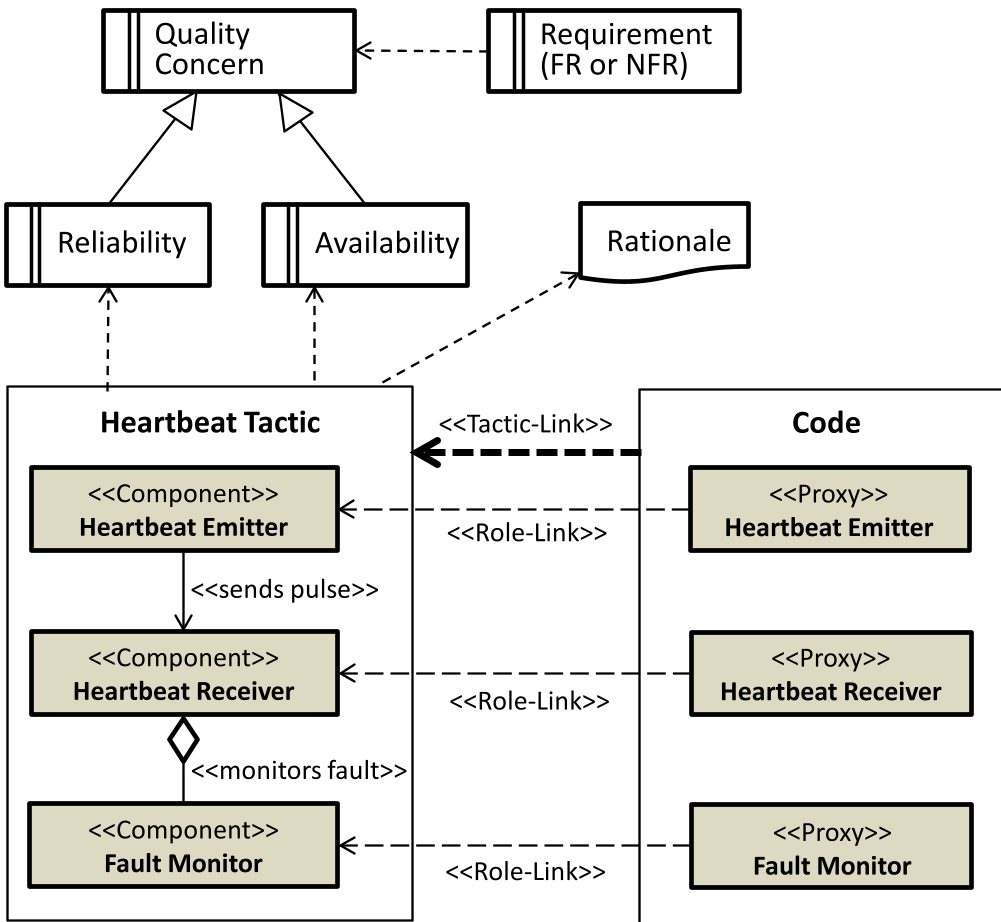 Figure: The tTIM for the Heartbeat tactic, defining roles like Emitter and Receiver.
Experiments: Testing on the Hadoop Titan
The authors tested their approach on Apache Hadoop, a framework with over 1,700 classes.
- Coarse-Grained Success: The code-trained classifier achieved near-perfect Recall (1.0) for Audit, Heartbeat, and Resource Pooling. This means the system almost never misses a class that is architecturally significant.
- Maintenance Support: In a simulation, whenever a developer modified a tactic-related class, the system sent a warning. This proactive approach maintained a specificity of over 0.93, meaning very few "false alarms" for most tactics.
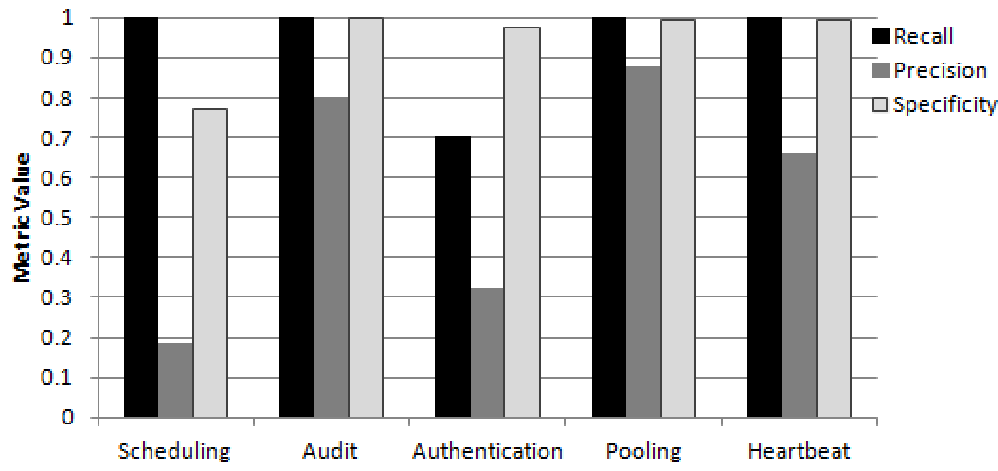 Figure: Performance metrics for tactic detection in Hadoop. Note high recall across major tactics.
Deep Insight: Why Tactics Over Patterns?
The brilliance of this paper lies in its pivot from Patterns to Tactics. Design patterns are about "how we organize code," but Tactics are about "what quality we want to achieve." By focusing on the intent (Reliability, Security), the authors have created a traceability tool that is actually aligned with the business value of the software.
Limitations & Future Work
While powerful, the approach relies on consistent terminology. If a developer names their Heartbeat classes Banana and Apple, the IR-based classifier will fail. The authors suggest that future iterations using more advanced semantic analysis or deep learning could mitigate this "vocabulary problem."
Takeaway
If we want to stop software from "rotting," we must make the architecture visible within the code. This tactic-centric approach provides the automated "glue" needed to keep high-level design and low-level source code in sync throughout the system's lifecycle.