
The Bridge of Tags: Decoding the Social and Semantic Structure of Online Networks
Analysis of tag within online social networks
This paper presents a comprehensive two-level analysis of the tagging ecosystem in Del.icio.us, identifying it as a bridge between users and resources. By modeling tag co-occurrence as a social network and visualizing individual behaviors, the authors demonstrate that tagging systems exhibit "Small World" and "Scale-Free" properties with significant semantic relatedness.
TL;DR
In the era of the participatory Web, tags serve as the vital connective tissue between human cognition and digital resources. This research analyzes the massive dataset of Del.icio.us to prove that user-generated tags aren't just random labels—they form a sophisticated Small World, Scale-Free network with deep semantic roots. By combining complex network theory with innovative visualization, the study reveals how "collective intelligence" organizes the internet more effectively than traditional taxonomies.
Problem: The Chaos of User Annotations
Why do we care about tags? In the early 2000s, the "Semantic Web" promised a machine-readable internet, but it required rigid, expert-defined ontologies that were too hard for everyday users to maintain. Enter Folksonomies: a bottom-up approach where users label things freely.
The skeptics argued that this would lead to chaos—ambiguity, synonyms, and "noise." The central question of this paper is: Is there an underlying order in this social at-will tagging, and can we prove it mathematically?
Methodology: A Two-Level Deep Dive
1. The Network Perspective
The researchers treated tags as nodes in a graph. A link is formed between two tags if they are frequently used together to describe the same URL. This "Tag Network" is evaluated using metrics from physics and sociology.
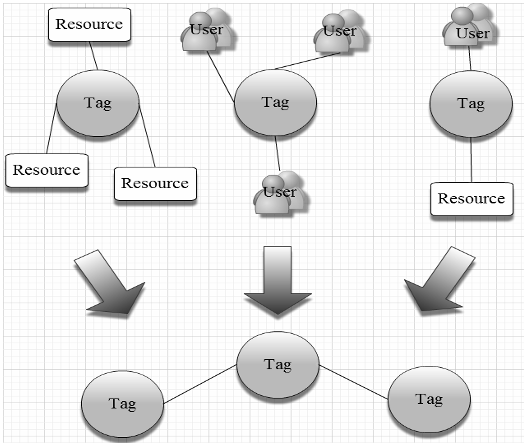 Figure: The triadic relationship between users, tags, and resources.
2. The Behavioral Perspective
To understand "How" and "When" people tag, the authors used Chromograms—mapping the first three letters of a tag to a specific color (Hue, Saturation, Brightness). This allows us to see patterns in human interest that would be invisible in a sea of text.
Technical Deep-Dive: Small Worlds and Scale-Free Hubs
The study’s most striking find is that the tag space mirrors the structure of the physical world and the internet itself:
- Small World Phenomenon: The "Six Degrees of Separation" exists in tags too. With an average path length of 6.97, you can get from "Java" to "Cooking" in surprisingly few hops. This high clustering coefficient (0.196) suggests that tags naturally form thematic "cliques."
- Scale-Free Distribution: A few "hub" tags (like software, blog, design) have a massive number of connections, while most tags have very few. This follows a power-law distribution ().
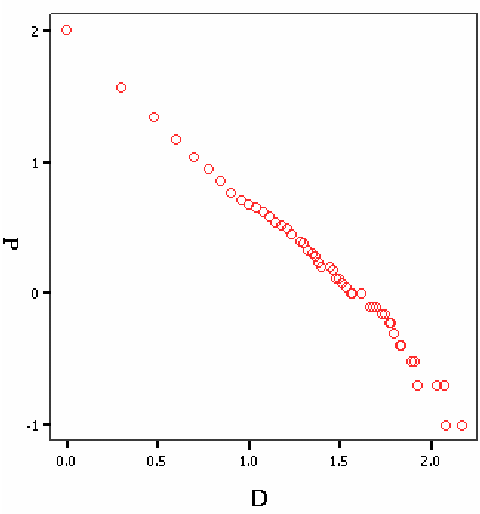 Figure: The power-law distribution proving the Scale-Free nature of tag networks.
Does it mean anything? (Semantic Relatedness)
Using Roget’s Thesaurus and search engine similarity (PMI), the authors proved that the distance between "connected" tags in the graph is significantly shorter than random pairs. This confirms that collective tagging acts as a surrogate for semantic understanding. When a thousand users link "Apple" with "Mac," they are building a real-world ontology that no dictionary can match in real-time.
Individual Behavior: The Rhythm of Tagging
Using TagScatter, the study tracks how users evolve. Most users have a "long tail" of interests: they use a few tags heavily and a vast number of tags once or twice.
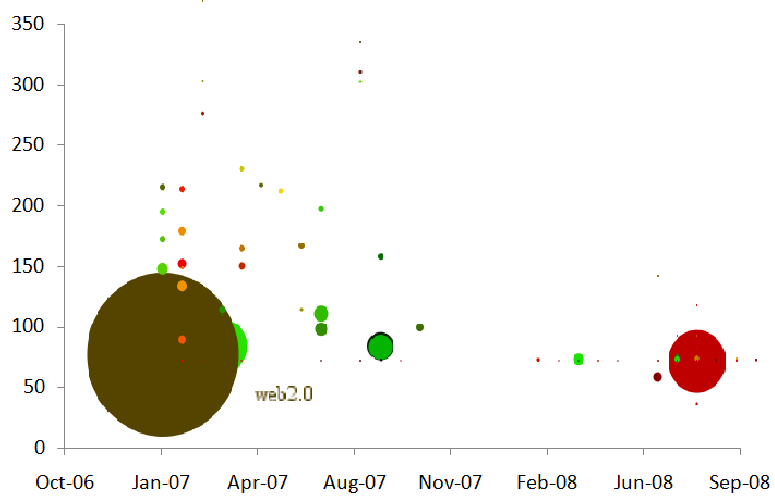 Figure: TagScatter reveals the correlation between tag age, usage frequency, and time intervals.
The paper also uncovers the Subscription Effect: Users who follow each other share 36% of their interest-based tags, compared to only 24% for random pairs. Social networks don't just connect people; they synchronize their focus.
Critical Insight & Conclusion
The genius of this work lies in proving that social noise actually yields structural signal. By showing that tags settle into stable distributions over time (a phenomena known as the "Scale-Free property of tags on a bookmark"), the authors suggest that social tagging is self-correcting.
Takeaway for Designers: If you're building a content platform, don't just rely on keywords. Leverage the network topology of tags to find "hidden" relatedness. Use the "hubs" for navigation and the "long tail" for personalized discovery.
Limitations: The study focuses on Del.icio.us (bookmarks). Modern tagging (hashtags on Instagram/Twitter) often includes more "spam" or "contextual" tags (e.g., #blessed), which might weaken the semantic relatedness observed in this 2009 study.