
ISID: Leveraging the Power of Tags to Discover Latent Social Networks
11620_Tag-based social interest discovery.
The paper introduces ISID (Internet Social Interest Discovery), a system that utilizes user-generated tags to identify shared interests and cluster users/URLs. It demonstrates that co-occurring tags effectively capture high-level human judgment, achieving superior community discovery compared to traditional social-graph or object-centric methods.
TL;DR
Social networks often hide communities that aren't connected by explicit "follows" or "friends." This paper introduces ISID (Internet Social Interest Discovery), a framework that uses collaborative tagging to group users and content. By focusing on the co-occurrence of tags rather than raw page text or social graphs, ISID uncovers deep thematic relationships that traditional algorithms miss.
Background: The Problem with Content and Connections
In the early social web (del.icio.us era), two main philosophies dominated social discovery:
- User-Centric: "Tell me who your friends are, and I'll tell you what you like." This fails when social graphs are sparse.
- Object-Centric: "If you and I both visit the same link, we are similar." This fails because of the Long Tail—most URLs are visited only once or twice, making it impossible to find statistical overlaps.
The authors argue that Tags solve both. Tags are "Human-in-the-loop" summaries. They are more concise than keywords and reflect a user's intent rather than just the page's vocabulary.
Methodology: From Tags to Topics
The core of ISID is treating a bookmark (User, URL, Tags) as a transaction. If several users use the tags [Linux, Networking, DNS] for different URLs, they have effectively voted on a "Topic."
1. Tag Convergence and Coverage
The authors first prove a crucial point: tags converge. Even as a URL's popularity grows, the variety of tags assigned to it remains stable and limited. More importantly, they found that tags have a high match ratio with document content but offer a higher level of abstraction (e.g., a page mentions "nameserver" but a user tags it "sysadmin").
2. The ISID Architecture
ISID uses an Association Rule Algorithm to find frequent tag patterns. To make this efficient, they employ a Prefix Tree to match topics against millions of posts without exhaustive searching.
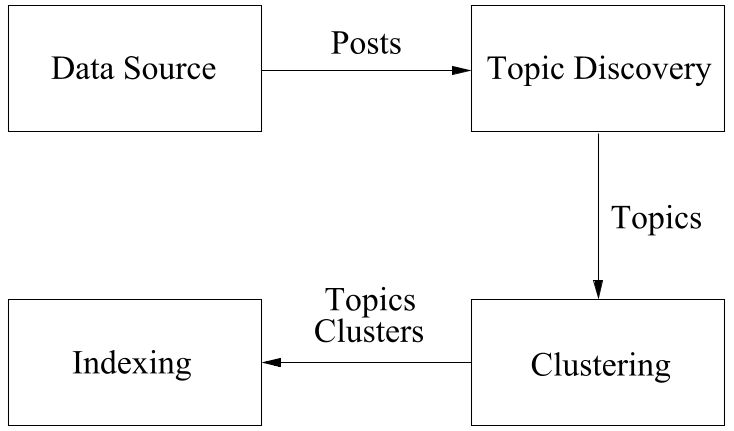 Figure: The ISID software architecture, showcasing the flow from data source to topic-centric clustering.
Why Co-occurrence is the Secret Sauce
Previous studies suggested tag-based clustering was weak. This paper refutes that by showing that multi-tag clusters (co-occurrences) are exponentially more accurate than single-tag clusters.
- A single tag like
[Apple]is ambiguous (Fruit vs. Tech?). - A tag set like
[Apple, iPhone, Jailbreak]is precise.
Experimental Results
The researchers measured "Cosine Similarity" using the TF-IDF vectors of the URLs within the discovered clusters.
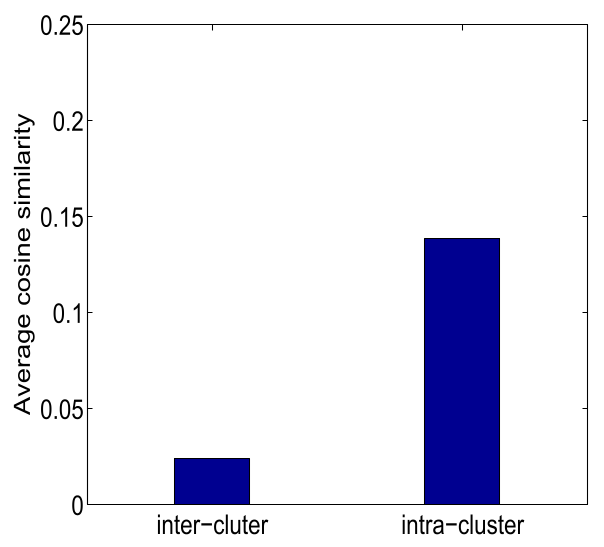 Figure: URL similarity is significantly higher within ISID clusters (Intra-topic) compared to between different clusters (Inter-topic).
Key Findings:
- High Coverage: Over 90% of all users had their primary interests captured by the system.
- Human Approval: Human editors reviewed the clusters and confirmed the topics were highly relevant, scoring them at a 4.5/5 average.
- Efficiency: Tag-based vectors are much smaller (~7.3% the size) than keyword-based vectors, making the computation far more cost-effective for large-scale systems.
Critical Insight & Conclusion
The genius of ISID lies in its recognition of Inductive Bias in tagging. When humans tag, they perform a mental "compression" of information. By mining these compressed bits, we can map the "interest graph" of the internet far more effectively than by looking at the raw, noisy data of the web pages themselves.
While this work predates modern embeddings and LLMs, the central thesis remains relevant: Shared vocabulary (tags) is the strongest signal for community formation in the absence of explicit social links.