
Beyond Tweets: Why Twitter Lists are the Secret to Discovering User Topics
Tag-based User Topic Discovery Using Twitter Lists
The paper proposes a novel method for identifying Twitter user topics by leveraging metadata from "Twitter Lists" rather than analyzing raw tweet content. By extracting tags from list names and calculating relevance using Point-wise Mutual Information (PMI), the method effectively categorizes users into specific interest groups.
TL;DR
Researchers from the University of Tsukuba have bypassed the "noise" of Twitter by ignoring tweets entirely. Instead, they use Twitter Lists—the labels other people give you—to determine your actual topics of expertise. By applying a mathematical framework involving Point-wise Mutual Information (PMI), their method achieves a 40% improvement in precision over traditional tweet-analysis techniques.
Background: The Subjectivity Trap
In the quest to understand what a Twitter user is "about," most researchers look at what the user writes. This is a mistake. Tweets are messy, filled with abbreviations, and often reflect a user's fleeting thoughts rather than their core identity. If a sports blogger tweets about the weather once, an NLP model might wrongly tag them with "meteorology."
The authors argue that Tagging is an objective act. When a third party adds you to a list named "Tech-Innovators," they are providing a high-quality, human-verified label of your topical authority.
The Problem: Filtering the "Nonsense"
While Twitter Lists are a goldmine, they aren't perfect. Many users create lists with generic names like "friends," "cool-people," or simply "list." These are Nonsense Tags—they have high frequency but zero topical value.
The challenge is: How do we distinguish between a "Topic Tag" (e.g., Music) and a "Personal Tag" (e.g., Friends)?
Methodology: The Logic of Relevance
The authors treat the relationship between users, lists, and tags as a matrix problem.
1. Tag Extraction
Most list names use hyphens (e.g., politics-news). The system splits these into "tags."
2. Scoring with Intelligence
They don't just count how many times you are tagged. They use a specific relevance score:
- : Accounts for frequency (how many people called you this).
- PMI (Point-wise Mutual Information): This is the "secret sauce." If a tag like "friends" is applied to almost everyone on Twitter, its PMI score drops. If a tag like "Haskell" is applied to only a specific group of users, its PMI score skyrockets.
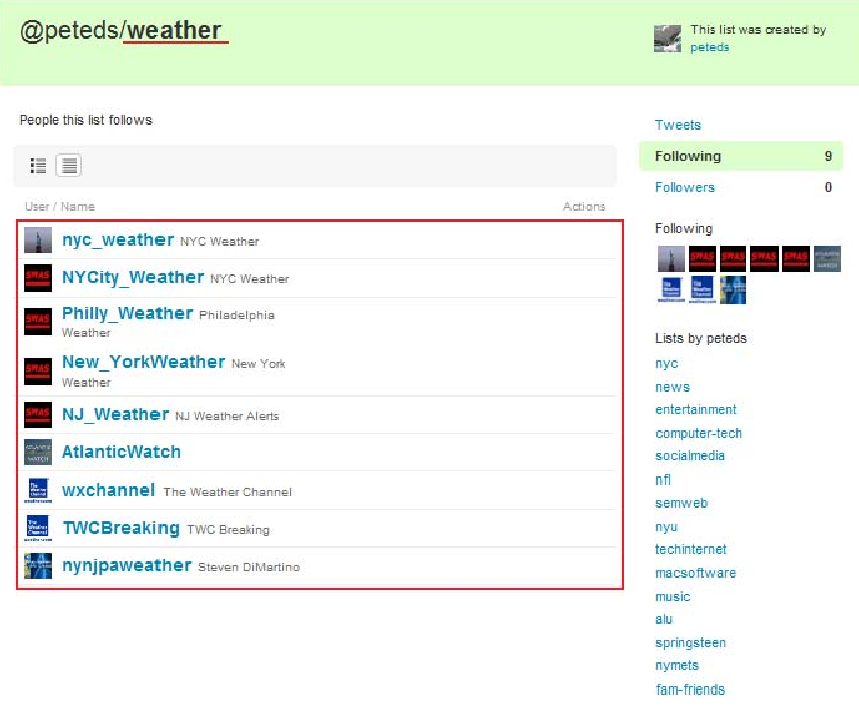 Fig 1: Example of the "Weather" list serving as a crowdsourced tagging mechanism.
Experiments: List vs. Tweets
The study compared three list-based variations against a keyword-from-tweets baseline.
- -Precision: Does the tag describe a property of the user?
- -Precision: Does the tag represent what the user actually tweets about?
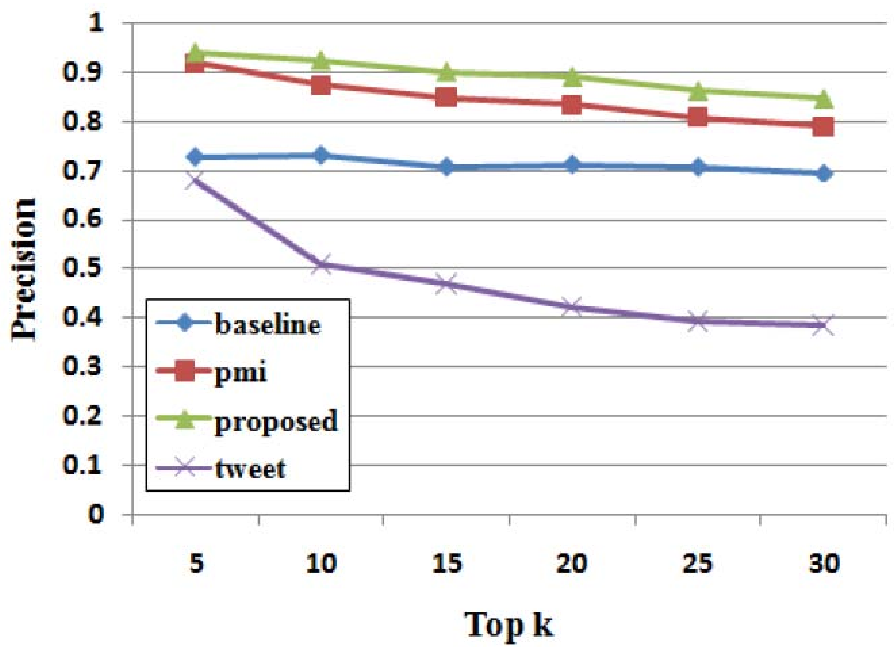 Fig 2: The proposed method (top line) significantly outperforms the tweet-based method (bottom line).
Key Recovery:
The list-based approach was 40% more accurate. Why? Because it is objective. As the authors note, web documents are often better described by their social bookmarks than their own meta-keywords.
Critical Insight: The "Hatoyama" Problem
Despite the success, the authors identified a lingering issue: Synonyms. For a politician like @hatoyamayukio, the system returned: politician, politics, seiji, politicians, seijika, statesman. While all are correct, they are redundant. Future work involves clustering these synonymous tags to provide a cleaner "user profile."
Conclusion
This paper is a masterclass in leveraging "wisdom of the crowd." By shifting the focus from what a user says to how the community classifies them, we gain a much more stable and accurate view of the social media landscape. For developers building recommendation engines, the message is clear: stop parsing the text and start looking at the lists.