
Bridging the Socio-Technical Gap: How Tagging Humanizes Software Task Management
How tagging helps bridge the gap between social and technical aspects in software development
This paper explores the adoption of "tagging" as a lightweight social computing mechanism to bridge the gap between technical and social aspects of software task management. Through an empirical study of 175 developers using IBM's Jazz platform, the authors identify how informal tagging practices facilitate communication, cross-cutting organization, and articulation work.
TL;DR
Modern software development is as much a social endeavor as a technical one. This paper investigates how social tagging—the simple act of adding keywords to tasks—acts as a vital "informal" layer in professional software engineering. By studying 175 IBM developers over two years, the researchers found that tags solve the rigidity of formal tools, allowing teams to coordinate "articulation work" (the work of doing work) with zero administrative overhead.
The Problem: The Rigidity of Formal Tooling
In large-scale projects, formal hierarchies (like "Filed Against" categories) often feel like an administrative burden. They are one-dimensional and slow to change. When a developer encounters a bug that impacts both "Linux" and "Performance," a standard tree structure forces them to choose one or wait for a manager to update the schema.
The authors argue that this gap between Technical (the code/bug) and Social (who needs to know, what the priority is, how it fits the milestone) is where most coordination breakdowns happen. Previous tools ignored this "articulation work," leading to project delays and communication failures.
Methodology: Observing the "Eclipse Way"
The study focused on a large IBM team using Jazz, an environment that supports the "Eclipse Way" development process. Unlike traditional trackers, Jazz allows developers to add arbitrary tags to "Work Items."
The researchers used two lenses:
- Quantitative Mining: Analyzing 37,590 work items and 13,902 tag applications from 2006 to 2008.
- Qualitative Interviews: Speaking with team leads and junior members to understand the why behind the tags.
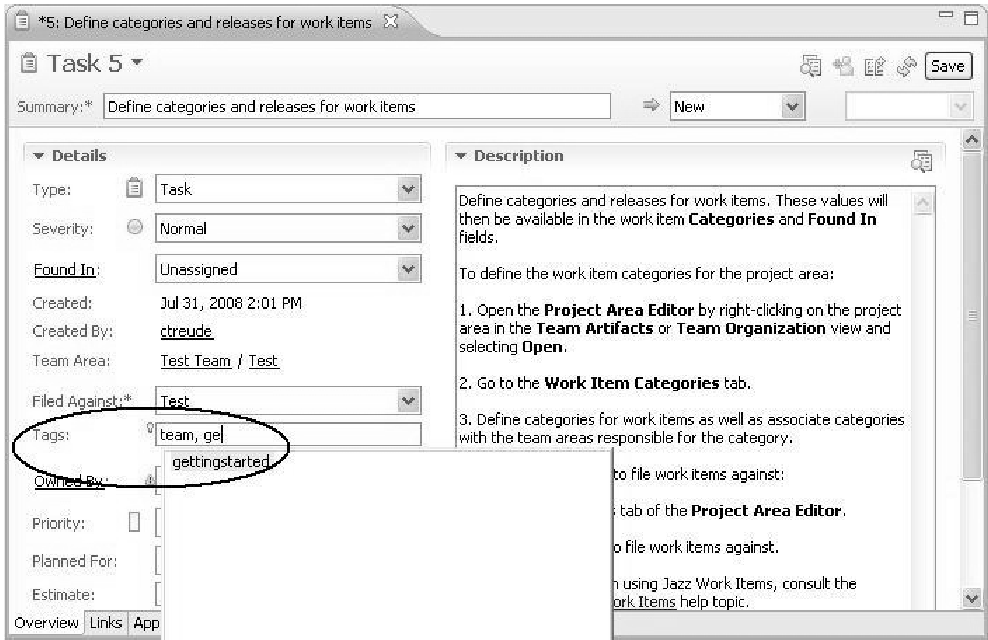 Figure 1: The Jazz interface showing the optional, lightweight tag field.
Core Insight: The Taxonomy of Tags
The paper’s most significant contribution is the categorization of how developers actually use these informal keywords. They identified four specific types of tags:
- Lifecycle Related: Transient tags like
beta2candidate. These have a "firm expiry" and are used to sprint toward milestones. - Cross-Cutting Concerns: Tags like
performance,usability, oraccessibility. These are "orthogonal" to categories, allowing developers to track issues that span the entire system. - Component-Specific: Acting as a "fluid" sub-hierarchy for categories that are too broad.
- Idiosyncratic: Unique workflow hacks. For example,
quickiefor easy fixes orfaqablefor items that should be documented later.
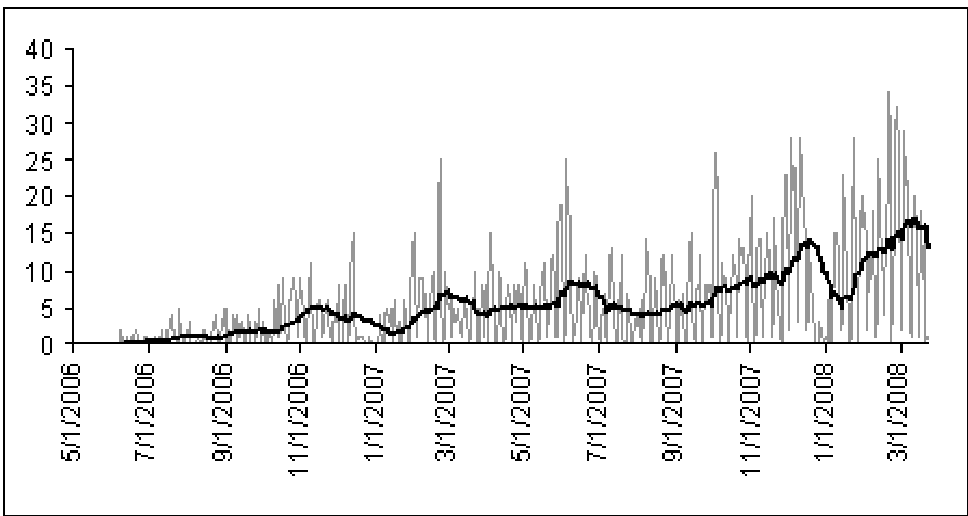 Figure 2: The steady growth of tag adoption, with peaks signifying intense milestone periods.
Results & Performance
The data proved that tagging isn't Just "noise." Over 60% of keywords were component-specific, yet 37% of actual tag instances were cross-cutting. This shows a "long tail" of vocabulary: a few common terms facilitate broad coordination (e.g., performance), while many niche terms handle local team needs.
Crucially, tags are a collaborative social signal. In nearly half of all cases, the person who tagged the item was not the person who created it. Tags are a way of saying, "Hey team, look at this," without sending an email or triggering a formal notification.
Critical Analysis & Future Outlook
The beauty of tagging lies in its simplicity. The authors highlight that as soon as you add "stronger semantics" or "formal metadata" to tags, they lose their value. They become work, rather than a tool to help work.
Limitations
- Early Adopter Bias: The IBM Jazz team was tech-forward; less innovative teams might not adopt such a bottom-up approach as eagerly.
- Search Limitations: At the time of the study, the Jazz search engine didn't index tags by default—a major missed opportunity for automated discovery.
Conclusion
The study concludes that lightweight tool support is not just a "nice-to-have" but a fundamental bridge in the socio-technical landscape. For developers and product managers today, the message is clear: Don't over-engineer your process. Sometimes, a simple, free-text field is more powerful than a million-dollar enterprise workflow engine because it allows the team's actual culture to manifest in the tool.