
Uncovering the Social DNA of Tags: A Complex Network Analysis of Del.icio.us
Analysis of Tags as a Social Network
This paper investigates the topological structure of tags in the social bookmarking site del.icio.us by modeling them as a complex social network. Using data collected via snowball sampling, the study demonstrates that tag networks exhibit "small-world" and "scale-free" properties, providing a quantitative framework for understanding collaborative annotation.
TL;DR
In the era of Web 2.0, tags are more than just labels; they are the connective tissue of collective intelligence. This paper analyzes the tag ecosystem of del.icio.us through the lens of complex network theory. It reveals that tags form a Small-World and Scale-Free network, characterized by high local clustering, short global paths, and a "rich-get-richer" distribution of popular terms.
Contextual Positioning
While early Web 2.0 research focused on the utility of tagging for individual organization, this work shifts the perspective to the topology of the aggregate system. It positions social annotations within the same mathematical framework as biological neural networks and power grids, proving that user behavior follows predictable, emergent structural laws.
Problem & Motivation: Beyond Simple Keywords
The central problem addressed is the lack of structural understanding of "Social Annotations." Why do certain tags become dominant while others vanish? Previous work treated tags as isolated metadata. The author’s insight is that tags are semantically linked through the objects they describe. By connecting tags that share bookmarks, we can visualize the "Social Network of Ideas."
Methodology: Mapping the Tag Universe
The study employed a Snowball Sampling method to crawl 8,354 tags. The core logic is simple: if Tag A and Tag B both describe the same URL, an edge is drawn between them.
The Two Pillars of Tag Topology:
- Small-World Characteristics: Defined by a low Average Path Length (6.969) and a High Clustering Coefficient (0.176). This suggests that any two tags are separated by very few "clicks," facilitating rapid information discovery.
- Scale-Free Nature: The network is not uniform. It is driven by Hubs—highly popular tags (like "web" or "tools") that link disparate clusters of niche interests.
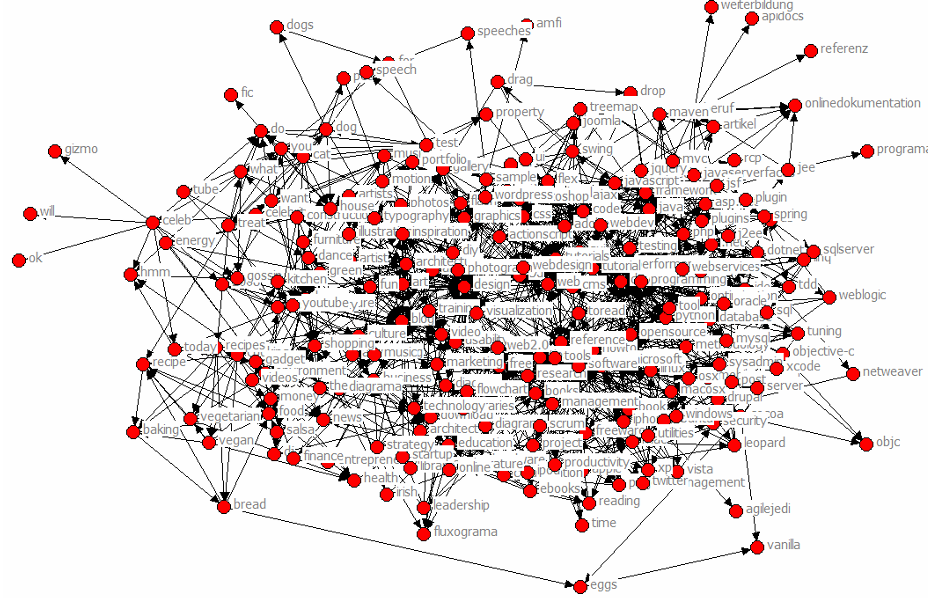 Figure 1: The visualization of the tag network, showing dense clusters connected by central hubs.
Experiments & Results: The Power Law of Human Logic
The most striking finding is the Power Law Degree Distribution. By plotting the number of connections () against their frequency on a log-log scale, the author found a linear relationship with an exponent .
Key Metrics:
- Average Path Length: 6.969 (vs. ~16 for the general Web). Information travels 2.3x faster in the tag space.
- Clustering: 0.176. Users tend to create "semantic cliques" where related terms are densely interconnected.
- Scale-Freeness: Most tags have few connections, while a tiny "elite" group of tags holds the network together.
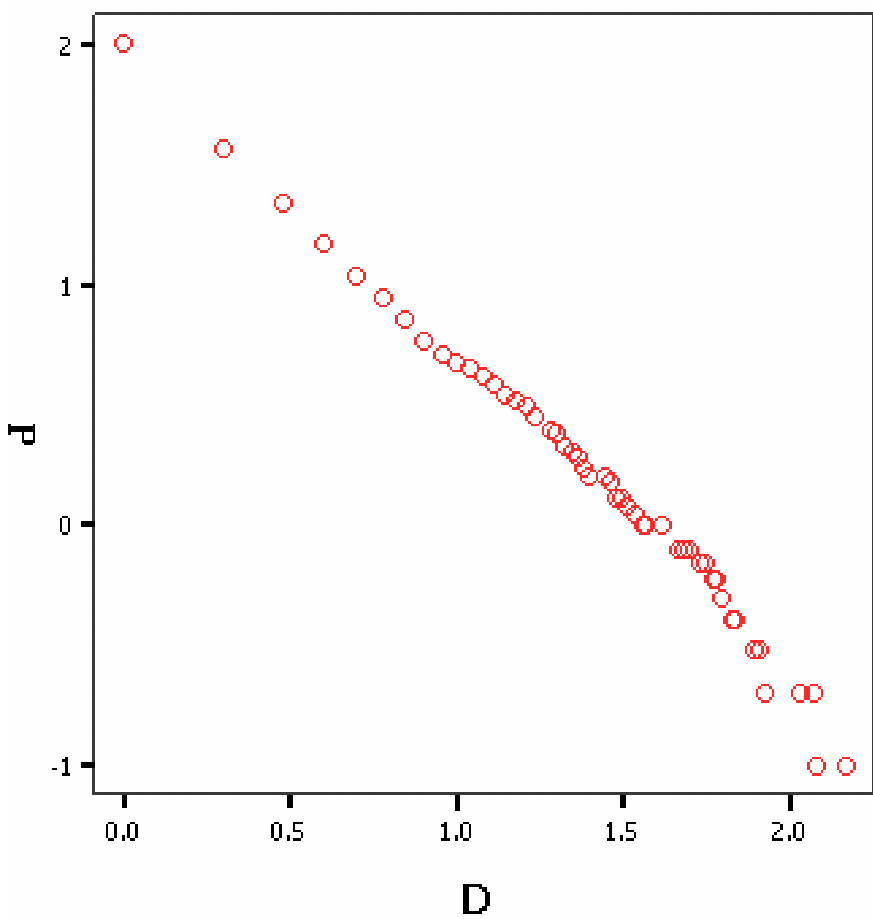 Figure 2: The power-law distribution confirming that a few "hub" tags dominate the network structure.
Critical Analysis & Conclusion
Takeaway
The "Small-World" nature explains why social bookmarking is so effective for discovery: it mimics the associative nature of human memory. The "Scale-Free" nature implies that system performance can be drastically improved by optimizing for the "Heavy Tail"—the highly frequent tags.
Limitations & Future Work
The study relies on a specific snapshot of del.icio.us data. Modern social networks (like Instagram or TikTok) use multidimensional tagging (hashtags + AI attributes), which might yield different Power Law exponents. Furthermore, the paper focuses on the topology but does not deeply explore the temporal evolution—how these networks grow and decay over time.
Practical Impact
For developers, this research suggests that Tag Suggestion algorithms should prioritize these "hubs" to maintain network connectivity. It also warns against "noise" in the long tail, recommending filtering mechanisms to prevent sparse, ambiguous tags from degrading the navigation experience.